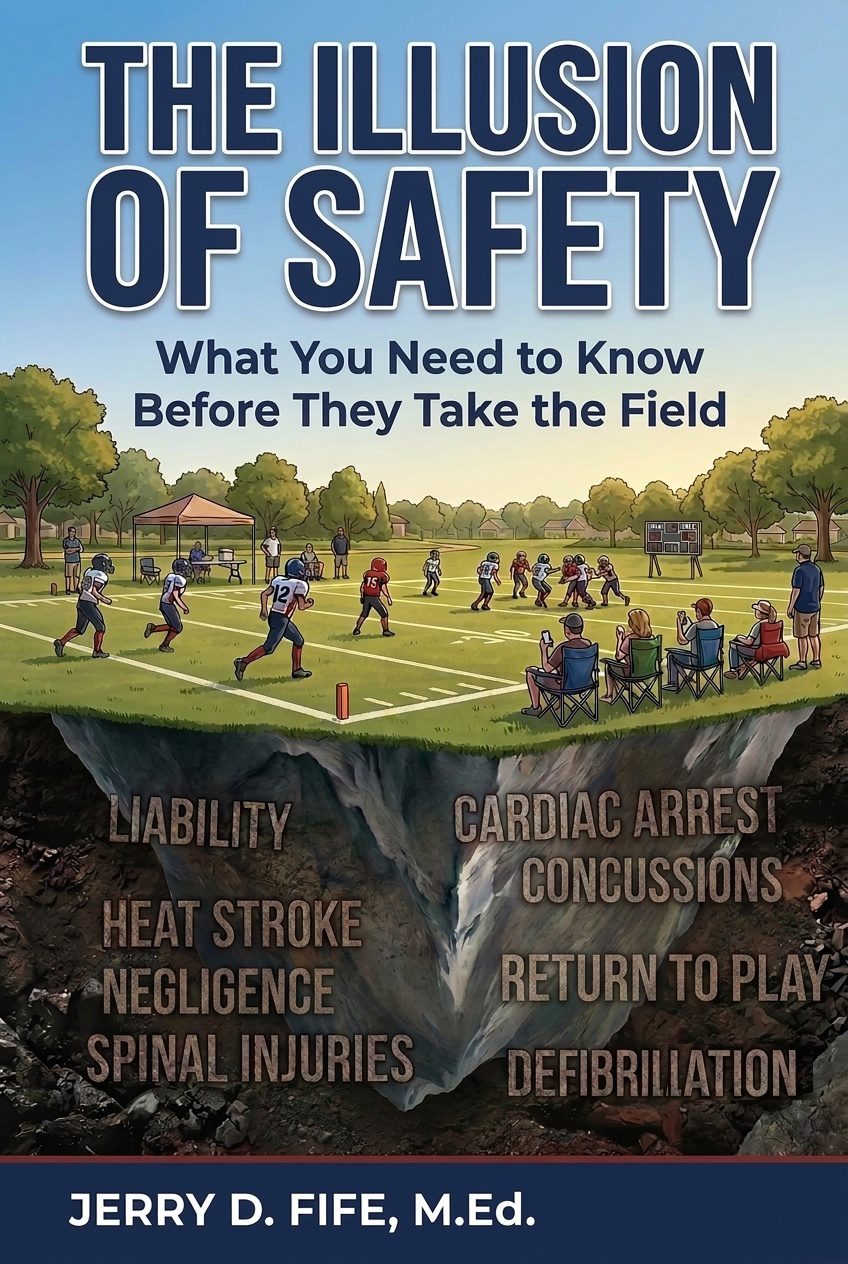
THE ILLUSION OF SAFETY
No One Was Responsible
By Jerry D. Fife, M.Ed. COO & Co-Founder, ProTect Athletics
PUBLICATION AND CATALOGING DATA
THE ILLUSION OF SAFETY: NO ONE WAS RESPONSIBLE
A National Operational Framework for Youth, Scholastic, and Collegiate Athletic Safety
First Edition: October 2026
Copyright © 2026 by Jerry D. Fife, M.Ed., and Athletic Safety Organization dba ProTect Athletics. All rights reserved.
Published by:
Athletic Safety Organization dba ProTect Athletics
A 501(c)(3) Tax-Exempt Public Charity | Federal EIN: 99-1611254
Web: ProTectAthletics.org | Contact: jerry@protectathletics.org
Recommended Citation (APA 7th Edition):
Fife, J. D. (2026). The illusion of safety: No one was responsible (1st ed.). Athletic Safety Organization dba ProTect Athletics.
501(c)(3) Mission Proceeds & Open Access Statement:
Net proceeds from the sale of print and digital editions of this book directly support the Athletic Safety Organization’s 501(c)(3) mission to host and deliver the Sports Safety Essentials (SSE) state compliance certificate program and the Youth Safety Officer (YSO) sideline credential for free or near-free through ASO’s in-house Learning Management System (LMS). Permission is granted to K-12 schools, youth sports organizations, and government agencies to reproduce Appendix B (Sideline Emergency Action Plan Template) and Appendix C (The Legislative Case) for operational safety and policy use with attribution to ProTect Athletics.
AUTHOR’S NOTE
I have received the call that no family ever wants to receive.
I have also sat in the seat of the person who had to make it.
Most people in this industry have experienced one side of that equation. Some have experienced neither. I have lived both.
My brother lost his life in a preventable industrial chemical and confined space accident, asphyxiated by acid fumes while working in our family business. The federal safety requirements that would have saved him did not even come into existence until 1993. They were written too late for my family. Youth sports today is operating in that exact same regulatory blind spot.
That is the only reason this book exists. It is the only credential that matters for what you are about to read.
This is not a theoretical framework developed in a conference room. It is not a compliance document produced by a committee that has never walked a youth athletic venue at six in the morning before anyone else arrived. It is the product of grief, of institutional experience, and of the absolute certainty that preventable deaths are preventable, but only if someone decides, before the emergency, that prevention is their responsibility.
That someone is you.
Read accordingly.
Jerry D. Fife, M.Ed. COO and Co-Founder, ProTect Athletics
LEGAL DISCLAIMER AND OPERATIONAL SCOPE
This book presents an evidence-based operational framework for youth athletic safety. Its protocols are grounded in published clinical guidelines from the American Heart Association, the National Athletic Trainers’ Association, the Korey Stringer Institute, the American College of Sports Medicine, and applicable state athletic safety statutes. The recommendations in this book are consistent with nationally recognized standards of reasonable care for athletic safety personnel.
This book does not constitute medical advice and does not replace the clinical judgment of licensed healthcare professionals. In any medical emergency, activate Emergency Medical Services (911) immediately. Nothing in this book authorizes a volunteer safety officer to perform procedures requiring medical licensure under applicable state law.
Volunteers who complete ProTect Athletics credential training and act in good faith pursuant to these protocols are encouraged to confirm the volunteer protection statutes in their specific state, as many states provide liability protection for uncompensated emergency responders acting in good faith within the scope of their training and without gross negligence, though volunteer protection statutes vary by jurisdiction. This book is designed to support that immunity by documenting that the credential holder acted in accordance with a recognized safety framework.
State athletic safety laws, local emergency response protocols, and medical position statements are subject to revision. Credential holders should verify their current state statutes annually. ProTect Athletics provides updated guidance through its credentialing program as standards evolve.
ACRONYMS AND ABBREVIATIONS
This list defines every acronym used in this book. Terms are defined as they apply in the context of youth athletic safety. When a term belongs to the ProTect Athletics credentialing framework, that is noted.
| Acronym | Full Term | Plain-Language Note |
|---|---|---|
| AED | Automated External Defibrillator | The device that delivers a shock to restore normal heart rhythm in cardiac arrest. The most critical piece of emergency equipment on any athletic sideline. |
| AHA | American Heart Association | Primary source for CPR guidelines and cardiac emergency standards cited in this book. |
| ACSM | American College of Sports Medicine | One of the primary governing bodies for sports medicine position statements, including heat illness standards. |
| ALS | Advanced Life Support | A higher level of emergency medical response capability. Request an ALS unit when calling 911 for a heat stroke event. |
| ASM | Athletic Safety Manager | ProTect Athletics operational and administrative safety management certificate program (three courses, 90 contact hours / 9.0 CEUs, plus monitored field practicum). Prepares the organizational-level safety administrator responsible for equipment lifecycle, venue safety operations, and risk governance. |
| ATC | Certified Athletic Trainer | A state-licensed, BOC-certified healthcare professional. The highest medical authority on any sideline. ProTect Athletics credentials do not replace ATCs; they fill the gap when one is not present. |
| ASTM | ASTM International | Standard-setting organization whose specifications govern portable goal safety and other athletic equipment requirements. |
| AAU | Amateur Athletic Union | National multi-sport youth athletics organization. Referenced in the context of unregulated private youth sports programs. |
| BOC | Board of Certification for the Athletic Trainer | The national credentialing body for Certified Athletic Trainers. The standard against which ProTect Athletics’ NCCA-aligned credentialing is benchmarked. |
| COI | Certificate of Insurance / Conflict of Interest | Proof of liability insurance coverage required from third-party facility operators (Ch. 15); also Conflict of Interest in academic and accreditation disclosures. |
| CPSC | Consumer Product Safety Commission | Federal agency whose data on portable goal fatalities is cited in Chapter 13. |
| CPR | Cardiopulmonary Resuscitation | Chest compressions and rescue breathing that circulate blood during cardiac arrest. Buys time for the AED. Does not restart a fibrillating heart without defibrillation. |
| CTE | Chronic Traumatic Encephalopathy | A progressive degenerative brain disease associated with repetitive head impacts. Discussed in Chapter 6 in the context of subconcussive impact research. |
| DAS℠ | Director of Athletic Safety | ProTect Athletics’ flagship NCCA-aligned national professional certification (five core courses, C1 through C5, plus specialty sport endorsements such as C6 Football Equipment Safety). The executive professional who architects and oversees the entire safety system for a multi-venue, multi-sport enterprise. Service mark of ProTect Athletics. |
| EAP | Emergency Action Plan | The written, venue-specific, rehearsed plan that assigns roles and guides every step of the emergency response before the emergency occurs. Not a static document, but a practiced system. |
| EHS | Exertional Heat Stroke | A life-threatening emergency defined by core body temperature above 104°F combined with central nervous system dysfunction. Treatment: cool first, transport second. |
| EMS | Emergency Medical Services | The paramedic and ambulance response system. Activated by calling 911. In cardiac arrest, survival depends on what happens before EMS arrives. |
| GPS | Global Positioning System | Coordinate-based location technology. Every EAP must include GPS coordinates of the playing surface, not just the facility address, for accurate 911 dispatch. |
| NAERA | National Athletic Equipment Reconditioners Association | The national body that certifies reconditioning facilities for football helmets and other protective equipment. Only NAERA-certified facilities can recondition helmets to NOCSAE standard. |
| NATA | National Athletic Trainers’ Association | Primary professional organization for Certified Athletic Trainers. Its position statements on heat stroke, concussion, and SCA are the clinical foundation of this book. |
| NCAA | National Collegiate Athletic Association | The governing body for collegiate athletics. Referenced in the context of ATC coverage standards and the House v. NCAA NIL settlement. |
| NCCA | National Commission for Certifying Agencies | The leading accreditation body for professional credentialing programs in the United States. The standard to which the DAS℠ credential is built. |
| NFHS | National Federation of State High School Associations | The governing body for high school athletics. Its sports medicine guidelines and lightning safety protocols are referenced throughout this book. |
| NIL | Name, Image, and Likeness | The commercial rights framework allowing athletes to profit from their identity. Referenced in Chapter 5 in the context of the regulatory gap between commercial athlete value and safety protections. |
| NOCSAE | National Operating Committee on Standards for Athletic Equipment | Sets the impact performance standards for football helmets and other protective equipment. All helmets must meet NOCSAE standards at manufacture and after reconditioning. |
| OSHA | Occupational Safety and Health Administration | The federal workplace safety agency. Used in this book as a structural parallel to youth athletics’ regulatory gap: an enforcement-first system that reaches people after the harm, not before. |
| SCA | Sudden Cardiac Arrest | The most time-critical emergency in youth sports. The heart’s electrical system fails, producing no effective blood flow. Survival drops 7 to 10 percent per minute without CPR and defibrillation. |
| SFIA | Sports & Fitness Industry Association | Industry research organization tracking sports and fitness participation across all age groups in the United States. |
| SIS | Second Impact Syndrome | A catastrophic condition in which a second concussion before the first has resolved triggers massive, frequently fatal cerebral swelling. The clinical reason why removal-from-play is non-negotiable. |
| SSE | Sports Safety Essentials | ProTect Athletics’ state-specific statutory compliance certificate program, delivered directly on ASO’s in-house Learning Management System (LMS) for free or near-free access. Provides the baseline knowledge foundation, verified state statutory mandates, and personal pre-season safety playbook required of adults working with youth athletes. |
| TBI | Traumatic Brain Injury | The clinical category that includes concussion. There is no such thing as a “minor” TBI in the context of return-to-play decisions. |
| WBGT | Wet Bulb Globe Temperature | The gold-standard environmental measurement for heat illness risk. Accounts for temperature, humidity, radiant heat, and wind speed. NATA provides specific practice modification thresholds based on WBGT readings. |
| YSO | Youth Safety Officer | ProTect Athletics’ nine-module frontline safety credential, delivered directly on ASO’s in-house LMS for free or near-free access. The designated, trained authority on the sideline responsible for executing the EAP, making removal decisions, and managing the first five to ten minutes of any medical emergency. |
PART 1: THE GAP
CHAPTER 1: BILL’S LEGACY
This organization exists because of a name most people will never know. Bill Fife.
Bill was twenty-six years old when he died. He was not a public figure. He was not a statistic waiting to happen. He was a young man still at home, working alongside his family, co-managing a business that his family had built with their own hands. He was at the beginning of everything. He had the kind of life in front of him that makes a death like his feel not just tragic but fundamentally wrong.
Bill Fife died in a preventable industrial chemical and confined space accident, asphyxiated by acid fumes while working in the family business. And what makes it impossible to accept is that his death was preventable not because the situation was beyond understanding, but because the knowledge that could have saved him simply was not there. Not because his family did not care. Not because they were careless or negligent. Because nobody gave it to them before that day arrived.
Think about how you learned to run a business in this country, particularly before the age of the internet. You filed for a license. You paid your fees. You opened your doors. And you learned the rules of operating that business the hard way: by breaking them and getting punished, by watching someone else get cited, or by getting lucky and never discovering what you did not know until it was too late.
The Occupational Safety and Health Administration exists to protect workers. OSHA writes the standards. OSHA enforces the standards. And OSHA does have consultation programs and educational resources. They exist. But they are voluntary. They are poorly publicized. And the average small business owner, the person running a family operation with a license and a work ethic and no safety department, does not know those programs exist until after something has already gone wrong.
What OSHA does consistently, reliably, and at scale is enforcement: inspections triggered by incidents, complaints, and fatalities, followed by citations and fines levied against people who, in many cases, never had meaningful access to the knowledge that would have kept them in compliance. OSHA assumes you know the rules. When you do not, OSHA does not show up to educate you. It shows up to punish you.
I am not saying this as an outsider. I have sat in the director’s seat. I have seen the system from the inside. And from that vantage point, the verdict is the same: OSHA is a reactive agency. It measures its outcomes in the penalties and the bodies that follow preventable failures. The proactive education that could prevent those failures reaches a fraction of the people who need it.
That structural failure is not limited to small businesses. Ask any family that has farmed this land for three generations how they learned the rules that govern their operation. They did not receive a manual when they inherited the property. They did not receive a briefing when the regulations changed. They learned the way farming families have always learned: through practice, through tradition, through the generational wisdom of doing things the way they have always been done. That is not ignorance. That is the natural result of a regulatory system that writes the rules, collects the fees, and then leaves the education to chance.
The phrase that defines farm safety culture also defines the culture that kills young athletes: “That is how we have always done it.”
That phrase lives on every sideline in the country. It is spoken by coaches who have run practices the same way for twenty years without a cardiac event and who therefore believe their method is safe. It is reinforced by organizations that have never had a fatality and therefore believe their system works. It is the comfort of survivorship bias: the assumption that the absence of tragedy is the same as the presence of safety.
It is not.
Bill Fife’s family was operating in that system. They were doing what families do: working hard, caring for each other, managing what was in front of them. The knowledge that could have changed the outcome of that day was not inaccessible because it did not exist. It was inaccessible because no system was designed to put it in their hands before they needed it.
That is OSHA’s failure in the workplace. That is the regulatory model’s failure on the family farm. And that is youth athletics’ failure on the field. The same structural deficiency: a system that creates rules, assumes knowledge, and punishes failure, while doing almost nothing to ensure that the people at the point of risk have what they need before they need it.
ProTect Athletics was born from that specific injustice. Not from the grief alone. From the understanding that grief without systemic change is just sorrow, and that the only way to honor a preventable death is to prevent the next one.
In the United States, the American Heart Association estimates that sudden cardiac arrest claims the lives of approximately 2,000 young Americans under the age of twenty-five every year.
They were not bad people. They were uninformed people in a system that had never made it a priority to inform them. The same system that failed Bill Fife.
Every credential we build, every volunteer we train, every protocol we put on a sideline exists because Bill Fife did not have to die. Because the knowledge existed. Because someone should have put it in the hands of the people who needed it before that day arrived.
Nobody was trained. Nobody was designated. Nobody was responsible.
This book exists to ensure that answer never belongs to your program. And it exists as a challenge to every state legislature, every governing body, and every athletic organization in this country: stop being OSHA. Stop writing the rules and assuming people know them. Start building the education pipeline that puts the knowledge in the hands of the people on the field before the emergency arrives.
The cost of that education is not prohibitive. The cost of not doing it is measured in children.
Bill Fife was twenty-six years old. He was working in the family business. He was not an athlete. He was not at a tournament or a practice or a game. He was at work, and he died because nobody around him had been trained, nobody had been designated, and nobody was responsible.
ProTect Athletics exists because that outcome is not acceptable. Not in a confined space. Not on a youth athletic field. Not anywhere adults are responsible for the safety of other human beings. Every credential this organization has built, every protocol, every training hour, every piece of legislation we advocate for, is a direct answer to what happened to Bill.
You are holding that answer. Now carry it.
CHAPTER 2: THE ILLUSION OF SAFETY
Every Saturday morning, across every youth recreational league in this country, the same ritual plays out.
Parents pull into parking lots. Kids pull on jerseys. Coaches draw up plays on clipboards. Someone starts a timer on a scoreboard. The game begins.
And somewhere in the back of every parent’s mind, a quiet, completely unexamined assumption exists: if something goes wrong, someone will handle it.
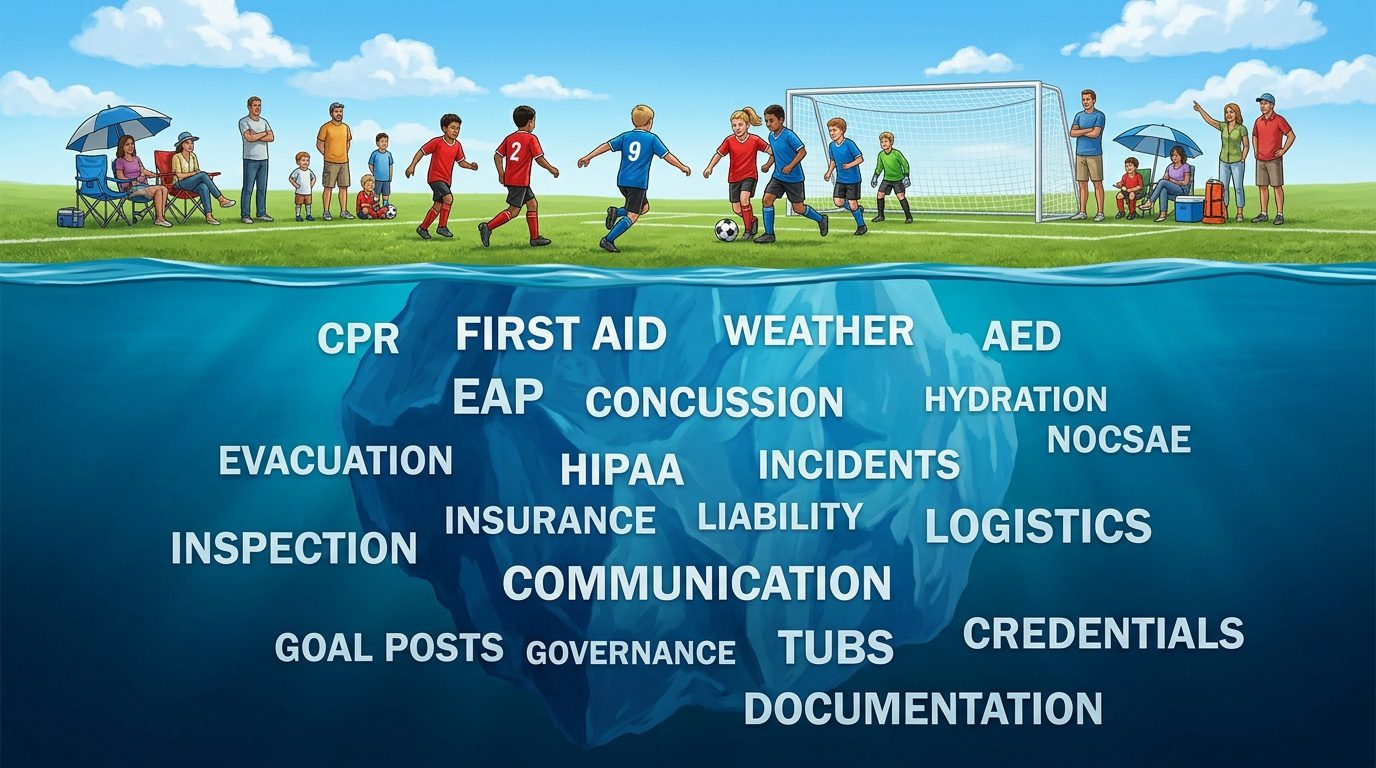
That assumption is the illusion of safety.
It is not based on evidence. It is not based on a conversation with the league director or a review of the organization’s emergency protocols. It is based on the fact that the fields are well-maintained, the uniforms look official, and the coaches seem confident. None of those things constitute a safety system. None of them will save your child’s life if their heart stops on that field.
The Korey Stringer Institute, one of the leading research bodies in the country on athlete safety, has published data showing that fewer than half of high school athletic programs in the United States employ a full-time Certified Athletic Trainer. At the middle school level, that number drops dramatically further. At the youth recreational level, it is effectively zero.
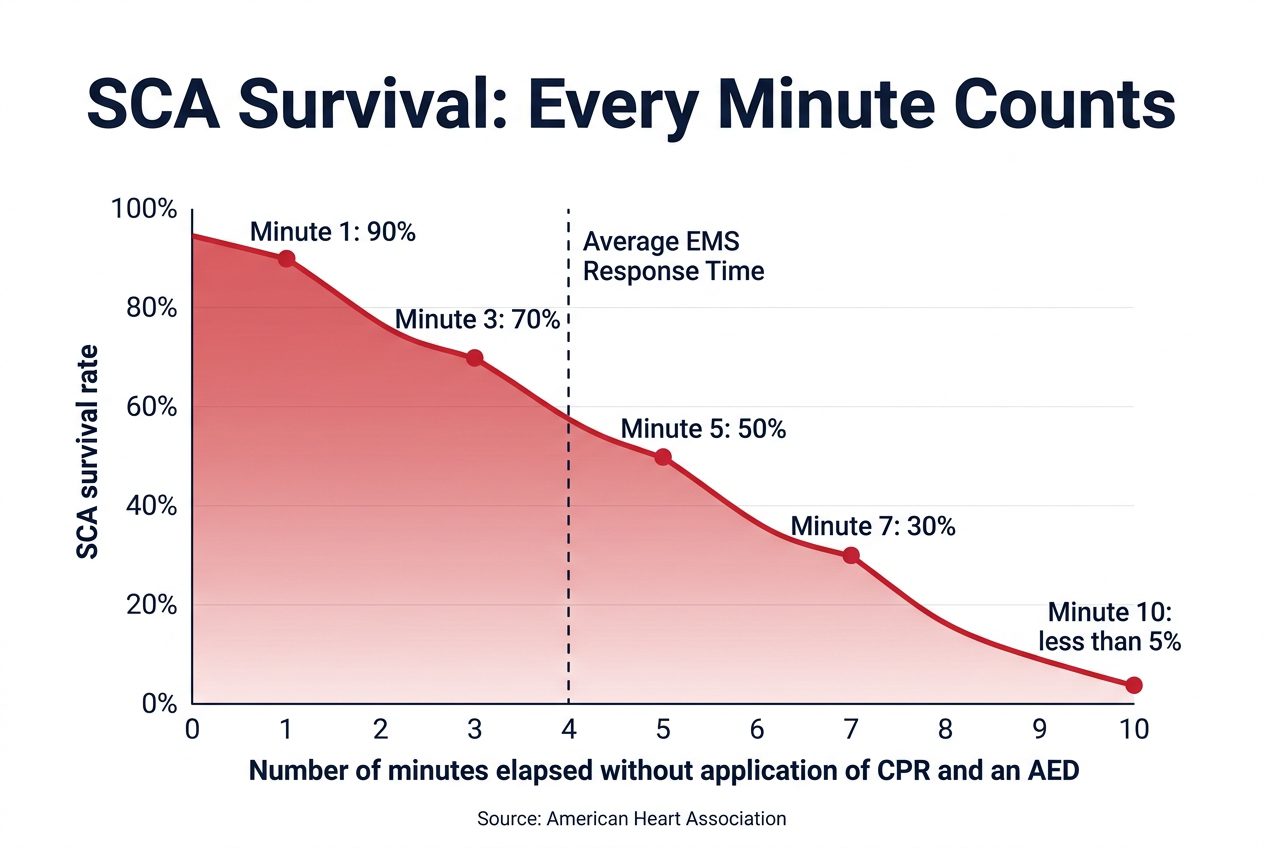
Think about what that means in practical terms. If a fifteen-year-old athlete goes into sudden cardiac arrest during a Friday night football game, survival depends on CPR being initiated within one to two minutes and an AED being applied within three to five minutes. Every minute without defibrillation reduces the probability of survival by approximately ten percent. By the time the ambulance arrives, if no one on that sideline has acted, the probability of survival may already be below fifty percent.
The organized event your child is attending right now almost certainly does not have a trained medical professional present. The organization almost certainly does not have a legally defensible Emergency Action Plan. The AED, if one even exists at the facility, may be locked in an office, not charged, and inaccessible to anyone who does not know the combination.
The illusion of safety does not come from deception. It comes from the visual cues of an organized environment. Referees signal authority. Uniforms signal structure. A functional scoreboard signals that someone is in charge. But none of those signals mean that anyone on that field is prepared for a medical emergency.
The illusion thrives on the absence of crisis. When nothing bad has happened in fifteen years, the assumption calcifies into certainty. It hardens into “we’ve always been fine.” And then one afternoon, on a perfectly ordinary Tuesday practice, an athlete collapses. And the certainty shatters in seconds.
The illusion of safety thrives in the dark. It thrives when parents do not ask questions. It breaks the moment a crisis hits the field and everyone looks at each other, waiting for someone else to step up.
The illusion is not malicious. Nobody involved in youth athletics is hoping something goes wrong. The coaches care about the kids. The league directors care about the programs. The parents care more than they can put into words.
But caring is not a protocol. Assuming is not a plan. And the illusion that someone else has handled the hard part is the single most dangerous assumption in youth sports. It has cost families their children. It will cost more families their children if no one does the work to replace the assumption with something real.
The next chapter begins that work.
CHAPTER 3: THE “NOBODY WAS RESPONSIBLE” PROBLEM
There are more than two dozen states in this country that have passed youth athletic safety laws. Washington State passed the Lystedt Law in 2009, the first concussion law of its kind in the nation. Ohio followed with Lindsay’s Law, requiring sudden cardiac arrest awareness training for coaches and athletes. Florida enacted the Zachary Martin Act to address heat illness prevention. These laws exist because athletes died without them.
The laws are real. The liability for non-compliance is significant. But look closely at the text of those laws, and you will find a fatal structural flaw hiding in plain sight.
Almost none of them name who is responsible for executing the protocol.
The assumption embedded in most youth athletic safety legislation is that a clinically trained professional is standing on the sideline with a clipboard. Lawmakers draft statutes as if every athletic event in the state operates with the medical infrastructure of a Division I university. But at the youth recreational and middle school levels, where the vast majority of young athletes actually compete, that infrastructure does not exist and has never existed.
When a state law demands a protocol but does not fund or require a credentialed person to execute that protocol, the law creates a liability trap. The organization’s Board of Directors inherits the legal obligation for compliance, but they have placed no trained, designated personnel on the field to actually enforce the rule.
What that means in practice is that the person responsible for executing state law on your child’s field is whoever happens to be standing closest when something goes wrong. A volunteer coach with a whistle. A well-intentioned parent who sprinted onto the field from the sideline. Someone with no defined authority, no formal credential, and no training on how to legally document what just happened.
The legal exposure here is not hypothetical. When a youth athlete suffers a catastrophic injury and a lawsuit follows, the first question the plaintiff’s attorney asks is this: who was the designated safety authority on that field at the time of the incident? If the answer is “there was no designated person,” the conversation ends there. The organization has already lost.
If a kid goes down, decisions have to be made in seconds. Who goes for the AED? Who initiates CPR? Who clears the field and manages the crowd? Who prevents panicked parents from moving a potentially spinal-injured athlete? If those roles are not explicitly assigned, trained, and rehearsed before the game starts, you will lose critical minutes in chaos. In cardiac emergencies, those are the minutes that determine whether your athlete walks off the field or leaves in a body bag.
When no one is explicitly named as the safety authority, everyone assumes someone else is handling it. When the dust settles and the worst has happened, the answer is always the same. Nobody was responsible.
The legislators who passed the Lystedt Law, Lindsay’s Law, and the Zachary Martin Act did something important and necessary. They said: this must not happen. They deserve credit for that.
But a law that says what must happen without specifying who makes it happen leaves a void in the middle of every athletic event in your state. That void does not fill itself. It fills with the assumption that someone else is handling it, right up until the moment an athlete collapses and no one moves.
One person. One designation. One credential. That is the entire structural answer to a fifty-year institutional failure. The rest of this book tells you how to build it.
CHAPTER 4: THE ATC SHORTAGE
Whenever I present the ProTect Athletics framework to clinical professionals, the first pushback is always the same: Are you trying to replace Certified Athletic Trainers?
The answer is no. Absolutely not. The Non-Replacement Principle is the bedrock of this organization. The SSE, the YSO, the ASM, and the DAS℠ do not replace a Certified Athletic Trainer. They fill the catastrophic void that exists when an ATC is not and cannot be present.
Now look at the math.
The Board of Certification for the Athletic Trainer (BOC) reports approximately 45,000 Certified Athletic Trainers in the United States. Those 45,000 professionals are distributed across professional sports organizations, Division I, II, and III collegiate programs, high schools, sports medicine clinics, military installations, and industrial settings. The high school level alone has more than 27,000 schools competing in interscholastic athletics.
The numbers do not add up. Not even close.
The Korey Stringer Institute’s national data confirms that fewer than half of US high school athletic programs have access to a full-time ATC. When you descend from high schools to middle schools, that coverage drops dramatically. When you descend further to the youth recreational level, where an estimated 45 million children under 18 are participating in organized sports in any given year, ATC coverage is effectively nonexistent.
Even in a world with unlimited ATCs, the economic reality of youth sports would prevent full coverage. A youth recreational soccer league running on a five-thousand-dollar annual budget cannot employ a full-time clinical medical professional whose entry-level salary begins at forty to fifty thousand dollars per year. The math is simply impossible.
If your program has a Certified Athletic Trainer, you are extraordinarily fortunate. Listen to them. Follow their clinical judgment without debate. They are the highest medical authority on your sideline.
But what about the rest of the country? What about the millions of young athletes competing in under-resourced programs, rural leagues, Title I school districts, and volunteer-run organizations? Do we simply accept their exposure? Do we leave them without any trained authority because their zip code cannot support clinical staffing?
That is unacceptable.
Programs without ATCs still carry legal obligations. They still have real and measurable liability exposure. Most critically, those young athletes deserve more than luck. They deserve a trained, credentialed adult who knows exactly what to do in the first five to ten minutes of a medical emergency, because those are the minutes that matter.
This is the window ProTect Athletics was built to protect.
The financial barrier is not an excuse. Because ProTect Athletics hosts and delivers the Sports Safety Essentials (SSE) state compliance certificate programs and the Youth Safety Officer (YSO) credential directly through the Athletic Safety Organization’s own in-house Learning Management System (LMS), backed by our 501(c)(3) grant initiatives and organizational partnerships, we are able to offer both SSE and YSO for free or near-free to coaches, parents, and volunteers. Your people invest a few hours. We provide the platform and the training. The liability gap closes. There is zero financial excuse left for leaving a sideline unprotected.
The Non-Replacement Principle is not a diplomatic gesture toward the athletic training profession. It is a structural reality. Certified Athletic Trainers are four-year-minimum, clinically supervised, state-licensed healthcare professionals. You do not replace that with a volunteer safety course, and ProTect Athletics does not claim otherwise.
What ProTect Athletics claims is this: forty-five thousand ATCs cannot cover the hundreds of thousands of youth sports events occurring simultaneously across this country every weekend. The math makes that impossible regardless of credentialing standards or professional advocacy. The youth recreational sideline will never have an ATC present at every event. What it can have, starting right now, is one trained, designated adult who knows what to do in the first three minutes before the ATC and the ambulance arrive.
That is the bridge. Build it.
CHAPTER 5: THE BUSINESS NOBODY REGULATES
Youth athletics is a $40 billion industry. Forty billion dollars per year flows through organized youth sports in the United States. Private equity firms are investing in youth sports facilities. Tournament operators are building multi-field complexes with hotel partnerships. Technology companies are developing recruiting platforms for athletes who have not yet finished elementary school. The infrastructure of professional sports has been replicated at the youth level in every dimension except one.
Safety.
An estimated 45 million children under the age of eighteen participate in organized youth sports in the United States each year (Aspen Institute Project Play, 2023). The average family now spends $1,500 per year per child on their primary sport. Families committed to travel ball, AAU, and elite club programs frequently spend far more: tournament fees, travel, lodging, specialized training, and private coaching that can push annual costs into the tens of thousands of dollars per child. That is not a recreational activity. That is a financial investment made on the belief, often encouraged by coaches and program operators, that the return will come in the form of a scholarship or a professional career.
Here is the math those coaches rarely share. Approximately 8 million students compete in high school athletics in the United States. Roughly 3 to 11 percent of them will go on to compete at any NCAA level. The number who reach professional sports is statistically near zero. A family that invests $30,000 over five years in a child’s athletic development has roughly a 3 percent chance of recouping that investment in the form of a college scholarship, and a fraction of one percent chance of producing a professional athlete.
The coach selling the hall of fame dream knows these numbers. He just does not share them.
What does it take to become the coach of sixty children in a $40 billion industry? In most travel ball, AAU, and independent club programs across the country, the answer is a background check. Not a first aid certification. Not a concussion protocol training. Not a heat illness awareness course. Not a cardiopulmonary resuscitation credential. A criminal background check confirming that you are not a registered sex offender. That is the safety floor of a $40 billion industry responsible for the physical welfare of tens of millions of children.
This is not regulatory oversight with gaps. It is the near-total absence of regulatory oversight by design. The federal government has no jurisdiction over private youth sports organizations. OSHA covers employees, not athletes, and most youth sports volunteers and coaches are not employees. The laws that exist, the Lystedt Law, Lindsay’s Law, the Zachary Martin Act, apply primarily to school-based sports and leave recreational leagues, travel programs, and club organizations largely untouched. The result is an industry that has professionalized its revenue model while retaining the safety standards of an unregulated hobby.
The money collected from a parent’s registration fees, tournament fees, and membership dues funds the complex, the equipment, the uniforms, and the marketing. It does not fund the Emergency Action Plan. It does not fund the AED on the sideline. It does not fund the training that would allow a coach to recognize that a child’s stumbling gait in the third hour of a summer tournament is not exhaustion but the onset of Exertional Heat Stroke.
The NIL economy has extended this paradox to its logical extreme. High school athletes across multiple states now sign name, image, and likeness deals and receive compensation for their athletic identity. College athletes now receive direct revenue sharing from their institutions, with some Division I schools distributing up to $20.5 million annually to athletes under the House v. NCAA settlement approved in June 2025. These athletes generate commercial value measured in millions of dollars. They are, in every economic sense, professionals. And they still have no OSHA workplace safety protection. The federal framework has not caught up to the commercial reality. Athletes are paid. Athletes are not employees. Athletes have no regulatory safety floor.
There is another dynamic driving this industry that does not appear in the financial data. The parent who only sees the dollar sign attached to their child’s athletic future is also the parent most likely to resist the safety protocol that threatens to interrupt it. The parent who has invested $15,000 in showcase tournaments is the parent who argues when a child is removed from play with a suspected concussion. The parent who believes the scholarship is coming is the parent who tells the coach to keep her daughter on the field.
The investment does not just affect the parent’s bank account. Research is explicit on the relationship between financial spending on a child’s sport and that child’s reported enjoyment of it: as one goes up, the other goes down. The more money a family invests in the dream, the less fun the child is having living it. And the more pressure the child operates under, the more likely they are to hide symptoms, play through pain, and underreport the conditions that safety protocols are designed to catch.
The industry has monetized the dream. Nobody regulated the risk.
ProTect Athletics is not waiting for federal jurisdiction to appear or for the NIL legal framework to resolve the employee question. The credential infrastructure is built and hosted on our own in-house Learning Management System so the training can be offered for free or near-free to the coaches and volunteers who need it. The mandate that makes it universal is the next step, and it is achievable through exactly the same legislative pathway that produced every youth sports safety law this country has ever passed: a story, a clinical coalition, a simple ask, and an organization willing to carry the draft legislation into the rooms where decisions are made.
The industry will not regulate itself. The incentive structure runs in exactly the wrong direction: more tournaments, more revenue; more revenue, more expansion; more expansion, more athletes in facilities with no mandated safety infrastructure.
That is not an accusation of bad faith. It is a description of an unregulated market operating exactly as unregulated markets operate. The only forces capable of changing it are consumer pressure, legislative mandate, and institutional credentialing requirements that make safety a condition of operating. ProTect Athletics is building all three. But until that infrastructure is law, the parent standing on the sideline is the last line of defense for the child on the field.
PART 2: THE FOUNDATION (Layer 1: SSE)
CHAPTER 6: THE BIG THREE
There are hundreds of ways an athlete can get hurt. Sprains, fractures, lacerations, and overuse injuries fill sports medicine clinics every day. Those injuries are painful. Some are serious. But they are rarely fatal in the first five minutes.
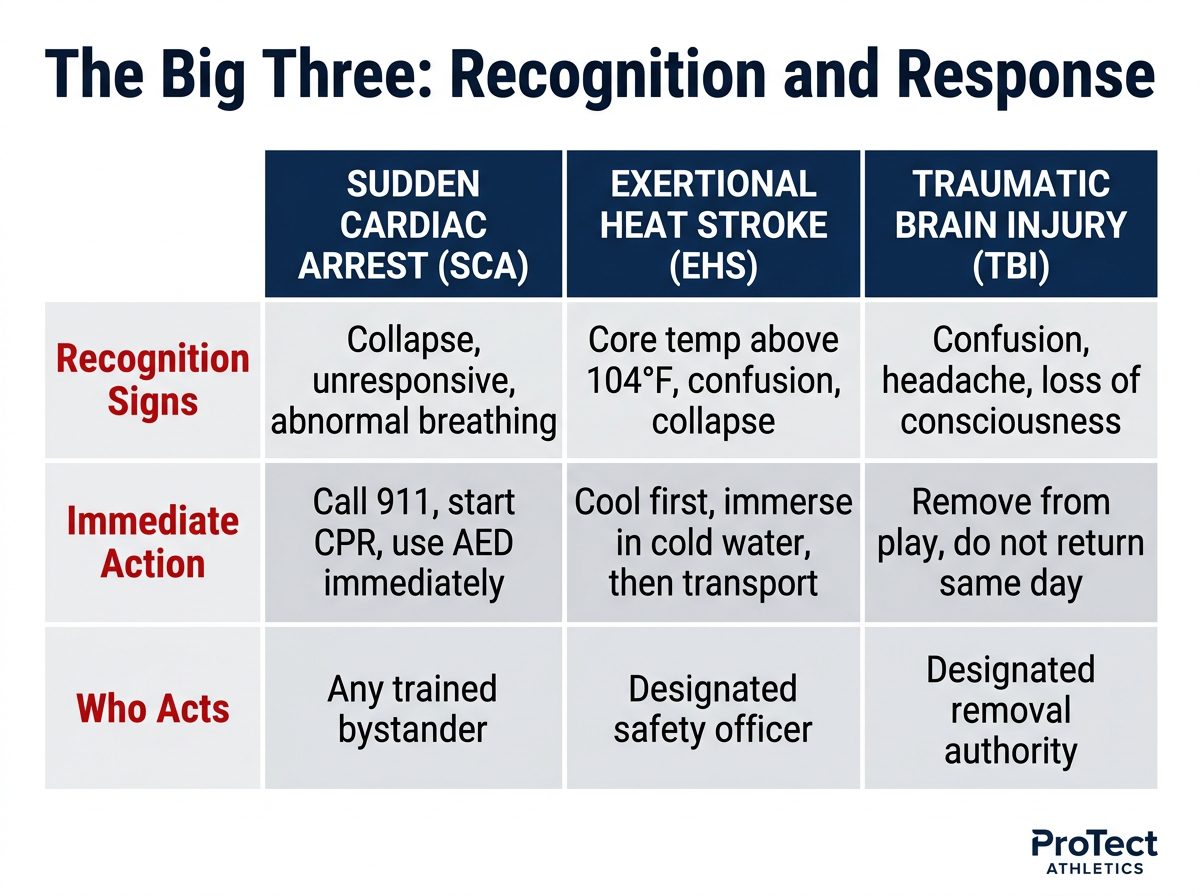
The Big Three are different. Sudden Cardiac Arrest, Exertional Heat Stroke, and Traumatic Brain Injury are the three conditions that kill and permanently disable young athletes in the time it takes an ambulance to arrive. They are the conditions where what you do in the first three to ten minutes on the field determines whether that athlete lives or dies, walks or is paralyzed, recovers fully or carries permanent damage for the rest of their life.
Every coach, every volunteer, every parent on a sideline must understand these three conditions. Not at the level of a physician. At the level of immediate recognition and immediate action. Because the window for action is brutally short, and it will not wait for the ambulance.
SUDDEN CARDIAC ARREST
Sudden Cardiac Arrest (SCA) is not a heart attack. This distinction matters because the public understanding of cardiac events is built around the image of an older person clutching their chest. That is not what SCA looks like in a young athlete.
In young athletes, SCA is most commonly caused by underlying structural heart conditions like hypertrophic cardiomyopathy, or by commotio cordis, where a blunt blow to the chest at the precise moment of the cardiac cycle triggers ventricular fibrillation. The heart does not stop beating in the way most people imagine. It begins fibrillating, a chaotic, quivering electrical storm that produces zero effective blood flow to the brain or organs.
Here is what SCA looks like on the field: an athlete collapses suddenly, often without any prior complaint. They may appear to seize. They may produce a gurgling, snoring, or gasping sound called agonal breathing. Many coaches and bystanders misinterpret agonal breathing as evidence that the athlete is still breathing and therefore do not initiate CPR. That misinterpretation is fatal. Agonal breathing is a brainstem reflex. It is not functional respiration. It is the body’s last electrical gasp, and it means the clock is already running.
Sports cardiology registry data estimates between 50 and 150 competitive student-athlete deaths from sudden cardiac arrest in the United States each year. Across all youth under age nineteen, including cardiac events outside of athletic participation, the broader population figure approaches 2,000 annually. Survival from SCA without CPR and defibrillation decreases by approximately seven to ten percent for every single minute that passes without intervention. By minute four, if no one has acted, survival probability has already dropped below fifty percent. By minute eight to ten, the probability of meaningful neurological recovery approaches zero.
The AED is not optional equipment. It is the only intervention that can terminate ventricular fibrillation and restore a normal rhythm. CPR keeps blood circulating and buys time, but CPR alone does not restart a heart in fibrillation. The AED does. An AED must be available, accessible, and applied within three to five minutes of collapse to give that athlete a real chance at survival.
The protocol is simple and non-negotiable: recognize the collapse, confirm unresponsiveness, call 911, begin CPR, retrieve and apply the AED, and continue until EMS arrives. The YSO credential trains participants to execute this sequence under the physiological stress of a real emergency, not just to recite it on a quiz.
EXERTIONAL HEAT STROKE
Exertional Heat Stroke (EHS) is not heat cramps. It is not heat exhaustion. It is a life-threatening emergency with a narrow treatment window and a treatment protocol that is the exact opposite of what most people’s instincts will tell them to do.
Exertional Heat Stroke is defined as a core body temperature exceeding 104 degrees Fahrenheit combined with central nervous system dysfunction. That second criterion is critical. The hallmark of EHS is not just a high temperature. It is neurological failure. An athlete with EHS may appear confused, combative, disoriented, or irrational. They may slur their speech, stumble, or collapse entirely. On a hot August practice field, these signs are often dismissed as fatigue or dehydration. That dismissal can cost the athlete their life or their kidneys.
The research on EHS treatment is unambiguous. The gold standard intervention is cold water immersion, submerging the athlete’s body in ice water as rapidly as possible to drive the core temperature below 104 degrees Fahrenheit. The principle is “cool first, transport second.” Do not wait for the ambulance and then cool the athlete at the hospital. Every minute above 104 degrees causes escalating, irreversible damage to the brain, liver, kidneys, and cardiovascular system. An athlete who arrives at the hospital already cooled has a dramatically better prognosis than one who arrives still hyperthermic.
This is why the presence of a cold-water immersion tub at outdoor practices in high-heat conditions is not a luxury. It is a life-saving piece of emergency equipment, as essential as an AED. The NATA position statement on Exertional Heat Stroke explicitly states that cold water immersion is the most effective cooling modality available and that delays in cooling are directly associated with worse outcomes and higher mortality.
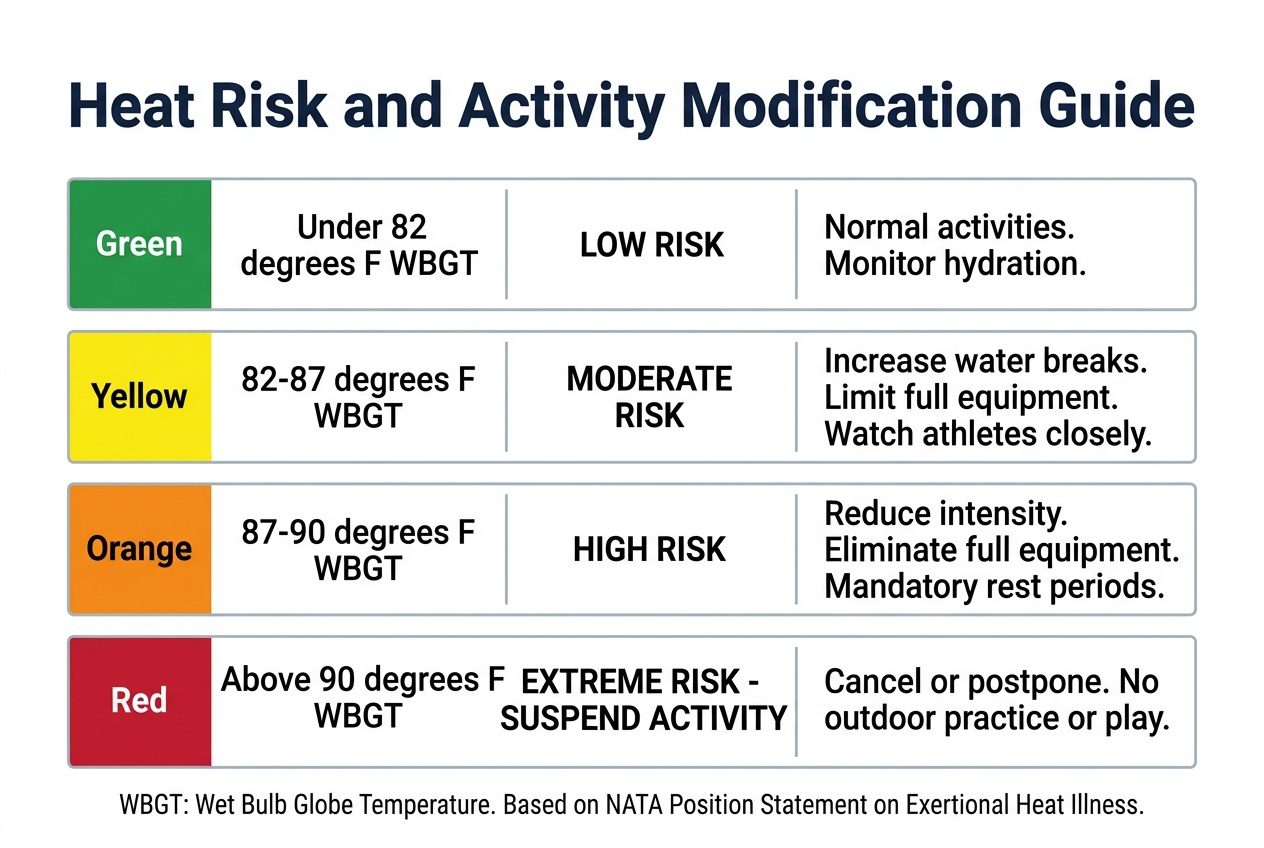
Environmental monitoring is not optional when heat is a factor. The Wet Bulb Globe Temperature (WBGT) index, which accounts for temperature, humidity, radiant heat, and wind speed, is the gold standard measurement for heat illness risk. NATA’s guidelines provide specific practice modification thresholds based on WBGT readings. A program that does not monitor WBGT before and during practice in summer conditions is operating blind and is legally exposed.
Heat stroke does not only happen on 100-degree days. It happens at 85 degrees with high humidity. It happens during the first week of fall preseason when athletes are not yet acclimatized. It happens to conditioned athletes who push past the physiological warning signs because they do not want to let the team down. The YSO credential teaches recognition, environmental monitoring standards, and the exact cooling protocol that keeps an athlete alive until EMS arrives.
CONCUSSION AND TRAUMATIC BRAIN INJURY
Every year, research into traumatic brain injury in sports becomes more damning. The era of “getting your bell rung” as a routine part of athletic participation is over. The science has ended that era, even if the culture has not caught up.
A concussion is a traumatic brain injury. There is no such thing as a mild concussion in the clinical sense that warrants dismissal. A concussion is caused by biomechanical forces transmitted to the brain through direct impact or rotational acceleration, producing a functional disruption of brain activity that may not be visible on standard imaging. The absence of a finding on a CT scan does not mean the brain is undamaged.
The most dangerous clinical reality in youth sports concussion management is Second Impact Syndrome (SIS). SIS occurs when an athlete sustains a second concussion before the first has fully resolved. The second impact, which does not have to be severe, can trigger a catastrophic loss of autoregulation in the brain’s blood vessels, leading to massive cerebral edema and swelling. SIS is associated with a mortality rate of approximately fifty percent and a near one hundred percent rate of permanent neurological disability in survivors. It is not rare in youth sports because youth sports is precisely where the return-to-play pressure is highest and the medical oversight is lowest.
The developing brain is uniquely vulnerable. Young athletes take longer to recover from concussion than adults. They experience more severe symptoms. They are at higher risk for SIS. And they are the least likely to self-report their symptoms because they fear losing their starting position or letting their teammates down.
The chronic traumatic encephalopathy (CTE) research emerging from institutions like the Boston University CTE Center is showing that repetitive sub-concussive impacts, blows that do not produce a diagnosed concussion, are still associated with long-term neuropathological changes. We are only beginning to understand the cumulative burden that years of contact sports place on the developing brain.
The field-level protocol for concussion management is not a judgment call. An athlete who shows any sign or symptom of concussion, including headache, confusion, nausea, visual disturbance, sensitivity to light or noise, balance problems, or retrograde amnesia about the event, is removed from play immediately. They are not cleared to return by the coach, the parent, or the athlete themselves. Only a licensed physician or certified athletic trainer can provide medical clearance for return to play. The YSO holds the line until that clearance is in writing.
Three conditions. Three windows. Three responses that are not interchangeable.
Sudden Cardiac Arrest: call 911, start CPR, apply the AED. Every second counts from the moment of collapse. Cool first, transport second for Exertional Heat Stroke: do not wait for the ambulance to begin immersion cooling. Remove from play immediately and return only with written physician clearance for concussion and TBI.
These protocols are not complex. They do not require a medical degree. They require that someone present has learned them, practiced them, and been designated to execute them before the emergency begins. That person is the entire point of everything that follows in this book.
CHAPTER 7: THE STATE OF THE LAW
The legislative response to preventable athlete deaths has been real, bipartisan, and almost universally inadequate.
In 2009, Washington State passed the Zackery Lystedt Law, the first youth sports concussion law in the nation, named after a thirteen-year-old who sustained Second Impact Syndrome during a middle school football game and was left permanently disabled. The Lystedt Law requires that any athlete suspected of sustaining a concussion be removed from play immediately and cleared by a licensed health care professional before returning. Within five years, all fifty states had passed similar legislation.
Ohio passed Lindsay’s Law in 2017, named after Lindsay Davis, a competitive ballerina who was diagnosed at age seventeen with hypertrophic cardiomyopathy, the leading genetic cause of sudden cardiac arrest in young athletes. After her diagnosis, Davis had an implantable cardioverter-defibrillator placed and was forced to permanently abandon her professional dance career. She channeled her grief into legislative advocacy, testified before the Ohio General Assembly, and was instrumental in securing passage of Senate Bill 252. Lindsay’s Law requires that coaches, parents, and youth athletes complete annual sudden cardiac arrest awareness training and review warning symptoms before each season. The law mandates immediate removal from play for any athlete who displays syncope or cardiac symptoms and prohibits return without physician clearance.
Florida enacted the Zachary Martin Act, addressing heat illness prevention in scholastic athletics after years of documented heat-related deaths in high school football. The law requires heat illness prevention policies, environmental monitoring, and defined practice modification guidelines based on heat index thresholds.
These laws represent genuine progress. They represent families who fought through their grief to ensure that no other family experienced what they experienced. They deserve to be honored.
But honoring them requires telling the truth about them.
Zackery Lystedt did not want a law named after him. He wanted to play football. Max Gilpin did not want a law. He wanted to make the team. No child who signed up to play wanted to be the reason a law exists. No parent who signed a permission slip imagined they were consenting to watch their child become a cautionary tale that legislators cite five years later.
They wanted to play. They wanted to watch. That is it.
There are dozens of laws across this country named after children who were hurt or killed in youth sports. We pass them in legislative chambers with the parents watching from the gallery and we shake hands and take photographs and call it a victory for safety.
It is not a victory. It is a monument to our failure.
A law named after a child who was hurt in sports is not a safety system. It is proof that we had no safety system. It is evidence that we waited, that we sat on our hands, made our assumptions, trusted our good intentions, and acted only after a family was destroyed. That is what we have built. A culture of reactive safety theater.
There is an old metaphor about the difference between an ambulance at the bottom of a cliff and a fence at the top. Every law named after a child who was hurt in sports is an ambulance. It arrives after everything that mattered already happened.
The parents of the children whose names are on those laws would tell you the same thing if you asked them. They do not want their child’s name on a law. They want your child to come home.
So do we. The difference between an ambulance and a fence is exactly what this book is about.
Honoring those families means looking honestly at what the laws accomplish and what they do not.
The fatal structural flaw in the overwhelming majority of state athletic safety legislation is this: the laws mandate the outcome but not the mechanism. They say what must happen. They rarely specify who must make it happen, what training that person must have, or what credential that person must hold.
The Lystedt Law says an athlete must be cleared by a licensed health care professional. It does not specify who is responsible for making the initial removal decision when no licensed health care professional is present on the sideline, which is the case in the vast majority of youth and middle school athletic events.
Lindsay’s Law requires sudden cardiac arrest awareness training. It does not require a designated responder. It does not require that the person who completed the training actually perform CPR, or that the training was anything beyond a thirty-minute online video.
The result is a system where an organization can be legally compliant and still leave an athlete completely unprotected in a real emergency. The board of directors has purchased the compliance certificate. The liability exposure remains exactly what it was before.
The plaintiff’s attorney understands this distinction perfectly. When a lawsuit follows a catastrophic injury, compliance certificates alone are insufficient to shield an organization from liability. The questions that matter are: who was the designated safety authority? What specific training had that person completed? Was there a written Emergency Action Plan? Was that plan rehearsed? Was there a functioning AED within three minutes of the field?
If the answer to any of those questions is unsatisfactory, the compliance certificate does not protect the organization. It simply demonstrates that the organization knew the law existed.
The ProTect Athletics credentialing framework was built specifically to close this gap. The SSE class is not a compliance checkbox. It is the baseline knowledge foundation. The YSO credential is the designated authority. Together, they transform legal compliance from a certificate on the wall into a trained person on the field.
The laws are real. The liability for non-compliance is real. The gap between what the law mandates and who executes it on the field is also real, and it is the gap this book is designed to fill.
Understanding your state’s athletic safety statutes is not optional for any organization that puts children in physical competition. Ignorance of the law has never been a defense in a civil courtroom, and it will not be when the plaintiff’s attorney establishes that your organization operated without a written EAP, without a trained safety officer, and without a documented response protocol. The law tells you what the floor is. Your organization’s job is to build above it.
CHAPTER 8: AWARENESS IS NOT A PROTOCOL
Every state that passed a youth athletic safety law has created, as a byproduct, a massive industry of online compliance training. Coaches log on, click through slides, watch video segments, pass a short quiz with unlimited attempts, and receive a certificate that says they are trained in athletic safety.
This is not training. It is record-keeping.
There is a fundamental difference between knowing that a protocol exists and being able to execute that protocol under physiological stress. The research on this distinction is extensive and unambiguous. The human body under acute stress undergoes measurable cognitive changes. Adrenaline is released. Heart rate spikes. Peripheral vision narrows. Working memory is compromised. The prefrontal cortex, responsible for complex decision-making and recall, is functionally subordinated to the amygdala, which is driving the fight-or-flight response.
In that physiological state, the coach who watched a thirty-minute video six months ago and has not practiced a single emergency response since then will not perform that response effectively. They will freeze. They will misidentify what they are seeing. They will wait for someone else to act. They will take the wrong action because it feels instinctively right, like moving a spinal injury victim or sending a concussed athlete back into the game because “they said they feel fine.”
The research on bystander CPR demonstrates this clearly. Studies consistently show that even people who have completed CPR training significantly underperform during actual cardiac events if that training has not been recently refreshed and physically practiced. The skill degrades rapidly in the absence of reinforcement.
Muscle memory is the only cognitive process that survives high-stress events reliably. Muscle memory is built through physical repetition, not through passive video consumption. The firefighter who enters a burning building does not think through each step. They have practiced those steps hundreds of times until the sequence is automatic. The athletic trainer who responds to a collapsed athlete does not pause to recall what they read in a manual. Their hands are already on the athlete while their voice is calling for the AED.
That is the standard ProTect Athletics trains toward. Not awareness. Automaticity.
The awareness courses that states require are necessary and ProTect Athletics supports them. They create a baseline of knowledge that is better than nothing. But the coaches and volunteers who complete those courses and believe they are prepared for a medical emergency on the field are operating under a dangerous misconception.
Knowing what SCA is does not prepare you to respond to a child who is seizing on the ground in front of you while thirty parents are screaming from the stands. Knowing what an EAP is does not mean you can execute one when the roles have never been assigned and the AED has never been retrieved in a drill.
The SSE compliance certificate program builds state-specific statutory knowledge. The YSO credential builds sideline operational competency. Those are not the same thing, and the distinction is not academic. It is the difference between an organization that survives an emergency and one that does not.
This is also why ProTect Athletics outlawed multiple-choice examinations across its entire educational and credentialing architecture. A bubble sheet cannot measure whether an adult can protect a child inside a three-minute cardiac window. Multiple-choice quizzes reward passive recognition and unlimited-attempt guessing, which is why standard online compliance courses fail the moment an athlete collapses. Across every layer of our framework, beginning with our state-specific Sports Safety Essentials (SSE) statutory compliance certificate programs built for ten states (Ohio, California, Virginia, Florida, Georgia, New York, Pennsylvania, Texas, Washington, and New Jersey), participants never click through multiple-choice trivia. They learn the exact statutory mandates of their state, build a verified personal pre-season safety playbook for their specific venue, and demonstrate applied decision-making across realistic emergency scenarios formatted for every adult learning style.
Who Pulls the Athlete?
Every state law that addresses youth athletic safety has language about return to play. The framework is consistent: an athlete suspected of a concussion, cardiac event, or serious injury cannot return to activity without written clearance from a licensed physician or certified athletic trainer.
That standard is necessary. It is also only half of the equation.
The question the laws mostly do not answer is the one that matters first: who has the authority to pull the athlete from play in the first place?
This is not a bureaucratic question. It is the most contested moment in youth sports safety, and it happens on the sideline, in real time, with a scoreboard running and parents watching and an athlete insisting they are fine.
The coach has the most structural authority on the field. The coach also has the most reasons not to use it. A championship on the line. A scout in the stands. A parent who has invested $20,000 in showcase tournaments screaming from the bleachers. An athlete who is their best player insisting the headache is nothing. Sports medicine research documents consistently that coaches are the adults most likely to minimize symptoms, rationalize continued play, and defer to an athlete’s self-report that they are ready to continue (Chrisman, Quitiquit, & Rivara, 2013; Register-Mihalik et al., 2013). That is not a character flaw. It is the predictable outcome of placing removal authority in the person who has the most competing interests.
The parent wants their child protected and has no formal authority to act. They cannot walk onto the field and remove their child from a game without triggering a confrontation that the organization has no mechanism to resolve. They are spectators to a decision that directly affects their child’s safety.
The athlete will not pull themselves. The research on this is unambiguous. Fear of losing playing time, fear of disappointing the team, fear of being seen as weak, and fear of jeopardizing a scholarship are all documented barriers to self-reporting in youth sports at every level. The athlete who says they feel fine is telling the coach what the moment demands, not what their neurological status requires.
Without a designated, credentialed authority, the removal decision defaults to the person with the most conflicts, or it defaults to no one, and the athlete stays on the field.
The YSO is the answer. The Youth Safety Officer’s sole function on that sideline is athlete safety. Not the score. Not the scout. Not the scholarship conversation. The credential creates the designated authority, and the designation creates the organizational clarity that removes the argument. When the YSO observes signs or symptoms that meet the removal threshold, they pull the athlete. That is their documented role. That is what their credential authorizes. That is what the EAP they signed specifies.
When the YSO makes that call and documents it, every other person on that sideline is protected. The coach did not override the safety officer. The league director did not instruct anyone to keep a symptomatic athlete on the field. The chain of designated authority worked exactly as designed. That documentation is the difference between a defensible organizational response and a plaintiff’s exhibit.
The return-to-play standard tells you who brings the athlete back. The YSO tells you who is authorized to stop the clock first. Both sides of that equation must be answered before the event begins, in writing, in the EAP, with a credentialed name attached to the removal authority.
If your program cannot answer the question “who pulls the athlete?” with a specific name and a specific credential, you do not have a safety system. You have a hope.
Awareness programs have saved zero lives. Trained, designated individuals on sidelines have saved lives. The distinction is not semantic. It is the difference between information and execution, between knowing what cardiac arrest looks like and being the person who acts on that knowledge in the first ninety seconds.
The question every administrator, every league director, and every board member should be required to answer before the season starts is this: at our events, who is the specific, credentialed, designated person responsible for pulling an athlete who shows signs of sudden cardiac arrest? Not who is generally aware. Who acts. Name the person or acknowledge the void.
CHAPTER 9: THE SLOW EMERGENCY
The three conditions in Chapter 6 kill young athletes fast. Minutes, in some cases seconds. The emergency is acute, identifiable, and urgent. Someone collapses. Someone calls 911. The clock starts.
There is another category of emergency in youth athletics that does not announce itself with a collapse. It builds pitch by pitch, rep by rep, practice by practice, season by season. It accumulates invisibly inside developing bodies that are not yet capable of communicating the damage being done to them. By the time the consequences surface, the injury that caused them may be months or years old.
This is the slow emergency. And nobody in youth athletics is systematically watching for it.
The Pitch Count Problem
Major youth baseball organizations including Little League, USA Baseball, and MLB have published Pitch Smart guidelines that establish age-appropriate pitch limits and mandatory rest days. Those guidelines exist because pediatric orthopedic surgeons documented epidemic rates of a surgery that was once performed almost exclusively on adult professional pitchers: Tommy John surgery, a procedure to reconstruct the ulnar collateral ligament of the elbow. This surgery is now performed routinely on fourteen-year-olds.
The guidelines are clear. The enforcement is not. A twelve-year-old pitcher may be governed by limits on his school team, his travel team, and his showcase circuit simultaneously. None of those coaches are required to communicate with each other. None of them have access to a cumulative pitch count that crosses organizational lines. A pitcher who reaches his weekly limit on his school team can walk into a Saturday tournament with a fresh count under travel ball rules and throw forty more pitches on an arm that has already exceeded its safe threshold.
Research confirms that compliance with pitch count limits is lowest in tournament settings, where the pressure to win overrides the discipline to protect. The arm that gets blown out in May may have been damaged incrementally in February, March, and April, by a system with rules that no one was required to enforce across the full scope of that athlete’s exposure.
The Hit Count Nobody Takes
Football presents an even more invisible crisis. There is no pitch count for a snap. There is no cumulative tracking system for the number of times a young player’s head absorbs impact in a practice, a game, a season, or a career.
Research published through major sports medicine institutions documents that youth football players can absorb hundreds of subconcussive impacts in a single season. A subconcussive impact is a hit to the head that does not produce the immediate, diagnosable symptoms of a concussion. No headache severe enough to report. No confusion visible to the coach on the sideline. No removal from play. And emerging neuroimaging research suggests that the cumulative effect of those unreported, untracked, undocumented impacts may produce structural and functional changes in the developing brain that will not surface clinically for decades.
The NFL spent years litigating its way through the science of chronic traumatic encephalopathy. Youth football has inherited that same science, without the resources or the regulatory framework to address it.
The Gymnastics Reality
Gymnastics presents the fatigue crisis in its most concentrated form. A competitive gymnast at the club level may train fifteen or more hours per week, beginning before puberty. Landing forces in gymnastics reach eighteen times a child’s body weight. A sixty-pound nine-year-old absorbs over a thousand pounds of force on a single vault landing, repeated hundreds of times per practice session.
The data on outcomes is unambiguous. More than ninety percent of competitive gymnasts sustain at least one injury per season. Not across a career: per season. Research on elite programs documents that injured gymnasts train significantly more hours per week than their uninjured peers, establishing the direct relationship between training load and injury risk. The American Academy of Pediatrics reports that approximately seventy percent of youth athletes quit organized sports by age thirteen, with injury and burnout cited as the top two reasons.
The gymnastics world has faced its institutional reckoning. The Larry Nassar case exposed not just criminal conduct but a systemic culture in which physical distress signals in athletes were routinely ignored or punished. Coaches restricting food and water. Athletes training on stress fractures. Children told their pain was weakness. The governing body responsible for oversight failed so completely that Congress created the U.S. Center for SafeSport as an independent investigative body to do the work the organization would not.
The Connection to Acute Emergencies
The slow emergency is not separate from the acute emergencies in Chapter 6. It is their precursor.
A fatigued athlete has slower neuromuscular response times. Their form breaks down. The controlled landing becomes uncontrolled. The safe tackle technique degrades under exhaustion into the helmet-to-helmet collision that produces the concussion. The pitcher with a compromised arm and no muscular protection around the joint is the pitcher whose elbow gives way. The gymnast in hour four of a session lands differently than she did in hour one, and that difference is where the ankle fracture happens.
Fatigue also degrades heat tolerance. An athlete who enters practice already depleted from a morning session, inadequate sleep, or insufficient nutrition has a fundamentally compromised thermoregulatory system. The WBGT threshold that would be safe for a rested athlete is not safe for an exhausted one. Nobody is measuring that. Nobody is required to.
The Scope of What ProTect Athletics Addresses
This book and the ProTect Athletics credential framework are built around the acute emergency: the cardiac arrest, the heat stroke, the concussion that happens in a single identifiable moment on a single identifiable field. That is the critical immediate gap and it is where lives are lost in minutes.
The chronic overuse crisis, the slow emergency that accumulates across seasons and careers in developing bodies, is a parallel epidemic that deserves its own treatment. ProTect Athletics sees it. We are not ignoring it. The YSO who is trained to recognize fatigue as a safety factor, who has the authority to pull a visibly depleted athlete before the acute emergency that fatigue makes more likely, is already taking the first step. The systematic infrastructure for monitoring chronic load in youth athletics is the next frontier.
The parent, the coach, and the league director who reads this book and asks “who is watching for this?” is asking exactly the right question.
The answer is nobody. Not yet.
The acute emergencies in this book kill in minutes. Sudden cardiac arrest, exertional heat stroke, severe anaphylaxis: the clock starts at the moment of collapse. But the slow emergency described in this chapter operates on a timeline measured in seasons, in cumulative pitch counts, in growth plates that close before the damage shows on an MRI.
The youth sports industry has built its financial model on year-round specialization. The sports medicine literature has documented the consequences. An athletic safety program that is only prepared for the acute crisis and not for the systemic risk factors that drive chronic injury is a program that has protected its organization from nothing. The Big Three demand an immediate response. The slow emergency demands institutional policy before the athlete ever takes the field.
PART 3: THE SIDELINE STANDARD (Layer 2: YSO)
CHAPTER 10: THE VOLUNTEER CREDENTIAL
Most youth sports organizations in the United States are run by volunteers. Coaches who volunteer because their kid plays. League directors who volunteer because someone had to do it. Assistant coaches who got recruited out of the stands because the team needed an extra body at Thursday practice and they happened to be there. Board members who agreed to a two-year term and are now in their seventh year because no one else stepped up.
These people are not the problem. They are the foundation of youth athletics in this country, and the overwhelming majority of them are doing extraordinary work with no budget, no staff, and no institutional support. The infrastructure of tens of millions of children’s athletic experiences is built almost entirely on the backs of adults who are giving their time because they love the game and they love the kids who play it.
The problem is that volunteer enthusiasm, however genuine and however committed, is not a credential. And in the context of an athletic medical emergency, the distinction between enthusiasm and credential is not a nicety. It is the legal and practical difference between a designated authority and a bystander with good intentions who is about to make a catastrophically wrong decision under maximum physiological stress.
Consider what it means to be a bystander with good intentions in the middle of a cardiac emergency. You have no assigned role in a plan. You have no rehearsed response. You have no written authority to make decisions. You are one of twenty adults on and around that field who all believe they should be doing something but none of whom has been told what. The result is paralysis, duplication, contradiction, and delay. Three adults pull out phones and call 911 simultaneously, none of them giving coherent information to the dispatcher because they are all talking at once. Two coaches run to find the AED and both come back empty-handed because neither knew where it actually was. A parent picks up the athlete because they are not moving and the parent’s instinct says to hold their child. The referee is waving for help from the parking lot. The team is standing in a circle around the athlete, blocking the airway from being cleared.
In Sudden Cardiac Arrest, those delays are not inconveniences. They are measured in lives, and the math is brutal. Seven to ten percent survival probability lost per minute without intervention. The bystander response described above took six minutes. You do that math.
The Youth Safety Officer credential exists to solve exactly this problem. The YSO is not a paramedic. They are not a replacement for a Certified Athletic Trainer or a physician. The YSO is the designated authority in the gap: the five to ten minutes between the moment of crisis and the moment EMS arrives. That gap is where young athletes die. Not because no one cared. Because no one was in charge.
A YSO is the person who has been formally designated by the organization as the safety authority for a specific event. They hold a credential that proves they have met a defined standard of knowledge and competency. They have a written role in the Emergency Action Plan. They have practiced that role before the event begins. When something goes wrong, there is no debate about who is in charge. There is no waiting for someone to step up. The YSO steps up automatically because that role has been defined, trained, assigned, and rehearsed in advance. Every other adult on that sideline knows whose voice carries the authority, and they follow it.
This is not theoretical. Studies of bystander response to cardiac arrest in public settings consistently document that bystander action rates increase dramatically when one person assumes clear, verbal leadership and assigns specific roles to specific individuals. “You, call 911. You, get the AED from the building. You, clear this area.” That is not instinct under stress. That is training. The YSO has been trained to do exactly that.
The Non-Replacement Principle is the foundation of everything the YSO credential represents. The YSO does not replace the Certified Athletic Trainer. The YSO fills the gap where the ATC is absent, because in the vast majority of youth, recreational, and many middle school athletic programs, the ATC is absent. The credential is not a workaround or a compromise. It is a purpose-built solution to a structural reality: most organizations will never be able to hire a full-time ATC, and the athletes in those organizations deserve a trained, designated adult on their sideline regardless.
The YSO credential is built on a nine-module, competency-based curriculum developed by credentialed professionals and reviewed by subject matter experts whose peer-reviewed research forms the scientific foundation of the training. Across nine structured modules covering the YSO role and scope of authority, building and rehearsing a venue-specific Emergency Action Plan, the Big Three (Head, Heart, and Heat), the Other Four high-consequence emergencies, venue hazard walks, environmental monitoring, protective equipment checks, crisis communication, and legal documentation, candidates are evaluated on applied scenario execution rather than multiple-choice recall. It is not an online video and a quiz. It is structured training designed to produce functional performance under stress, not passive completion under normal conditions. The distinction matters because the credential will never be used under normal conditions. It will be used in the worst moment your program has ever experienced.
Because the YSO curriculum is hosted directly on the Athletic Safety Organization’s in-house Learning Management System (LMS) and supported through grant initiatives and organizational partnerships, the credential is offered for free or near-free to coaches, parents, and volunteers. Every financial objection to mandating this training has been eliminated. The only remaining barrier is the decision to require it.
The YSO credential also matters profoundly for the organization’s legal defense. When a plaintiff’s attorney investigates a catastrophic injury, the first question is not whether anyone cared. The question is whether anyone was formally designated and trained. A YSO credential on file, attached to a written Emergency Action Plan, with a documented training date and renewal record, is the beginning of a defensible organizational response. Without it, the organization is asking a jury to accept that good intentions were sufficient preparation for a life-or-death emergency. Juries are rarely sympathetic to the argument that good intentions were adequate preparation for a life-or-death emergency.
Being passionate about athlete safety is admirable. Being credentialed is irreplaceable.
The credential framework for exactly this role has been built. The question every program must answer is whether it is going to put a trained, designated person in that role before something goes wrong.
The YSO is not a liability. Every organization afraid of the credential because it implies a duty of care has already accepted the duty of care. The moment an adult accepts responsibility for children in an athletic setting, the duty exists. The only question is whether that adult is trained and designated, or untrained and assumed.
A trained, credentialed, designated Youth Safety Officer does not create new legal exposure for an organization. It documents that the organization took its duty of care seriously, identified the risk, trained someone to manage it, and put that person on the field with authority to act. That documentation is the difference between gross negligence and reasonable care in a civil courtroom. Credential the YSO. Name the person. Write it down.
CHAPTER 11: THE EMERGENCY ACTION PLAN (EAP)
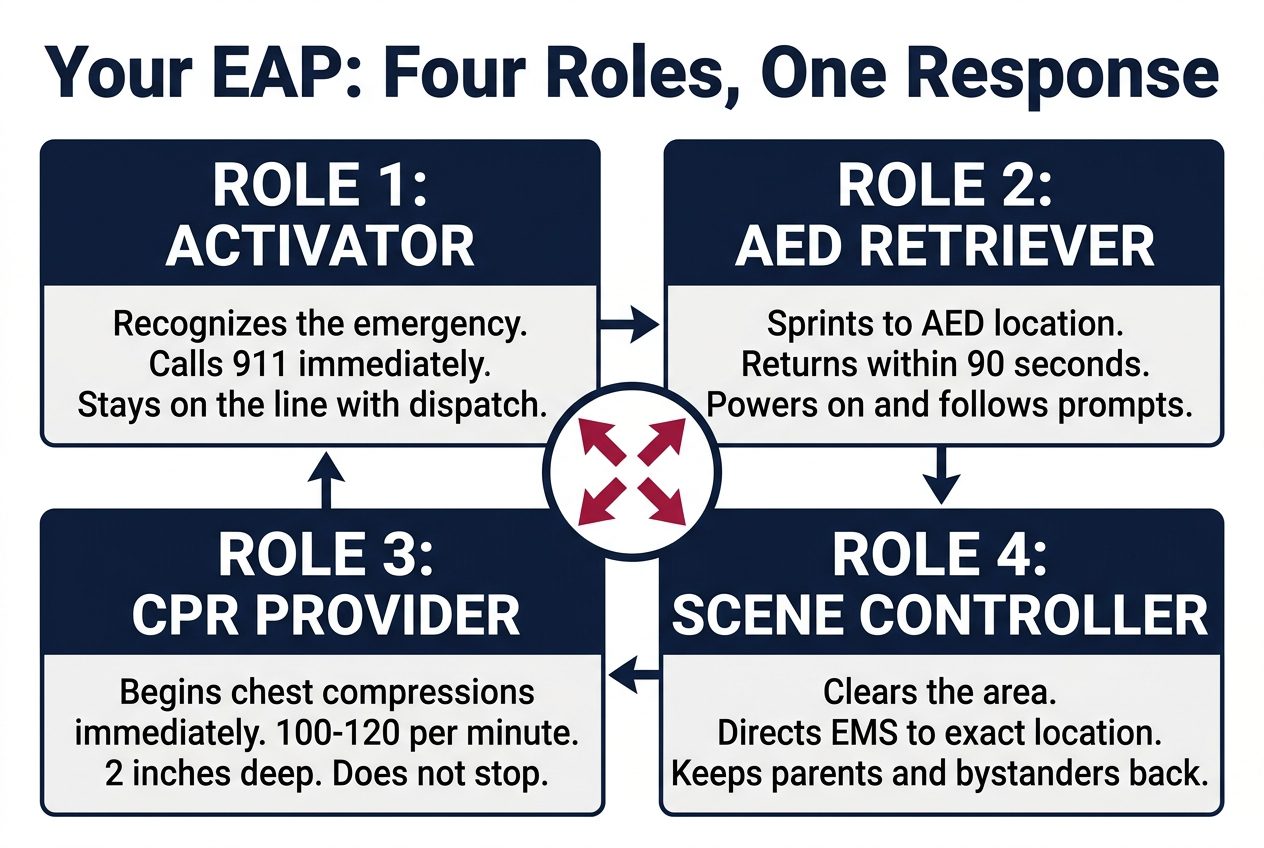
The most dangerous document in youth athletics is the Emergency Action Plan that has never been tested.
Most organizations that have an EAP wrote it once, filed it in a binder, and have not looked at it since. It says “Call 911.” It lists the address of the facility. It may name someone as a contact. And for the vast majority of real emergencies, it is completely useless. Not because the people who wrote it did not care. Because they did not understand the difference between a document that describes an emergency response and a plan that has been practiced, assigned, venue-verified, and rehearsed until it becomes a reflex.
Here is where EAPs fail in practice. A real medical emergency does not happen at the main facility with the well-known address. It happens at Field 7 of the county recreation complex, a five-field park where “the address” puts the ambulance at the main entrance a quarter mile from the field. The locked gate between the parking area and the playing surface is not mentioned anywhere in the EAP. The AED is in the main building, a four-minute walk from where a child just collapsed. The person listed in the EAP as the designated AED retriever graduated and is no longer with the program. Nobody updated the document.
EMS arrives in eleven minutes instead of six because the dispatcher could not identify the correct field and the coach who called 911 did not know the GPS coordinates of the playing surface. The athlete does not survive.
That sequence of failures is not a hypothetical. It is the documented pattern in post-incident analyses of preventable athletic deaths across the country. The EAP existed. It failed because it was a document, not a practiced system.
A legally defensible EAP is venue-specific. Not organization-specific. Not sport-specific. Venue-specific. Every unique location where your athletes practice or compete requires its own documented, rehearsed Emergency Action Plan. The EAP for the high school stadium does not apply to the middle school practice field behind the building. The EAP for your home facility does not apply to the away site where you travel every other Saturday. Each venue has different AED locations, different access points, different gate configurations, different distances from the nearest trauma center, and different 911 dispatch jurisdictions. A plan that does not account for all of those specifics is not a plan for that venue. It is a plan for a different venue that happens to share the same organization’s letterhead.
Venue Identification and GPS Coordinates
The single most operationally important element of any EAP is the exact GPS coordinates of the playing surface. Not the facility address. Not the park name. The GPS coordinates of the center of the field.
When you call 911 in an emergency, you are under maximum physiological stress. Your working memory is compromised. The ability to articulate a clear address while simultaneously managing a cardiac emergency is beyond the cognitive capacity of most untrained adults in that moment. GPS coordinates bypass all of that. They give the dispatcher a precise location that routes the ambulance directly to the right field, through the right entrance, in the minimum possible time. Every YSO records the GPS coordinates of their venue before every event and has those coordinates available on the EAP and on their phone.
Access, Gates, and EMS Routing
A locked gate between the ambulance and the athlete is a death sentence measured in minutes. Every EAP must document the specific gate or entrance designated for emergency vehicle access, whether that gate is locked during events, who holds the key during every event and can be immediately reached to open it, and the route from that entrance to the playing surface.
This is not administrative detail. This is the operational information that determines whether a paramedic reaches your athlete in four minutes or nine. The YSO walks the access route before every event. They confirm the key is in someone’s pocket, not in an office. They confirm the path is clear of equipment, vehicles, and obstructions. They confirm the gate number or entrance designation they will give the 911 dispatcher before they ever need to make that call.
Role Assignments: The Most Critical Element
The single most important thing an EAP does is eliminate the bystander effect by assigning specific roles to specific people before the emergency occurs.
Every EAP must name a specific person for each of the following four crisis roles under the direction of the Designated Safety Officer, and those assignments must be confirmed before every event begins:
Role 1: The 911 Activator. One designated person whose sole job when the emergency protocol activates is to call 911, provide the exact GPS coordinates of the playing surface, describe the emergency, and stay on the line with the dispatcher until EMS arrives. This person does not run to get the AED and does not step into compressions. Their entire function is that phone call, which is more complex and more critical than it sounds when executed in real time.
Role 2: The AED Retriever. One designated person who knows the exact location of the nearest AED, who can sprint to it and return to the athlete’s side within three minutes, and who knows how to power it on and apply the pads. This person has walked and timed the route before the event. They know whether the AED cabinet is locked and how to open it. They have not merely “seen” the AED once during orientation.
Role 3: The CPR Provider. One designated, CPR-trained responder who immediately begins high-quality chest compressions at 100 to 120 compressions per minute, two inches deep, and does not stop until the AED is analyzing or EMS physically assumes care. Assigning this role in advance eliminates the fatal bystander hesitation where multiple adults stand over an unresponsive child waiting for someone else to put their hands on the chest.
Role 4: The Scene Controller. One designated person who clears the field, manages the team and spectators so panicked parents do not rush the playing surface and compromise the scene, unlocks the emergency vehicle access gate, and physically stands at the entrance to meet the first emergency vehicle and guide paramedics directly to the athlete.
When these roles are assigned and confirmed before the event, every person on that sideline knows exactly what to do the moment the YSO activates the protocol. There is no decision-making required under stress. There is only execution of the role that was assigned in advance.
Documentation, Review, and Rehearsal
An EAP must be reviewed at the beginning of every season, updated whenever venue conditions change, and re-signed by the designated YSO annually. An EAP signed three years ago by a person who is no longer with the program does not constitute organizational preparedness. It constitutes evidence that the organization stopped paying attention.
The EAP must be physically rehearsed. A tabletop walkthrough is the minimum: every role-player present, every role assigned, every step talked through from activation to EMS handoff. A full field drill, ideally unannounced, is the standard that separates organizations that know how to respond from organizations that believe they do.
Every time a drill is conducted, it is documented: date, participants, roles assigned, time-to-AED, observations, and any corrective actions taken. That documentation is part of the organization’s safety record.
The YSO curriculum teaches the exact mechanics of building, documenting, and rehearsing a legally defensible Emergency Action Plan. The template is in the appendix of this book. Use it as a starting point. Build it to your specific venue. Sign your name to it. Then practice it until the roles are automatic.
A written Emergency Action Plan that has never been rehearsed is a legal document, not a safety plan. It documents intent. It does not produce execution. The first time the roles are actually tested cannot be when a child is on the ground in cardiac arrest.
Walk the venue before every event. Confirm the AED location. Walk the AED path and time it. Confirm the gate code or the key holder. Assign the four roles and read them aloud to every person holding one. Sign the form. Then, when the emergency arrives, every person on that field already knows exactly what they are doing and why. The plan does not save the athlete. The rehearsal does.
CHAPTER 12: THE FIELD-LEVEL PROTOCOL
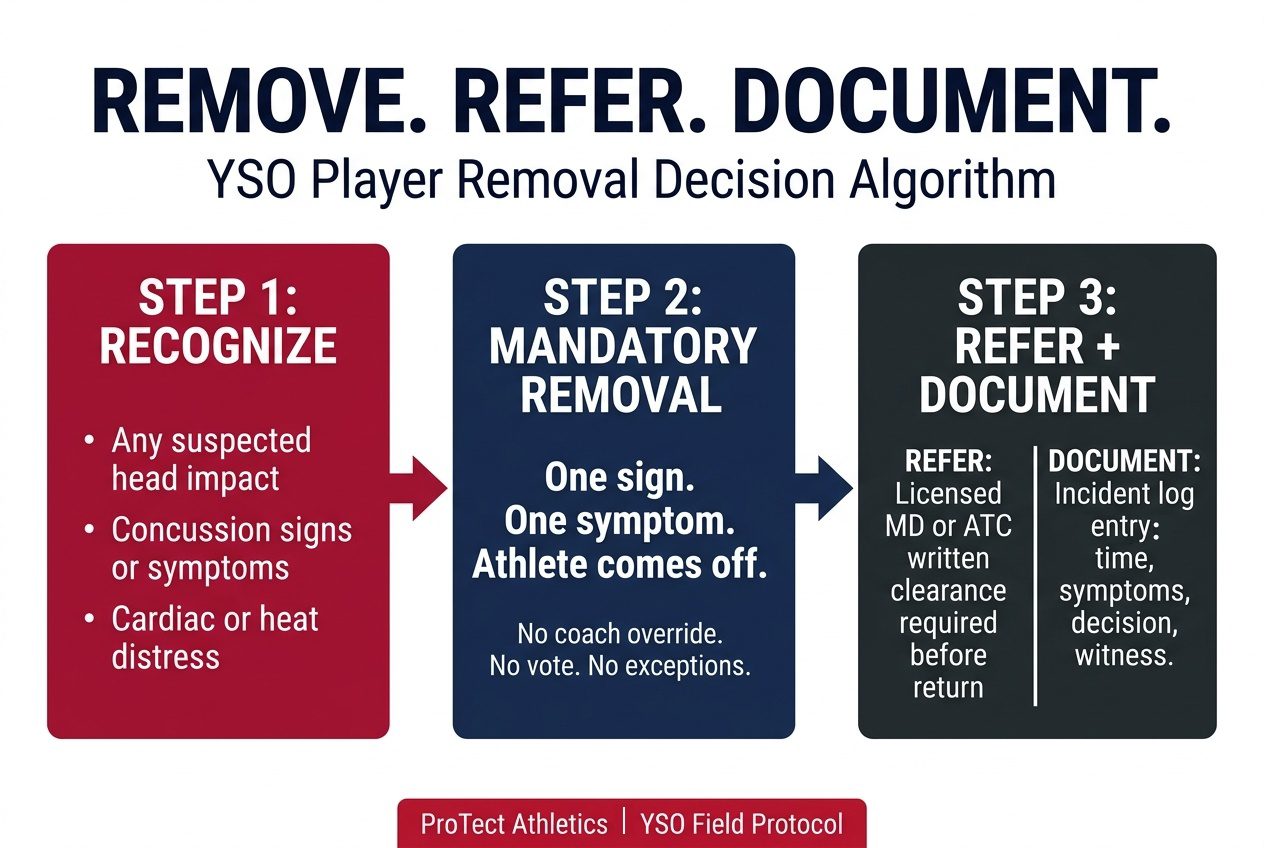
There is a moment that every coach in youth athletics will eventually face. It arrives without warning and it demands a decision before you have had time to think.
An athlete takes a hit to the head. They go down, then get up. They shake it off. They walk to the sideline, look you in the eye, and tell you they are fine. They want to go back in. Their teammates are watching. Their parents are in the stands. The score is tied with two minutes left in the game and this athlete is your best player.
Every psychological force in that environment is pushing you toward one decision. Put them back in.
That is precisely the moment this protocol was built for.
Because in that moment, the coach is being asked to make a medical assessment without the training, the tools, or the authority to make one. The athlete says they feel fine. But the athlete cannot accurately report their neurological status, because the neurological system being asked to perform that assessment is the same system that has just been disrupted. A concussed brain is not a reliable reporter of its own condition. The athlete who looks you in the eye and says “I’m fine, Coach” and genuinely means it is not lying to you. They are demonstrating the exact cognitive impairment that makes returning to play dangerous.
The field-level protocol removes the guesswork, the social pressure, and the decision from the moment. It is three steps. They are non-negotiable. They apply to every suspected emergency condition covered in this book: concussion, cardiac event, heat stroke, spinal injury, or any other condition that falls within the YSO’s removal criteria.
REMOVE
When an athlete shows any sign or symptom consistent with a condition on the YSO removal criteria list, they come off the field. Immediately. Completely. Without negotiation.
The YSO does not ask the athlete how they feel. They do not poll the coaching staff. They do not wait for the parent to weigh in from the stands. They do not hold a brief consultation to determine if the symptom is significant. The moment the sign or symptom is observed, removal is automatic. This is not inflexibility. It is the only approach that is both medically sound and organizationally defensible.
Second Impact Syndrome is the clinical reality that defines why removal cannot be conditional. SIS occurs when an athlete returns to play following an unresolved concussion and sustains a second impact before the first injury has healed. The second impact does not need to be severe. It does not need to produce immediate symptoms. What it produces is a catastrophic loss of vascular autoregulation in the brain, leading to massive cerebral edema that is frequently fatal. Per published case series, the mortality rate of SIS is approximately fifty percent (Cantu, 1998; Boden et al., 2013). The rate of permanent, severe neurological disability in survivors approaches one hundred percent.
SIS does not happen to athletes who stay off the field. Every case of SIS in the medical literature involves a return-to-play decision that should not have been made.
The removal criteria for the YSO include but are not limited to: any headache, confusion, or disorientation following head contact; visual disturbance; nausea or vomiting; dizziness or loss of balance; any period of loss of consciousness, however brief; retrograde amnesia about the event; unusual fatigue or drowsiness; sensitivity to light or noise; and any athlete who “just doesn’t seem right” in the judgment of the YSO. That last criterion matters. The YSO who cannot identify a specific symptom but observes that an athlete’s affect, gait, or response time is abnormal from their baseline is observing a valid clinical signal and is authorized to act on it.
REFER
The YSO does not diagnose. The YSO does not clear. The YSO refers.
Once an athlete has been removed from play under this protocol, they must be evaluated by a licensed physician or a Certified Athletic Trainer before they return to any athletic activity. Not a coach. Not a parent. Not the athletic director with twenty years of experience who has seen this before. A licensed clinician with the scope of practice to perform a standardized neurological and physical assessment and to interpret its results.
This rule is not a suggestion. It is the standard that every major medical organization in sports medicine, including the National Athletic Trainers’ Association, the American College of Sports Medicine, the American Academy of Pediatrics, and the American Medical Society for Sports Medicine, endorses without exception.
The YSO communicates clearly to the athlete’s family: this athlete has been removed under the emergency protocol. Here is what I observed. Here is when it occurred. They need to be seen by a physician before they return to play. That is not a recommendation. That is the standard. The YSO provides the parent with the removal documentation, explains the return-to-play requirement, and confirms that the family has a specific plan to obtain clinical evaluation.
The coach who tells a parent “let’s see how they feel tomorrow and go from there” has just exposed the organization to liability that no compliance certificate will protect them from. Return-to-play is a clinical decision. It requires clinical authority. The YSO enforces that boundary on every removal, on every occasion, regardless of who is applying the pressure.
DOCUMENT
If it is not written down, it did not happen. In youth athletic safety, this is not a procedural preference. It is a legal standard that courts apply consistently in cases involving athletic injuries.
The moment an athlete is removed from play, the YSO begins documenting. The documentation record must contain: the exact time of removal; the mechanism of the injury or event, in specific terms; the signs and symptoms observed, listed individually and precisely; the athlete’s condition and level of consciousness when they left the field; the name and contact information of the parent or guardian notified and the exact time of that notification; the name of the clinical professional or facility to which the athlete was referred; and any actions taken in the interim, including first aid, positioning, or monitoring.
This documentation serves multiple functions simultaneously. It is the clinical handoff document that gives the emergency room or clinic physician the information they need to assess the athlete accurately. It is the legal record of what occurred on your field and what the organizational response was. It is the baseline against which the return-to-play clearance will be measured. And it is the institutional memory that protects the organization if questions arise six months or two years after the event.
Courts have awarded substantial damages in athletic injury cases specifically because documentation was absent, incomplete, or inconsistent. The absence of documentation is interpreted by plaintiff’s attorneys and by juries as evidence that no protocol was followed. The presence of accurate, complete, timestamped documentation is evidence that the organization responded appropriately within the scope of its training and authority.
The YSO carries the removal documentation form on every sideline. It takes three minutes to complete. It may define the outcome of a lawsuit that begins three years from now.
Remove. Refer. Document. Three steps. No exceptions. The YSO owns every one of them.
The authority of the Youth Safety Officer in a player-removal decision does not rest on personal courage. It rests on institutional architecture built before the game begins.
Before any season or event, every organization operating under a ProTect Athletics safety framework must establish three structural supports for the YSO’s removal authority. First, the league or tournament rulebook must explicitly recognize the Designated Safety Officer as the removal authority for suspected concussion, cardiac, or heat emergencies, with the referee having standing to enforce that decision as a game official. Second, the YSO’s authority must be documented in the organization’s signed safety policy and communicated to every head coach at the preseason meeting, before the competitive pressure of a championship game makes compliance feel optional. Third, every removal decision must be entered into the incident log in real time, creating a contemporaneous legal record that the decision was made, on what basis, and by whom.
The YSO who attempts to pull a concussed athlete without those three structures in place is not implementing a safety protocol. They are engaging in a personal confrontation with no institutional backing, which no volunteer should ever be placed in. The confrontation is not the protocol. The governance architecture is the protocol. Build it in the preseason or accept the consequences when it matters.
CHAPTER 13: KNOWING YOUR VENUE
The field your athletes compete on is not a neutral surface. It is a system of potential failure points, most of which have injured or killed athletes at events that looked exactly like yours.
Most coaches walk onto a field and see a playing surface. They evaluate the footing, note the wind, check the scoreboard, and get to work. A trained Youth Safety Officer walks onto the same field and sees a risk environment. They see the unsecured portable goal on the west end. They see the concrete curb at the edge of the run-out zone behind the baseline. They see the AED that was reported to be in the equipment room is locked and the manager with the key has not arrived yet. They see the heat index on their weather app has crossed the threshold that requires a practice modification. They see the gap in the fence that emergency vehicles were supposed to access but is currently blocked by two equipment trailers that were parked there for convenience.
They see all of this before a single athlete steps on the field because they have been trained to look for it and because the pre-event environmental inspection is a documented requirement of their credential, not an optional add-on that happens when there is time.
The pre-event inspection is methodical, sequential, and documented. It covers the same categories every time. It takes fifteen minutes. It is the difference between an injury that was prevented and a lawsuit that was not.
PORTABLE GOALS AND ELEVATED EQUIPMENT
The Consumer Product Safety Commission has published data documenting multiple deaths and serious injuries caused by portable goals, basketball standards, and other elevated equipment that was not properly anchored. The failure mode is predictable and consistent: an unsecured goal or standard is climbed on, hung from, or simply destabilized by wind or contact, and it tips forward onto an athlete. A standard portable soccer goal weighs 150 to 300 pounds. A lacrosse goal with netting can exceed 100 pounds. When that mass falls, it falls fast, it falls flat, and it falls without warning.
CPSC guidelines and ASTM standards are explicit: portable goals must be anchored with ground stakes, sandbags rated to the goal’s weight, or approved mechanical anchors whenever they are assembled and in use. They must not be left assembled and unsecured overnight, between events, or any time athletes are on the field. They must be moved by multiple adults using proper carry technique. They must never be climbed on, hung from, or used for any purpose other than the sport they were designed for.
The YSO confirms before every event that every portable goal, every basket standard, every piece of elevated moveable equipment on and around the field is properly secured according to the manufacturer’s specifications. If a goal cannot be anchored in a specific location due to surface material or ground conditions, it does not get used. The game is modified. No competition or practice result justifies the risk of an unsecured goal.
THE RUN-OUT ZONE
The run-out zone is the area immediately surrounding the playing surface that athletes enter as a natural extension of play. A basketball player driving baseline and going out of bounds at speed. A soccer goalkeeper diving and sliding past the end line. A lacrosse player chasing a ground ball into the sideline area. A football player running a crossing route that takes them out of bounds into the bench area. These are not unusual plays. They happen in every game.
Whatever is in the run-out zone during those plays is a hazard. Metal bleacher uprights. Equipment bags stacked against the perimeter fence. Concrete curbing or drainage grates at the edge of the field. Coolers and medical kits placed inside the boundary. Opposing team members warming up along the sideline. Spectators who stepped inside the perimeter because they wanted a better view.
The YSO clears the run-out zone of all non-essential objects and personnel before every event begins and monitors it throughout the event. Hard, fixed objects that cannot be moved, concrete supports, metal fencing, permanent structures, are identified and flagged. When possible, padding is applied. When padding is not possible, the YSO documents the hazard and communicates its location to the coaching staff so that play near those boundaries receives heightened attention.
AED ACCESSIBILITY: THE THREE-MINUTE STANDARD
The American Heart Association research on cardiac arrest outcomes establishes clearly that defibrillation within three to five minutes of collapse is the threshold that produces meaningful survival rates. Beyond five minutes without defibrillation, survival probability drops below fifty percent. Beyond eight minutes, the probability of survival with full neurological recovery approaches zero.
The AHA and multiple sports medicine bodies therefore recommend that an AED be physically accessible within three minutes of any location where athletes may be. “Accessible” does not mean present somewhere in the building. It means retrievable and deliverable to the athlete’s side within three minutes by a designated person who knows exactly where it is and has walked that route.
Before every event, the YSO physically locates the nearest functioning AED, confirms that the battery charge indicator is current, confirms that the pads are not expired, confirms that the cabinet is unlocked or that the person with the key is immediately accessible, and times the walk from the AED to the center of the playing surface. If that time exceeds three minutes, the AED placement is operationally inadequate for that venue. The YSO documents this finding and escalates it to the facility manager and the organization’s leadership in writing.
If an AED is not available within the three-minute standard at a venue, the YSO is authorized under ProTect Athletics’ protocol to recommend postponement of the event and to document the basis for that recommendation. The organization’s leadership makes the final decision. But the YSO’s documentation of the deficiency, and of the organization’s response to that documentation, becomes part of the legal record.
TURF, SURFACE CONDITIONS, AND FIELD HAZARDS
A buckled synthetic turf seam is not a maintenance issue. It is a mechanism for ankle fractures. A painted yard line that has raised and separated from the field surface catches cleats. A bare patch on a grass field hides the depression underneath that rolls an ankle. Sprinkler heads that were not recessed properly are tripping hazards that do not announce themselves until an athlete at full speed goes down on one.
The YSO walks the full playing surface before every event, not along the perimeter, but across it, covering the field systematically to identify surface defects. Any surface condition that poses a tripping or injury risk is flagged and addressed before play begins. If it cannot be addressed, it is documented, the coaching staff is notified of the specific location, and if the condition is severe enough to make the surface unsafe, the event is postponed.
The inspection documentation creates a record that the organization identified and responded to field conditions. When an injury occurs on a field that was inspected and found acceptable, that documentation supports the organization’s defense. When an injury occurs on a field where a hazard was documented but not addressed, that same documentation becomes evidence of knowing negligence.
ENVIRONMENTAL MONITORING
Heat and lightning are addressed in detail elsewhere in this book. The venue inspection protocol incorporates both. Before any outdoor event in conditions where heat illness is possible, the WBGT reading is taken, documented, and evaluated against the NATA threshold chart for practice modification. Before any outdoor event where weather is a possibility, the YSO has a weather monitoring application active and has established the specific Flash-to-Bang count that will trigger evacuation.
These are not ad hoc decisions made when conditions deteriorate. They are decisions that are made in writing before the event begins, communicated to all coaching staff, and enforced without exception when the established thresholds are reached.
The venue walk is not optional, and it is not a fifteen-second glance at the field before the whistle. It is a systematic, pre-event evaluation of every emergency response obstacle between your athletes and the EMS team responding to their collapse.
Walk the route from the field center to the AED. Time it. Walk the route from the AED to the ambulance gate. Confirm the gate is unlocked. Confirm the key holder is present and has the key on their person. Identify the nearest shelter for lightning evacuation and measure the time it takes to move a hundred athletes to that shelter. Know your field GPS coordinates and confirm them against what 911 dispatch would see if you called from that exact location.
This walk takes twenty minutes. It is the twenty minutes that determines whether the athlete who collapses in the second half of your tournament makes it to the hospital with neurological function intact or does not.
CHAPTER 14: THE OTHER FOUR
The Big Three dominate the conversation about catastrophic athlete safety because they are the most statistically prevalent killers in youth sports. Sudden Cardiac Arrest, Exertional Heat Stroke, and Traumatic Brain Injury are the conditions most likely to occur, most likely to kill, and most likely to be managed poorly on a sideline without a trained, designated authority.
But they are not the only conditions that require a trained, designated response. A credentialed Youth Safety Officer must also be prepared to manage four additional emergencies with precision and speed, because the wrong instinctive action in any of these four scenarios can cause the same catastrophic outcome as the wrong response to a cardiac event.
SPINAL INJURY
The suspected spinal injury is the emergency where good intentions and instinctive action most reliably make things worse.
When an athlete sustains a significant traumatic impact to the head, neck, or back, the reflex of every adult nearby is to help. To reach down and pull them up. To remove the helmet so they can breathe. To sit them up to see if they are okay. To move them to the sideline where they will be more comfortable. Each of these responses, executed with genuine care and urgency, can convert a survivable spinal injury into permanent paralysis or death.
The cervical spine is the most mechanically vulnerable segment of the vertebral column, and it is the segment most frequently involved in sports-related spinal injuries. A fracture or dislocation in the cervical spine may not immediately sever the spinal cord. The cord may be intact but surrounded by an unstable bony structure. In that state, the spinal cord can survive the initial trauma. Whether it survives the response to that trauma depends entirely on whether the spine is moved before EMS arrives to stabilize it. The difference between complete and incomplete spinal cord injury, and between paralysis and recovery, may be determined entirely in those first minutes by whether the adults on the scene knew what not to do.
The protocol is absolute and admits no exceptions: do not move the athlete. Do not remove the helmet. Do not attempt to change the athlete’s position for any reason short of a lost airway requiring CPR. Manually stabilize the head and neck in the position found, with hands placed on either side of the helmet without applying compressive force, and maintain that position completely still until EMS arrives to apply a cervical collar and perform a controlled transfer.
The mechanism of injury is the trigger for this protocol, not the athlete’s presentation. An athlete who is fully awake, alert, and telling you that they are fine after a direct blow to the head or neck, or a fall from height, or a collision involving significant rotational force, is still under spinal protocol until EMS clears them. An athlete who states they feel fine but who was unconscious for any period following the impact is an absolute spinal precaution. Consciousness and the absence of obvious neurological symptoms do not rule out spinal injury. The mechanism rules it in, and the protocol does not lift until qualified medical personnel lift it.
If the athlete loses their airway and CPR becomes necessary, a modified jaw thrust maneuver is used to open the airway without extending the cervical spine. This technique is taught in the YSO curriculum and practiced until it is automatic, because it is the one scenario where maintaining spinal precautions and maintaining the airway must be accomplished simultaneously.
SEVERE BLEEDING
Traumatic severe bleeding in athletic settings is uncommon relative to the Big Three, but it is not rare, and the window for effective intervention is brutally short. Arterial lacerations can produce life-threatening blood loss in minutes. The Stop the Bleed campaign, developed in the aftermath of mass casualty events and now promoted by the American College of Surgeons and the Department of Homeland Security, exists because research demonstrated clearly that bystander intervention in severe bleeding events saves lives at a rate comparable to bystander CPR for cardiac arrest.
The two-tiered response to severe bleeding is direct pressure followed by tourniquet application when direct pressure is insufficient.
Direct pressure means applying firm, continuous, uninterrupted pressure directly to the wound with the cleanest material immediately available, gloved hands, gauze pads, clothing, and maintaining that pressure without lifting to check the wound. The instinct to lift and look is natural and it is fatal. Every time pressure is lifted, the clot formation that was beginning is disrupted and the bleeding cycle restarts from the beginning. The correct technique is to press and hold, add material on top if blood soaks through the first layer rather than removing and replacing, and do not release until EMS takes over.
When bleeding involves an extremity and direct pressure does not control it within sixty to ninety seconds, a tourniquet is indicated. The tourniquet is applied two to three inches proximal to the wound on the limb, pulled tight and secured until the bleeding visibly stops or dramatically reduces. The exact time of application is written directly on the tourniquet or on the athlete’s skin with a marker, in permanent ink. This time documentation is not administrative procedure. It is critical clinical information for the trauma surgeon who will determine when the tourniquet can be safely removed, and who needs to know how long the limb has been under compression.
A properly applied tourniquet saves a limb and a life. A tourniquet applied too loosely restricts venous return without stopping arterial flow, which accelerates blood loss rather than stopping it. A tourniquet removed prematurely because a bystander believed the bleeding had stopped re-exposes the wound at the moment the athlete is most hemodynamically vulnerable. The YSO is trained in tourniquet application and practices it before it is needed.
Every sideline kit maintained under the YSO credential standard contains at minimum: a commercial tourniquet such as the C-A-T or SOFTT-W, gauze pads, medical tape, and non-latex gloves. These items cost approximately fifty dollars total. The alternative is impossible to price.
ANAPHYLAXIS
Anaphylaxis is a systemic allergic emergency that can progress from first symptoms to fatal cardiovascular collapse in under ten minutes. In athletic settings, the most common triggers are insect stings from bees, wasps, or hornets encountered at outdoor facilities, food allergens consumed before or during the event by athletes with documented sensitivities, and in some cases latex exposure through medical gloves in an athlete with latex allergy.
The clinical progression of anaphylaxis is specific and recognizable if the YSO knows what to look for. Initial symptoms often include skin changes: hives, flushing, or a blotchy rash appearing on the trunk, arms, or face. These may be accompanied by itching, swelling of the lips or tongue, runny nose, or watery eyes. As the reaction progresses, respiratory symptoms develop: throat tightness, difficulty swallowing, a sensation of the airway closing, wheezing, or stridor. Cardiovascular compromise follows: drop in blood pressure, rapid weak pulse, lightheadedness, and loss of consciousness.
The critical clinical reality of anaphylaxis is that this progression does not follow a predictable timeline. In a highly sensitized individual, the transition from first symptom to cardiovascular collapse can occur in five minutes or less. The YSO who waits for the reaction to “see how bad it gets” has already waited too long.
The intervention is epinephrine, and it is not optional. Epinephrine administered by auto-injector into the outer thigh muscle is the only effective first-line treatment for anaphylaxis. Antihistamines including diphenhydramine (Benadryl) do not act quickly enough to interrupt an anaphylactic cascade and must never be substituted for epinephrine in a suspected anaphylactic event. They may be given in addition to epinephrine as adjunctive treatment, but they do not replace it and they do not delay its use.
After epinephrine is administered, 911 is called immediately regardless of apparent clinical improvement, because of the phenomenon of biphasic anaphylaxis. Biphasic anaphylaxis is a recurrence of the allergic reaction, sometimes more severe than the initial episode, occurring four to twelve hours after the first event and in the absence of any re-exposure to the allergen. Approximately twenty percent of anaphylactic reactions are biphasic. An athlete who received epinephrine and appeared to recover completely can re-enter cardiovascular collapse hours later without additional allergen exposure. All anaphylactic events require clinical monitoring in a medical setting following the initial field response.
Before every event, the YSO confirms with every coaching staff member: are any athletes on this roster documented to have a severe allergy? If yes: is their prescribed epinephrine auto-injector physically present at this event, not at home, not in the team vehicle, not in the locker room? An EpiPen that is not present at the event is not available when the event produces the emergency. The YSO does not allow an athlete with a documented severe allergy to take the field without their epinephrine on site.
LIGHTNING
Lightning kills an average of twenty to thirty people per year in the United States, with athletes and outdoor recreational participants consistently comprising the majority of those fatalities (National Weather Service; NATA, 2013). It injures hundreds more. Of all the weather-related hazards that affect outdoor athletic events, lightning is the one most consistently managed through delayed decision-making, group rationalization, and the social pressure of not wanting to be the person who calls the game.
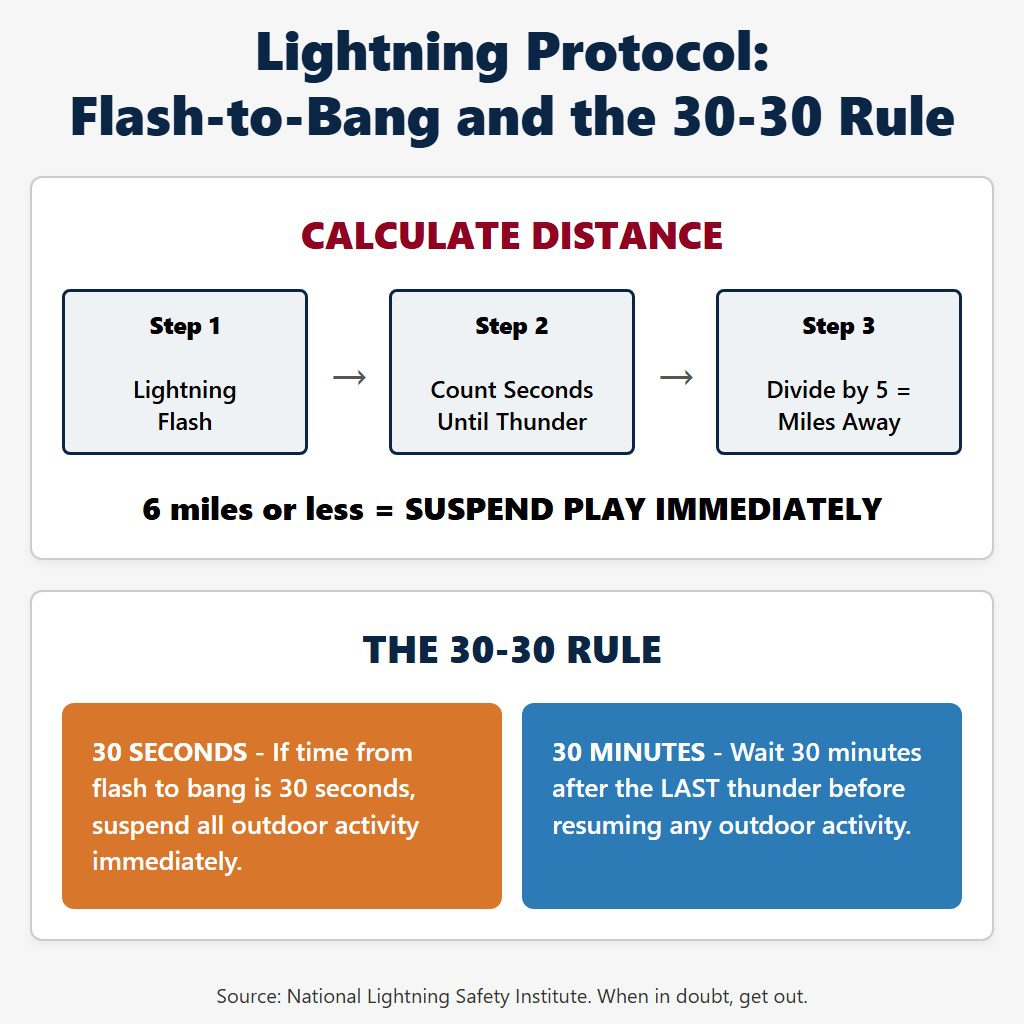
The science is not ambiguous and it does not require interpretation. Lightning science is not something a YSO applies judgment to in the moment. It is a standard that is decided in advance and enforced when the threshold is reached.
The Flash-to-Bang method is the validated real-time assessment tool. When lightning is observed, counting begins immediately. Seconds are counted until thunder is heard. That count is divided by five to calculate the approximate distance of the lightning in miles. If the result is six miles or less, which corresponds to a count of thirty seconds or less between flash and bang, the playing area must be cleared immediately. Athletes and staff move to appropriate shelter and do not return until the thirty-minute all-clear clock has run.
The thirty-minute rule is the standard adopted by NATA, the National Federation of State High School Associations, the American Red Cross, and virtually every major sports and outdoor recreation authority in the United States. The thirty-minute clock begins running from the last observed flash of lightning or the last heard sound of thunder. Every subsequent lightning flash or thunderclap resets the clock to thirty minutes from that new observation. The rationale is atmospheric: a storm that appears to have moved past a location may still have active electrical charge in the air above it. The thirty-minute standard ensures that the electrical environment has fully stabilized before athletes return to an exposed outdoor surface.
Safe shelter has a specific definition that excludes several structures athletes and coaches commonly assume are adequate. A substantial building with plumbing or electrical wiring provides effective protection because those systems provide a path to ground. A hard-topped metal vehicle with windows closed provides protection because the metal shell, not the rubber tires, channels electrical current around the occupants. Structures that do not constitute safe shelter include open dugouts, covered bleachers, equipment sheds, press boxes, canopies, picnic shelters, and any structure that is open on one or more sides. Standing under an isolated tree is actively more dangerous than standing in an open field, because isolated trees are disproportionately struck by lightning and the ground current from a tree strike can kill or injure everyone within a radius of thirty to sixty feet.
The YSO does not negotiate the lightning protocol with coaches, athletic directors, league officials, or parents. The thirty-second Flash-to-Bang count is not a recommendation that reasonable people can weigh against the importance of completing a game. It is a threshold established by authoritative bodies based on lightning physics and casualty data. When that threshold is reached, the field clears. The YSO calls it, it is documented with the time, and the thirty-minute clock starts. If there is a subsequent flash of lightning or sound of thunder before thirty minutes have elapsed, the clock resets and is documented again.
Every event at an outdoor venue operates under a documented lightning protocol that was established before the event began and communicated to every coaching staff member, official, and parent present. The protocol is not announced for the first time when lightning is observed. By then, it is too late for orderly implementation. The protocol is posted, communicated, and understood before the first athlete steps on the field.
The Big Three are the most common catastrophic emergencies in youth athletics. The Other Four are not common. They are also not rare, and they are not survivable without preparation.
A volunteer who has trained on spinal precautions, who knows to call 911 immediately for suspected c-spine trauma and to stabilize rather than move, has done their job. A volunteer who has confirmed that every athlete with a documented severe allergy has their epinephrine on site and has reviewed who administers it under applicable state law, has done their job. A volunteer who identifies an arterial bleed requiring tourniquet application and acts on it before EMS arrives, has done their job. A volunteer who implements the 30-30 rule before the bolt, not after, has done their job.
Preparation for the Other Four does not require paramedic training. It requires that someone on that sideline took the time to think through what happens when the emergency is not the one they expected.
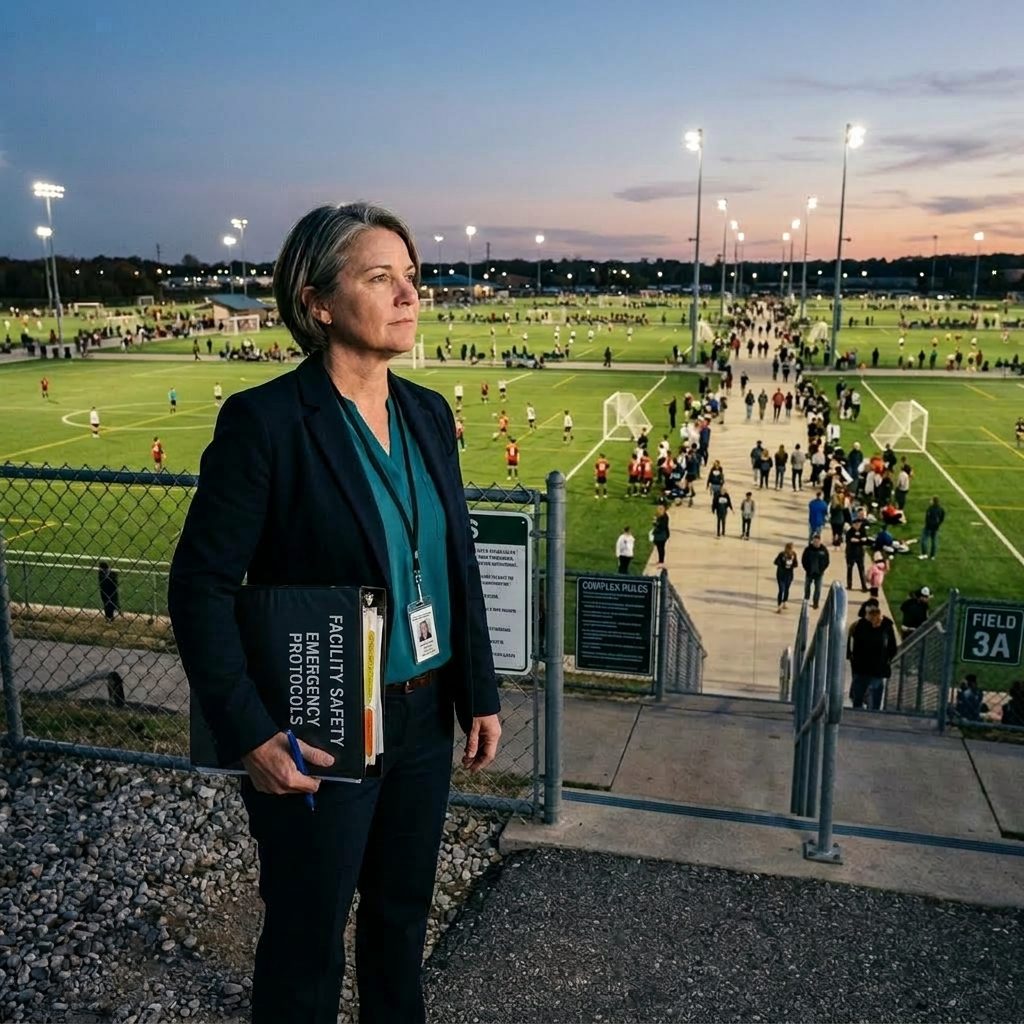
PART 4: MANAGING SAFETY AT SCALE (Layer 3: ASM)
CHAPTER 15: THE LOGISTICS OF LIABILITY
When you are responsible for one team on one field, safety is manageable with discipline, a trained designee, and a practiced Emergency Action Plan. When you are responsible for a school district, a multi-sport club organization, a county recreation department, or a collegiate athletic program with dozens of teams, hundreds of athletes, scores of venues, and thousands of pieces of equipment in constant circulation, safety is no longer a sideline discipline. It is an organizational system. And managing a system requires a fundamentally different set of skills, a different scope of authority, and a different administrative infrastructure than managing a single event.
This is the domain of the Athletic Safety Manager (ASM) certificate program.
The ASM is the operational spine of a safe athletic program at scale. Built as a three-course, 90-contact-hour (9.0 CEU) operational and administrative safety management certificate program with a monitored field practicum, the ASM curriculum trains administrators across three rigorous operational pillars: Protective and Emergency Equipment Safety Operations (ASM-101), Athletic Venue and Environmental Safety Operations (ASM-102), and Safety Compliance and Risk Governance (ASM-103). The ASM sits structurally between the field-level execution of the YSO and the executive governance of the Director of Athletic Safety or organizational leadership. They own the physical assets, the documentation architecture, the training pipeline, the compliance calendar, and the inter-departmental coordination that makes consistent safety possible across an entire organization. The YSO responds to the emergency in front of them. The ASM builds and maintains the system that ensures the YSO has what they need, every time, at every venue, before the emergency occurs.
Consider the equipment management problem in isolation, because it is one of the most significant and most consistently mismanaged liability exposures in scholastic athletics.
Helmet Lifecycle Management
A high school football program may have fifty to one hundred helmets in active use at any given time. Each helmet is not simply a piece of equipment. It is a liability asset with a legally governed lifecycle that begins at the moment of manufacture and ends at the moment of certified removal from service, and every step in between must be documented.
The National Operating Committee on Standards for Athletic Equipment sets the performance standards that helmets must meet to be certified for play. Those standards are not suggestions. They are the measurement against which a helmet’s adequacy will be evaluated in litigation. A helmet that meets NOCSAE standards on the date of manufacture may not meet them ten years later, which is why manufacturers establish shelf-life limits, typically ten years from the date of manufacture, after which a helmet must be removed from service regardless of its physical appearance. Material degradation in the foam liner and shell occurs at the molecular and polymer level, invisible to the naked eye, progressively reducing the helmet’s energy management capacity even when the helmet looks and feels structurally sound. The helmet that was certified safe in 2014 may not be safe in 2024, and the ten-year rule exists precisely because no visual inspection can detect the degradation that has occurred internally.
Between manufacture and retirement, helmets must be reconditioned on a defined cycle by a facility certified by the National Athletic Equipment Reconditioners Association. Reconditioning is not cleaning. It is a comprehensive inspection and certification process that examines the structural integrity of the shell, the composition and condition of all padding and liner systems, the functionality of all hardware including buckles, snaps, and face mask attachment points, and performance compliance with current NOCSAE impact standards through physical testing. A reconditioned helmet carries a current certification and a date stamp that documents compliance. An unreconditioned helmet carries the program’s uncovered liability.
When a helmet fails during play and causes a traumatic brain injury, the sequence of events that follows is predictable. The plaintiff’s attorney does not ask the coach what the helmet looked like before the game. They file a discovery request for the helmet’s complete chain-of-custody record: the original purchase receipt with the date of manufacture or receipt, every annual reconditioning certificate from the date of purchase to the date of the injury, the serial number tracking log establishing which athlete used that specific helmet, and the documentation showing who physically inspected the helmet and on what date before it was issued to the athlete who was injured.
If those records exist, are complete, and show a documented reconditioning and inspection cycle without lapses, the organization has a defensible position. If those records do not exist, or if they show a missed reconditioning cycle, or if the serial number log cannot establish which helmet was on which athlete’s head, the organization’s liability exposure is substantial and its legal defense is structurally undermined before the first deposition.
This is not a hypothetical. Helmet-related litigation in youth and scholastic athletics regularly produces settlements and verdicts in the millions of dollars. The documentation record is one of the most determinative factors in how those cases resolve. Organizations with clean, current, serial-number-level documentation have a path to defense. Organizations that were operating on visual inspection and institutional memory do not.
The ASM owns this system. They establish the serial number tracking log at the time of purchase and maintain it through the life of every piece of protective equipment. They manage the reconditioning calendar, coordinate delivery to NAERA-certified facilities, file the certificates on return, and remove from service every piece of equipment that has exceeded its lifecycle without exception.
AED and Safety Equipment Lifecycle
The same discipline applies to every piece of safety-critical non-protective equipment in the program. AEDs are not set-and-forget devices. They require documented inspection at defined intervals, battery testing, pad expiration monitoring, and device replacement at the end of the manufacturer’s recommended service life. A functional AED during the last inspection that has a failed battery during a cardiac emergency is not a maintenance oversight. In the context of a wrongful death lawsuit, it is a documented breach of the organization’s duty of care to the athlete.
The ASM maintains an inspection log for every AED in the facility and at every off-site venue where the organization’s athletes compete. That log is current, timestamped, and accessible to legal review on demand. The ASM verifies pad expiration dates on every inspection and replaces them before expiration, not after. The ASM tests the battery indicator on every inspection and does not assume a green light today means a functional device in six months.
The cold-water immersion equipment used for heat stroke response requires its own maintenance and readiness protocol. The tub must be functional, clean, and positioned correctly before every outdoor practice in heat-risk conditions. The ice supply must be pre-positioned or a confirmed delivery protocol must be in place. This is not complicated logistics. It is the difference between a cooling system that is ready when an athlete collapses and one that takes twenty minutes to set up while the athlete’s core temperature is climbing.
Building the System
Every organization that employs more than one team and more than one venue needs a centralized safety administration function that spans those teams and venues. The ASM provides that function. They do not do the safety work on each individual sideline. They build the system that enables the YSO on each sideline to do their work effectively and with organizational backing. They are the infrastructure behind the response.
Insurance documentation, facility use agreements, equipment reconditioning records, and third-party operator COIs do not prevent emergencies. They determine what happens to your organization after one.
The administrative infrastructure of organizational athletic safety is unglamorous. It does not generate headlines or inspire athletes. But when the subpoena arrives, it is the only thing standing between your organization and a finding of gross negligence. The ASM who has built this infrastructure before the emergency is not being paranoid. They are being professionally responsible in precisely the way the law expects a trained safety manager to be responsible.
Build the infrastructure now. The emergency is not going to schedule itself around your readiness.
CHAPTER 16: SAFETY CULTURE FROM THE TOP
The greatest barrier to effective athletic safety in youth and scholastic programs is not lack of knowledge. It is not lack of technology. It is not even lack of funding, though that is a genuine constraint.
It is organizational culture that treats safety as secondary to competition. And it is leadership that tolerates that culture because the social and institutional rewards of winning are more immediately visible than the consequences of a safety failure that has not happened yet.
This culture is not malicious in most organizations. It is structural. Athletic programs are evaluated on wins, championships, athlete development, and competitive reputation. Coaches are hired and fired on the basis of win-loss records and player placement. Athletic directors are judged on the success of their programs as defined by competitive outcomes. Boosters and parents invest emotionally and financially in outcomes measured by scoreboards and scholarship offers. In this environment, the safety officer who pulls a star player from a championship game is not perceived by everyone in the building as doing their job. They are perceived by some of the most influential people in the building as creating a problem.
That is the environment the Athletic Safety Manager has to build a safety culture inside of. Not around it. Inside it.
Safety culture does not emerge spontaneously from the bottom of an organization. It is not produced by posting signs on the wall, distributing compliance certificates, or running an annual training session. It is constructed deliberately, enforced consistently, and modeled explicitly from the top of the organizational hierarchy downward. Every administrator, every board member, every head coach who treats a safety protocol as negotiable teaches every person in the organization that safety is negotiable. Every administrator who publicly backs a safety officer in a high-friction moment teaches everyone watching that safety is not negotiable.
The Separation of Authority
The Athletic Safety Manager’s first and most foundational task in building safety culture is the structural clarification of authority domains. There are two domains of authority in any athletic program, and they must never overlap.
The head coach is the absolute authority over competitive decisions: strategy, lineup, game management, athlete development, and every decision related to the outcome on the field. No one overrides the head coach in their domain. That authority is appropriate and it is non-negotiable.
The safety officer is the absolute authority over medical and environmental decisions: athlete removal from play based on signs or symptoms of an emergency condition, Emergency Action Plan activation, weather protocol enforcement, equipment safety compliance, and any decision that relates to the physical safety of the athletes in that program. No one overrides the safety officer in their domain. That authority is equally appropriate and equally non-negotiable.
These two authorities operate in parallel. They exist simultaneously. Neither overrides the other in its own domain. The coach decides who plays. The safety officer decides who is medically eligible to play. Those are different questions, and they are never the same question.
This separation must be formalized in written policy adopted by the board of directors or governing body. An unwritten understanding between a safety officer and a head coach is worth nothing when that coach is in the fourth quarter of a championship game with their star player on the sideline and two administrators in the press box who outrank everyone on the field. Written policy, adopted by the governing body, is the only protection the safety officer has in that moment. Without it, they are enforcing a standard they do not have the organizational authority to enforce, and they will lose every high-friction confrontation with anyone who outranks them.
The High-Friction Moment
Every safety culture is tested in its hardest moment. And every organization’s response to that moment tells the entire organization exactly where safety sits in the hierarchy.
The championship game concussion. The heat stroke scare in the first week of preseason when no one has had time to drink enough water and the first athlete to go down is the one the coaches were depending on. The parent who runs onto the field convinced that her daughter is being benched not because she has a concussion but because the coach doesn’t like her. The booster who has significant financial influence over the program and who is certain that the kid who just got removed needs to go back in because he looked fine when he walked off.
These are the moments that define whether a safety culture is real or whether it is theater. If the administration publicly and unambiguously backs the safety officer in those moments, the message transmitted to every coach, every athlete, and every parent in the program is that the protocol applies without exception, even when it is uncomfortable, even when it costs something on the scoreboard. If the administration allows the protocol to be overridden, or hedges, or quietly pressures the safety officer to exercise more “flexibility,” the message is the opposite, and every subsequent training, every subsequent EAP, every subsequent compliance certificate becomes a performance that no one with any institutional knowledge actually believes.
Accountability as the Architecture of Culture
Safety culture is not built on values statements and mission documents. It is built on accountability that is applied consistently and without exception to every person in the organization, regardless of their competitive value.
The star quarterback who removes his helmet on the sideline during a lightning evacuation is subject to the same consequence as any other athlete. The winning coach who pressures a YSO to return a concussed athlete to play receives the same formal response as any other coach who violates the safety protocol. The athletic director who tells a safety officer to “use some judgment” when the thirty-second Flash-to-Bang count is reached is held to the same standard as anyone else who attempts to override an established safety protocol.
When accountability is applied selectively, based on competitive value or institutional rank, it is not accountability. It is favoritism dressed up in process. And every person in the organization can see the difference.
The ASM’s job is to build the systems, policies, and documentation architecture that make accountability consistent and defensible. The board’s job is to support that architecture when it is tested. When both are working correctly, the safety culture does not depend on any individual’s personal commitment. It is structural.
Safety culture is not a training program you launch at the start of the season. It is the signal that leadership sends every day about what the organization actually values when performance and safety conflict.
Every head coach who is evaluated, retained, and promoted based on win-loss record without a parallel evaluation of safety protocol compliance sends a signal. Every board meeting that allocates twelve minutes to the budget and zero minutes to the safety report sends a signal. Every administrator who backs down when a coach resists the YSO’s removal decision sends a signal. Those signals accumulate into culture. And that culture is what the plaintiff attorney will describe to the jury when establishing whether your organization’s negligence was ordinary or gross.
Safety culture starts at the top because the top is where the consequences land.
CHAPTER 17: DEFENSIBLE DOCUMENTATION
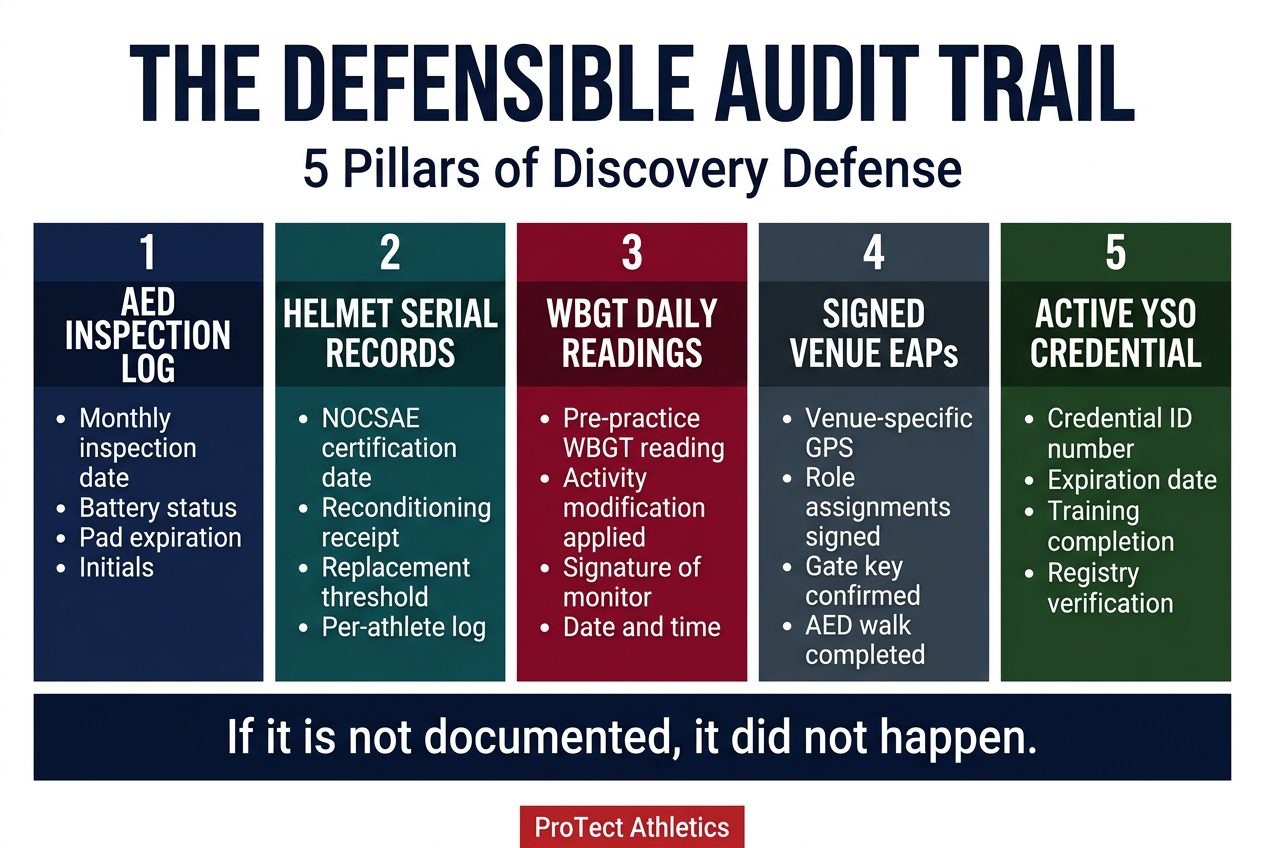
In the litigation environment that governs modern athletics, the quality of your documentation is the quality of your defense. This is not a metaphor or an administrative preference. It is the practical reality of how athletic injury lawsuits are investigated, argued, and resolved by courts and juries that have no context for your organization’s values, intentions, or institutional culture. They have documents. They evaluate the documents. The documents tell the story.
Understand what happens after a catastrophic athletic injury in the current legal environment.
The family retains an attorney. The attorney files a complaint against the school district or organization, the athletic association, the league, the event operator, and any named individual officials. Discovery begins, and discovery is thorough. The plaintiff’s legal team issues requests for production that cover every document, record, log, communication, email, and text message related to the injured athlete, the event at which the injury occurred, the equipment involved in the injury, the training records and credential history of every staff member present at the event, the Emergency Action Plan for the specific venue, the environmental monitoring logs for the day of the event, the inspection records for the facility and the equipment, and every incident report or removal log generated during the season.
Those documents will be produced. If they exist and are current and accurate, they tell the story of an organization that operated within a defined standard of care, made reasonable decisions based on available information, and responded to the emergency with trained personnel following documented protocols. That story supports a defense.
If the documents do not exist, or are incomplete, or are inconsistent with each other, or if the discovery request produces a six-month-old AED inspection log, a helmet without a reconditioning certificate, an EAP that was never updated after the facility changed its AED location, and no incident documentation from the day of the injury, those absences tell a different story. That story ends in a settlement or a verdict that reflects what it costs when an organization’s paperwork tells a jury that it did not take safety seriously.
Environmental Monitoring
The Wet Bulb Globe Temperature index must be checked and documented before outdoor practices and events in any conditions where heat illness risk is present. The NATA position statement on Exertional Heat Illnesses specifies exact WBGT thresholds for activity modification: unrestricted activity below the threshold, modified activity between thresholds, and cessation of outdoor activity above the highest threshold. These are not general guidelines. They are the clinical standard that will be cited in any litigation involving a heat illness event.
A program that documents WBGT readings before every outdoor summer practice, with corresponding notes on any activity modifications made based on those readings, has created a legally defensible record that demonstrates: the organization knew about environmental heat risk, the organization monitored it, and the organization adjusted its activities based on the measurement. A program that did not monitor and document WBGT before a practice where an athlete collapsed from heat stroke has created an indefensible record. The plaintiff does not need to prove the organization was negligent. The absence of monitoring documentation becomes evidence of negligence.
AED Inspection Logs
Every AED in every facility and at every venue where the organization’s athletes compete must have a documented inspection log that is current within thirty days. The inspection documents the date, the battery status indicator reading, the pad expiration date, the device model and serial number, and the name of the person who conducted the inspection. An inspection tag attached directly to the device provides a visible at-a-glance record.
If an AED battery fails during a cardiac emergency and the last documented inspection was eight months ago, that single document becomes the centerpiece of the litigation. The question is not whether the organization intended for the battery to fail. The question is whether the organization took reasonable steps to ensure the device would function when needed. An eight-month gap in documentation answers that question against the organization.
Helmet and Equipment Records
Every piece of protective equipment must be tracked by serial number from purchase to retirement. The chain-of-custody log establishes, for any piece of equipment, the date of purchase, the date of every reconditioning, the athlete to whom it was issued for each season, the date and result of every inspection, and the date and reason for retirement. This record must be retrievable on demand by serial number.
If the plaintiff’s attorney asks which helmet was on the injured athlete’s head, your serial number log must be able to answer that question immediately. If it can, and if that helmet has a complete, current reconditioning and inspection history, you have a defense. If it cannot, or if the history has gaps, you are explaining the gaps under cross-examination.
Incident and Removal Documentation
Every athlete removal from play for a medical reason must be documented before the event ends, not the next day, not during the post-game review, and not reconstructed from memory. The documentation must include the exact time of removal, the mechanism or event that prompted it, the specific signs and symptoms observed and documented in clinical terms, the athlete’s condition and level of consciousness at the time of removal, the name of the parent or guardian notified and the exact time of that notification, and the name of the clinical professional or facility to which the athlete was referred.
This document serves simultaneously as the clinical handoff that gives the treating physician what they need to assess the athlete, the legal record of the organizational response, and the baseline documentation against which any return-to-play clearance will be evaluated. Organizations that discover at the time of litigation that they have no incident documentation from the day in question are not in a position to reconstruct that record credibly. The absence of a contemporaneous document is treated by plaintiff’s attorneys and by courts as evidence that the protocol was not followed.
Training Records
The credential and training history of every adult who interacts with athletes in a supervisory capacity must be documented, current, and accessible. This includes SSE completion dates and expiration dates, YSO credential issuance and renewal dates, CPR and first aid certification dates, and any sport-specific safety training required by the governing body. These records prove that the organization made a deliberate, documented effort to place trained personnel in positions of safety responsibility. They do not guarantee a perfect outcome. They demonstrate a reasonable standard of care.
The ASM owns all of these records. They establish the systems, define the schedules, maintain the logs, and ensure that when the discovery request arrives, the organization’s documentation does not surprise anyone on the legal team.
Every piece of documentation described in this chapter serves two purposes. The first purpose is operational: consistent records create institutional memory that survives personnel turnover and produces better safety outcomes over time. The second purpose is legal: if an athlete is catastrophically injured at your event, the documentation you kept or failed to keep will be the primary exhibit in establishing what your organization knew, when it knew it, and what it did about it.
The organization that kept its EAPs, its training records, its incident logs, its equipment inspection sheets, and its venue walk documentation is the organization that can demonstrate reasonable care. The organization that ran its program on good intentions and verbal agreements is the organization that gets destroyed in discovery.
Document everything. Retain it. Know exactly where it is.
CHAPTER 18: BUILDING YOUR SAFETY COALITION
Every Athletic Safety Manager will eventually face the same conversation. The specifics vary by organization, by sport, by season, and by budget cycle. The structure is always the same. You have identified a critical, documented safety gap. A cold-water immersion tub is absent from a football program that runs August preseason practices. The AED coverage at a five-field youth soccer complex leaves three of the five fields outside the three-minute retrieval standard. A coaching staff of twelve includes only two people with current credentials, and neither of them is assigned to the three highest-risk practice settings. You bring the gap to the administration. They tell you it is not in the budget, or that it will be addressed next fiscal year, or that they have been operating this way for years without an incident and do not see the urgency.
This conversation fails when the ASM argues on the basis of moral obligation. The administrators and board members who control budgets are not, in most cases, indifferent to athlete safety. They are people who are responsible for managing limited resources across many competing priorities, each of which has an advocate standing in front of them making a compelling moral argument. When the safety officer says “we need to do this because it is the right thing to do,” they hear a request that is morally equivalent to twenty other requests they received last month. The budget meeting ends. The safety equipment stays off the order list. The moral argument goes nowhere.
The conversation succeeds when the ASM argues on the basis of documented liability exposure, specific cost data, and formal organizational process. This is not cynicism. It is pragmatism in service of the mission.
The Formal Gap Analysis
The foundation of the ASM’s budget argument is the formal written gap analysis. This document is not a complaint or a recommendation. It is a structured organizational risk document that presents, in sequence: the specific safety deficiency identified, documented with date and evidence; the established standard or clinical position statement that defines it as a deficiency and the authoritative source for that standard; the documented probability and severity of the adverse event the deficiency creates; the cost of remediation in specific dollar terms with vendor quotes or catalog references; and the documented cost of not remediating, expressed in the terms that boards understand.
The cost of not remediating is where the conversation shifts.
The median wrongful death settlement in a youth athletic setting in the United States is measured in millions of dollars, and settlements of this magnitude have followed heat stroke deaths, cardiac arrest deaths, and catastrophic spinal cord injuries at events that were indistinguishable from any other event in those programs’ histories. The cost of a certified, inspection-ready AED is under two thousand dollars. The cost of a commercial cold-water immersion tub and ice protocol is under one thousand dollars. The cost of the credential training required to produce a YSO, delivered directly through the Athletic Safety Organization’s in-house LMS for free or near-free access through our grant and partnership model, is negligible to zero. When those numbers appear on the same page as the median settlement cost for the injury the gap exposes the organization to, the board’s calculation changes from “we cannot afford this” to “we cannot afford not to do this.”
The formal gap analysis also serves an important secondary purpose: it creates the documentary record that the deficiency was identified, reported, and brought to the attention of the organization’s leadership. If the deficiency is subsequently remediated, that record demonstrates the organization’s responsiveness. If it is not remediated and an injury occurs, that record becomes one of the most significant documents in the litigation that follows.
The Recorded Decision Request
When a formal gap analysis is presented and the administration declines to fund the remediation, the ASM’s next step is the formal recorded decision request. The language matters. The request is: “I am asking the board to make a formal, documented vote on whether to fund the remediation of this safety deficiency, as documented in the gap analysis submitted on this date.”
This request changes the political calculus of the conversation in ways that are immediate and significant. An administrator who will casually decline a verbal budget request over a conference call becomes significantly less comfortable declining to fund a documented safety remediation via a formal, recorded, minuted board vote. The act of requesting the vote signals to everyone in the room that the decision and its consequences will be part of the organizational record. Most boards will fund the remediation rather than create a recorded vote declining to address a known, documented safety gap.
When the injury does eventually occur, the recorded vote is among the most consequential documents in the litigation. An organization that was formally presented with a documented safety deficiency, that considered the remediation request in a formal board meeting, and that voted to decline the funding, has significantly increased its civil liability exposure in a way that is exceptionally difficult to defend. The knowledge of the risk was documented. The decision not to act was recorded. The jury does not need to infer negligence. The organizational record proves it.
Building External Allies
The ASM’s coalition extends beyond the internal organizational hierarchy. Insurance carriers who underwrite athletic programs increasingly offer premium reductions and preferential coverage terms to organizations that document formal safety systems, credentialed personnel, and established inspection protocols. The financial incentive of an insurance premium reduction is a budget argument that boards understand without needing to be educated about clinical standards.
State athletic associations, governing bodies, and league administrators who are beginning to engage with safety mandates are natural allies for the ASM who is already building compliance infrastructure. Being ahead of the mandate rather than reactive to it positions the organization as a leader rather than a compliance subject, and it positions the ASM as an expert resource rather than a burden.
The coalition also includes the families of the athletes in the program. Parents who understand what the safety credential means, what the EAP provides, and what the YSO designation represents are advocates for maintaining and expanding those systems. A parent education session at the beginning of every season that explains the safety infrastructure in place, the training the personnel have completed, and the protocols that govern every event does two things simultaneously: it builds the informed advocate base that supports the safety budget, and it demonstrates the organizational commitment to transparency that insurers, governing bodies, and courts interpret as evidence of a genuine safety culture.
Build your coalition with data, documented liability exposure, formal organizational process, and the informed families who are your most powerful advocates. The funding follows.
Safety does not fund itself, and safety managers who approach their boards or league directors with moral arguments and no financial data consistently lose the budget fight. The organizations that have successfully built sustainable safety infrastructure have done so by making the economic case as clearly as the moral case.
Insurance premium reductions, litigation cost avoidance, registration-fee competitive advantage, and reputational risk quantification are not abstractions. They are numbers your organization can calculate against the cost of credential training, AED equipment, and documentation systems. The safety coalition succeeds when the CFO and the legal counsel are in the room alongside the athletic director. Get all three in the room before the season starts.
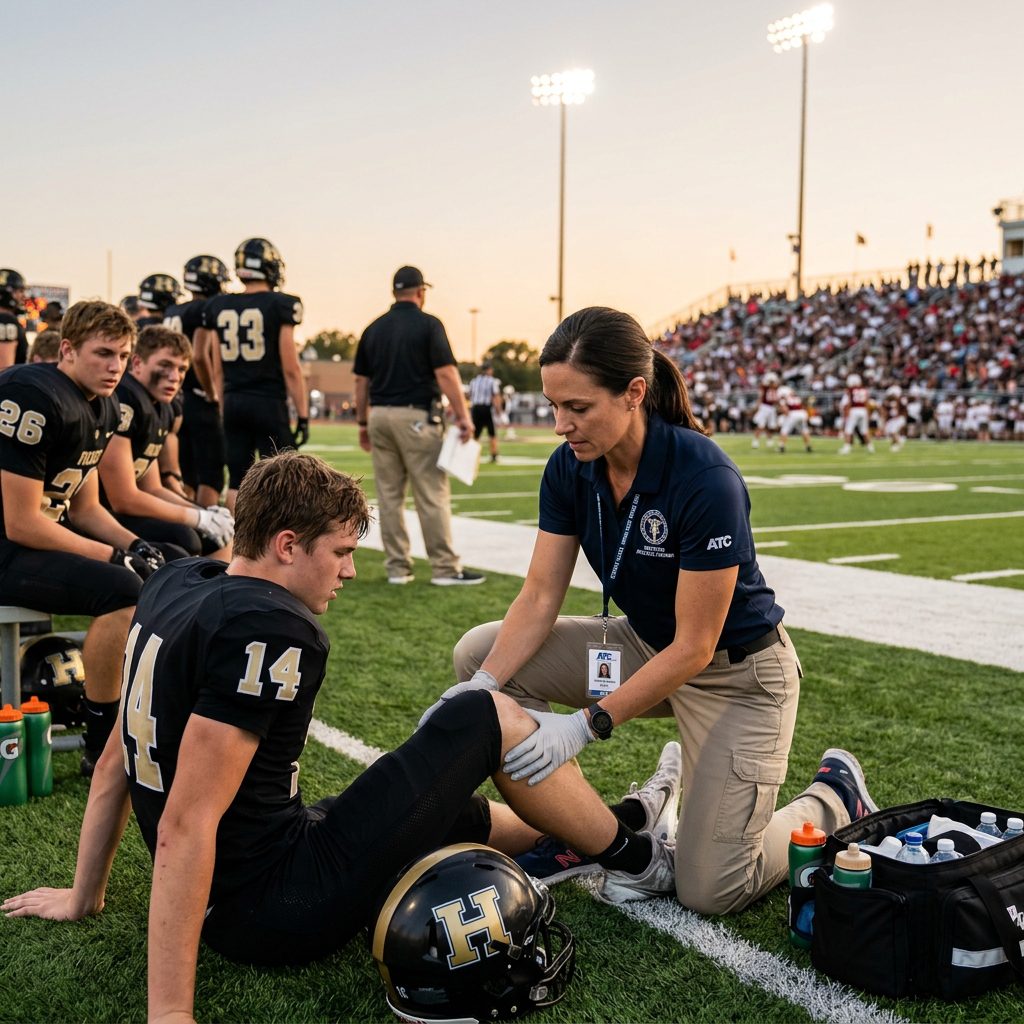
PART 5: THE PROFESSION (Layer 4: DAS℠)
CHAPTER 19: THE DIRECTOR OF ATHLETIC SAFETY
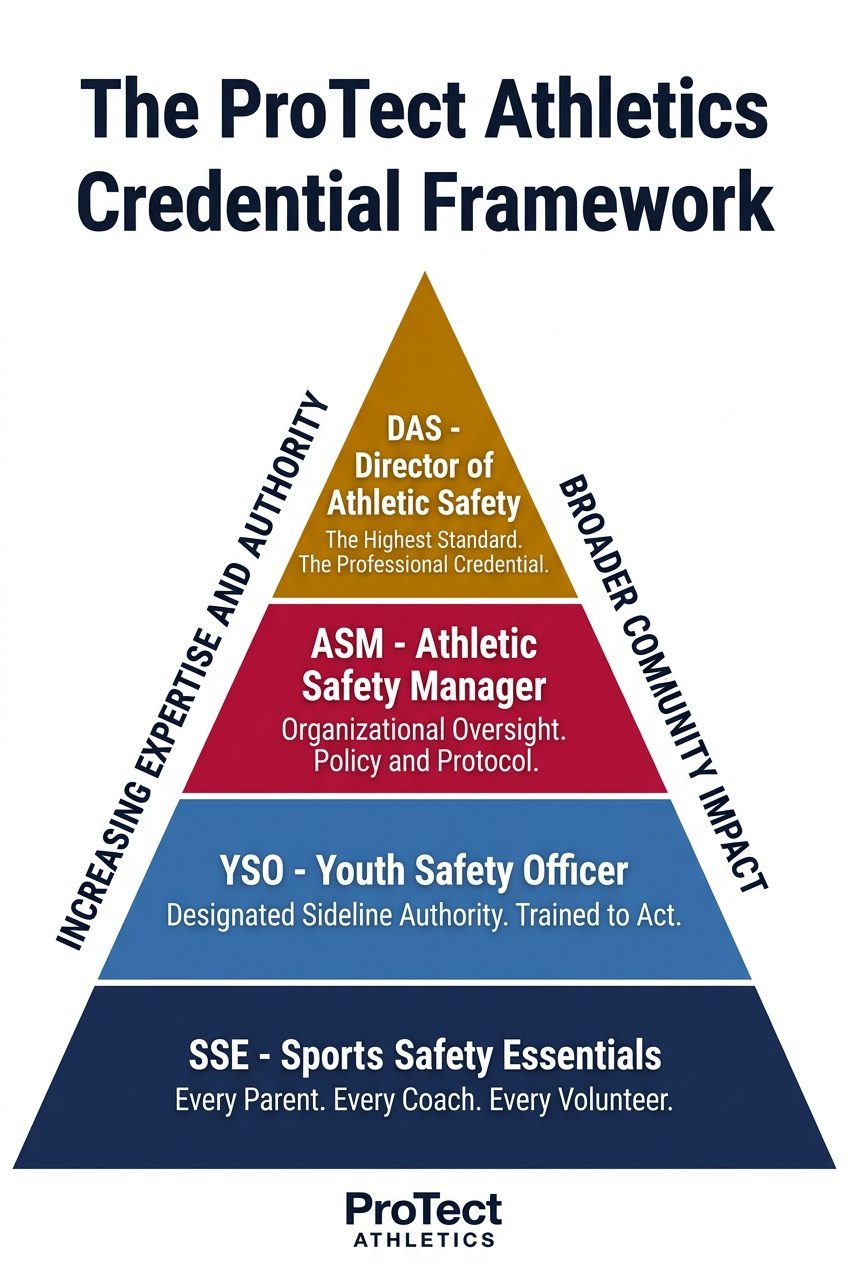
There is a version of athletic safety in this country that is aspirational. It describes what organizations could do, what programs should have, and what the ideal sideline looks like with adequate resources, trained staff, and institutional commitment. It is well-intentioned, largely unattainable for most organizations at most budget levels, and thoroughly disconnected from the reality of the tens of millions of children who are competing right now in programs that have none of those things.
Then there is the version of athletic safety that ProTect Athletics is building. The one that starts where the gap actually is, fills it with what is achievable, and constructs the professional framework that makes sustainable, legally defensible safety possible at every organizational level, from the recreational league with a volunteer coach to the large school district with a full athletic staff.
To understand how the ProTect Athletics ecosystem functions as a complete national standard, consider how higher education structures professional preparation. The four layers of our framework form a deliberate educational ladder:
- Layer 1: Sports Safety Essentials (SSE) is the High School Diploma of athletic safety. Hosted directly on the Athletic Safety Organization’s in-house Learning Management System (LMS) so it can be offered for free or near-free to every community, SSE is a state-specific statutory compliance certificate program (now built for Ohio, California, Virginia, Florida, Georgia, New York, Pennsylvania, Texas, Washington, and New Jersey) that gives every coach and volunteer verified state law and a personal pre-season playbook.
- Layer 2: Youth Safety Officer (YSO) is the Associate’s Degree level. Also hosted directly on ASO’s in-house LMS to remain free or near-free for volunteer-run leagues and schools, YSO is a nine-module frontline operational credential that places a designated, rehearsed responder on the sideline for the first five to ten minutes of a crisis.
- Layer 3: Athletic Safety Manager (ASM) is the Bachelor’s Degree level. ASM is a three-course, 90-contact-hour (9.0 CEU) operational and administrative safety management certificate program (
ASM-101,ASM-102, andASM-103, plus a monitored field practicum) that prepares the administrator managing equipment lifecycles, multi-field venues, and institutional compliance. - Layer 4: Director of Athletic Safety (DAS)℠ is the Master’s Degree level. At the apex of the framework sits the executive safety architect.
In strict alignment with national accreditation governance, ProTect Athletics maintains a clear structural firewall between certificate programs and professional certification. SSE and ASM are curriculum-based compliance and operational certificate programs. The DAS℠ is a national professional certification built to meet the accreditation standards of the National Commission for Certifying Agencies (NCCA).
The DAS℠ curriculum is structured across five comprehensive core courses followed by sport-specific specialty endorsements: Course 1 (C1): Introduction to Athletic Safety, Course 2 (C2): Got to Know It to Protect It (clinical anatomy and injury mechanics), Course 3 (C3): Biomechanics and Ergonomics, Course 4 (C4): The Why (environmental physiology, legal liability, and emergency governance), and Course 5 (C5): Making It a Profession (enterprise risk architecture, root cause analysis, and surviving policy), culminating in specialty endorsements such as Course 6 (C6): Football Equipment Safety. The NCCA is the leading framework for professional credentialing standards in the United States. It requires that the credential be developed through a rigorous, psychometrically validated process rooted in formal job task analysis conducted with working professionals in the field. It requires that the competency standards be established through that analysis rather than determined by the credentialing organization alone. It requires that the examination be independently validated against those standards. It requires that ongoing recertification requirements maintain the professional standard over time and ensure that credential holders remain current as the field evolves.
Being built on nationally recognized credentialing principles aligns DAS℠ with the same standard held by the Board of Certification for the Athletic Trainer, the credentialing body for Certified Athletic Trainers. It is the same standard held by the National Board of Medical Examiners. When a DAS℠ presents their credential to a school board, a district administrator, an insurance carrier, or a court, they are presenting something that can be evaluated against an independently verified standard, not something the issuing organization certified to itself.
That distinction matters in every context where the credential is used.
What the Director of Athletic Safety Builds
The DAS℠ is the architect of the entire safety system below them. Where a YSO executes the Emergency Action Plan, the DAS℠ wrote it and established the process by which it is reviewed, updated, and rehearsed. Where the ASM manages the equipment lifecycle and the documentation architecture, the DAS℠ built those systems, secured the organizational buy-in to sustain them, and established the accountability mechanisms that ensure they do not erode when staff turns over. Where the SSE coach completes the required compliance training, the DAS℠ designed the training pipeline, tracks the credentialing calendar, and ensures that every person in the organization with safety responsibility is current and documented.
The DAS℠ is the professional who has the knowledge to build the system, the credential to present that system with institutional authority, and the organizational position to enforce it when it is tested. Without the credential, a safety professional is a knowledgeable advocate operating on informal authority that evaporates the moment someone in the organizational hierarchy pushes back. With the credential, they are a recognized professional whose recommendations carry the weight of an independently validated standard and whose decisions in a medical situation carry the legal authority of a formally designated expert.
What It Looks Like When an Organization Gets This Right
Insurance carriers underwrite athletic organizations against risk, and the factors that determine premium rates include not just the sport and the age of the participants, but the organizational safety infrastructure. An organization that employs a safety professional credentialed under nationally recognized principles, maintains documented EAPs for every venue, operates a current equipment lifecycle management system, and deploys credentialed YSOs at every event occupies a demonstrably lower risk profile than the organizational average. Insurance carriers who are presented with that documentation are looking at a different calculation than they apply to the default program. The financial return on the DAS℠ credential is not theoretical. It is actuarial.
School boards respond to credentials they can verify independently. When a safety professional presents their qualifications to a board of education and asks for an allocated position with a defined authority and a corresponding budget, the independent psychometric standards behind the credential answer the board’s implicit question about whether this is a real professional standard or an organizational marketing device. Boards have been presented with both. The answer is in the verification.
The Non-Replacement Principle at the Executive Level
The DAS℠ credential was not designed to compete with the Certified Athletic Trainer. The ATC is a licensed healthcare professional with clinical scope of practice that the DAS℠ does not hold and does not claim. The Non-Replacement Principle that defines the YSO credential applies equally at the top of the framework. The DAS℠ is the professional who runs the safety system in organizations where a full-time ATC is not employed, which includes the overwhelming majority of youth athletic organizations in the United States. In organizations that do employ ATCs, the DAS℠ provides the administrative, policy, and organizational infrastructure that the ATC’s clinical role does not cover.
They are not competing. They are complementary. And together they constitute the complete professional safety coverage that every athlete in every program deserves.
The Director of Athletic Safety credential represents the highest level of the ProTect Athletics framework. It is designed for the professional who is not managing a single field or a single program but overseeing the safety infrastructure of a multi-venue, multi-sport enterprise: a school district, a regional governing body, a large recreational authority, or a professional organization.
The DAS℠ is built on the same psychometric and operational principles that govern professionally recognized credentialing programs nationally, including job task analysis, validated competency domains, and ongoing continuing education requirements. ProTect Athletics is committed to meeting the highest credentialing standards in the field as the program matures and scales.
The credential is not the end state. It is the professional standard that defines what qualified athletic safety leadership looks like in an era when tens of millions of children are competing with no guaranteed trained adult on the sideline. Someone has to set that standard. ProTect Athletics is setting it.
CHAPTER 20: BEYOND THE SURFACE
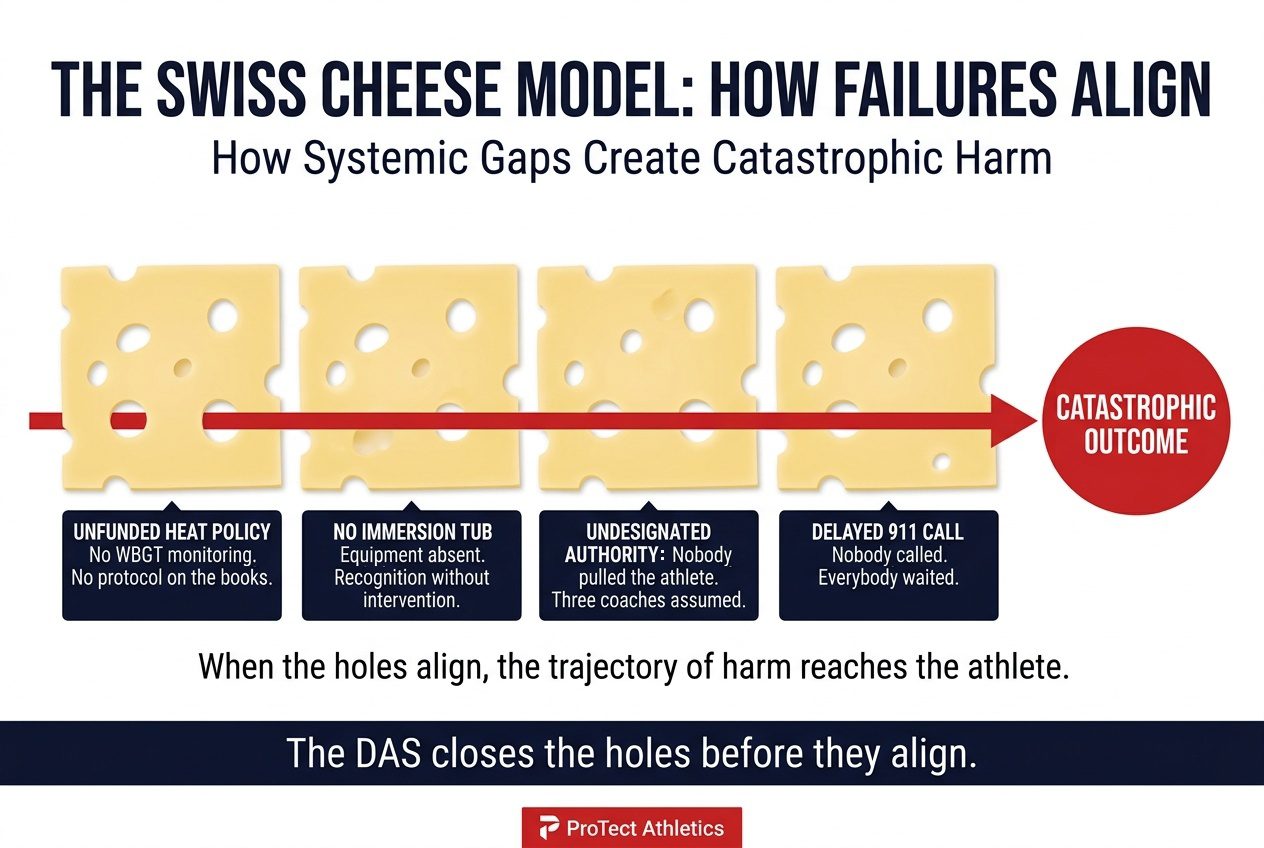
Every organization reacts to athletic injuries. The programs that build genuinely safe cultures over time are the ones that analyze them.
There is a fundamental and consequential difference between responding to an emergency and learning from it. Responding is necessary. It is urgent, it is visible, and most organizations that have invested in safety training are reasonably capable of it. Learning from the emergency is the work that follows, the structured analysis of the conditions that produced the emergency, the systemic failure beneath the surface event that made the emergency possible or inevitable. Most programs do not do this work. They respond to the emergency, document the outcome, and return to normal operations with the same underlying conditions that produced the emergency still intact and waiting.
The Director of Athletic Safety does not close the loop at incident response. They open the investigation.
The Five Whys
The structured tool for this analysis is the Five Whys, a methodology developed within the Toyota Production System and subsequently adopted by virtually every industry where system failure carries high consequences, including healthcare, aviation, and military operations. The premise is straightforward and the application is disciplined: when an adverse event occurs, the investigator does not accept the surface cause as the root cause. They ask why the surface event occurred, then ask why that answer is true, and continue asking why at each level of the response until they reach the systemic condition that is the actual point of failure. Five levels is a guideline, not a limit. The investigation continues until the answer to “why” is a condition that the organization has the power to change and has not yet changed.
Here is the Five Whys applied to a real class of athletic fatality that has occurred in programs across the country, in circumstances indistinguishable from thousands of other programs that did not have a fatality that year.
A sixteen-year-old football player collapses during the second week of summer preseason practice on a hot, humid afternoon. He dies from Exertional Heat Stroke.
Why did he die? His core body temperature exceeded 106 degrees Fahrenheit and was not reduced in time to prevent fatal organ failure.
Why was his temperature not reduced in time? The program had no cold-water immersion equipment on site. The coaching staff attempted to cool him using ice bags applied to the skin surface, which reduces core temperature at approximately one-tenth the rate of full body cold-water immersion. By the time EMS arrived and transported him to a facility with a cooling protocol, the window for survival had closed.
Why was there no cold-water immersion equipment? The athletic director had received a verbal request for a tub and ice protocol the previous spring and had declined to include it in the equipment budget. The request was not escalated and was not formally documented.
Why was the request not formally escalated? Because no one in the organization held the formal responsibility for conducting a pre-season safety readiness audit, presenting documented deficiencies to the administration in writing, and tracking whether those deficiencies were remediated before the first practice.
Why did no formal pre-season safety audit process exist? Because the organization had no credentialed safety professional whose defined role included pre-season risk assessment, formal gap identification, and structured remediation tracking. The coaching staff was responsible for running the program. Nobody was responsible for auditing the conditions under which the program ran.
The root cause of that athlete’s death is not a hot day. It is not inadequate coaching. It is an administrative vacuum: the absence of a professional with both the expertise to identify the gap before the season and the organizational authority to ensure it was closed before the first athlete set foot on the field.
Fix the root cause and every athlete who ever practices in that organization after that day is safer. Not because the coaching staff is more committed. Because the system that surrounds them has been corrected at the actual point of failure.
File an incident report, note the coaching staff on the proper procedure, and close the case, and the identical conditions are waiting, unchanged, for the next athlete in the next heat event.
Applying the Analysis
The Five Whys is not a blame tool. It is a system tool. Its purpose is not to identify a person who failed. Its purpose is to identify the organizational condition that allowed a person or a procedure to fail without correction. The vast majority of safety failures in youth athletics do not trace back to a malicious actor. They trace back to a gap in the system: a policy that was never written, a resource that was never funded, a role that was never formally assigned, an authority that was never formally granted. Those systemic gaps are invisible until the circumstances produce the event that makes them visible.
The DAS℠ learns to see the gaps before the event. The Five Whys teaches them to trace the gaps after the event and close them with precision.
Every root cause analysis produces a formal recommendation. That recommendation identifies the systemic condition, proposes the specific organizational change required to correct it, specifies who is responsible for implementing the change, and establishes a timeline and a verification mechanism. It goes to the board as a formal document. The board responds formally. The response is recorded. The correction is tracked.
This is how organizations that experience a tragedy emerge from it safer than they were before. And it is how organizations that have not yet experienced a tragedy build the system that makes some tragedies avoidable.
The Proactive Application
The DAS℠ does not wait for an adverse event to apply root cause thinking. They conduct prospective risk analysis: examining the conditions in their program systematically, identifying the gaps that have not yet produced an injury but that carry the potential to do so, and applying the same structured remediation process before the event rather than after it.
The program that has never had a heat stroke death is not necessarily a safe program. It may be a program that has not yet had the weather conditions, the practice schedule, and the athlete’s physiological state align in the way that produces the outcome. The DAS℠ who examines the program’s heat preparedness before August and identifies the absence of cold-water immersion equipment, the absence of a documented WBGT monitoring protocol, and the absence of a heat acclimatization policy is conducting prospective risk analysis. They are seeing the gap that has not yet claimed a victim and they are closing it.
That is the work that does not make the news. It is also the work that keeps names off the next law.
The Swiss Cheese Model does not explain failure after the fact. It predicts it before the fact. Every alignment of holes in the system, every untrained volunteer, every unsigned EAP, every locked AED cabinet, every coach who was never evaluated on safety compliance, is a hole in the cheese. The catastrophic event occurs when they align.
The Director of Athletic Safety reads the system before the holes align. Near-miss reporting, root cause analysis, and non-punitive safety reporting culture are not academic frameworks imported from aviation and industrial safety as an intellectual exercise. They are the operational tools that let a safety professional see the failure coming and close the gaps before a child pays for them with their life.
This is the work. Not the response. The prevention.
CHAPTER 21: WRITING SURVIVING POLICY
The ultimate test of a Director of Athletic Safety is not what happens during their tenure. The credential, the experience, the institutional knowledge, the relationships, the culture they built: all of that is real and all of it matters during the period when a credentialed, committed professional is present and engaged. But athletic organizations are not static. Personnel change. Leadership turns over. Head coaches take jobs at other programs. Athletic directors move up or move on. Board members serve their terms and rotate out. The professional who built the safety infrastructure retires.
What happens to the safety culture after they leave?
If the safety culture of an organization is inseparable from the personal commitment and individual knowledge of one person, that organization does not have a safety system. It has a dependent relationship with a human being who will eventually not be there. When that person leaves, the systems they maintained in their own files, the informal understandings they upheld through personal authority, the protocols they enforced through individual relationships, all of it is at risk. The new administrator may be equally committed, and the safety culture may survive the transition intact. Or they may be less committed, or less knowledgeable, or simply overwhelmed by the operational demands of a new role. And the safety culture that was built over years of deliberate work begins to erode the week after the last committed person cleaned out their desk.
People leave. Policies survive.
The Director of Athletic Safety builds safety into the institutional DNA of the organization: the governing documents, the employment contracts, the facility agreements, the vendor requirements, and the organizational bylaws. Not because they do not trust the people who follow them. Because they understand that institutional trust is not a safety strategy.
Surviving Policy Mechanisms
Standard operating procedures that live in the ASM’s filing cabinet are not surviving policy. They are personal systems. They will be used by the person who created them, referenced by the people who were trained on them, and quietly discarded by the administrative staff who arrive after the next leadership transition and find a binder full of protocols written by someone they never met, with no organizational mandate requiring their use.
Surviving policy lives in the organization’s governing documents and in its contractual obligations.
Bylaws are the organization’s foundational governing document. They carry a legal weight and an institutional permanence that internal memos, policy handbooks, and unwritten expectations do not. A safety requirement embedded in the organization’s bylaws cannot be quietly discarded by a new coaching staff or erased from the website by a cost-cutting administration. Changing a bylaw requires a formal organizational decision, a board vote, a recorded outcome, and in many organizations a specified supermajority or advance notice period. That procedural friction is not bureaucratic inconvenience. It is the protection that keeps a safety standard in place across leadership transitions.
The DAS℠ works to embed three categories of requirement into the organization’s bylaws: the requirement that all coaching and volunteer staff complete defined safety training as a condition of service renewal each season, the requirement that each venue at which the organization operates maintain a current, signed, venue-specific Emergency Action Plan, and the requirement that a designated, credentialed safety authority be present at every organized athletic event involving participants under a defined age. These three requirements, embedded in bylaws and enforced through the annual renewal process, function as a safety floor that persists regardless of who is leading the program in any given year.
Employment Contracts as Policy Instruments
Employment contracts are the mechanism by which safety requirements attach to individual coaching positions in a legally enforceable way. The requirement that all coaching staff complete SSE training before the first practice of their first season with the organization, with annual renewal as a condition of continued employment, should appear as a written term in the employment offer letter and the employment agreement. Not as a referenced handbook policy. As a written contract term.
When the new athletic director arrives and decides that compliance training is optional and that coaches with ten years of experience do not need to renew their certificates, the employment contract language is the response. The coaches who were hired under those terms accepted a contractual obligation. The organization that seeks to modify that obligation faces an amendment process that requires consideration of both parties, not a unilateral administrative decision. The safety standard is protected not by the good intentions of the current leadership but by the legal terms that were negotiated and executed when the coach was hired.
For volunteer positions where formal employment contracts are not typical, the equivalent instrument is a written volunteer agreement that includes the same safety training requirements as a condition of authorization to work with athletes. Volunteers who do not complete the required training are not authorized to function in their role for that season. The authorization is tied to the credential, and the credential is tracked by the safety system.
Facility Use Agreements
The Director of Athletic Safety’s reach extends beyond the organization’s own personnel to every outside entity that uses the organization’s facilities. Travel teams, tournament operators, club programs, and recreational organizations that rent athletic facilities do not always share the host organization’s safety culture. They may have lower training requirements, older equipment, absent or inadequate EAPs, and no credentialed safety personnel. When they operate on your field, their athletes are exposed to conditions the host organization does not control. When one of those athletes is injured, the legal question of whether the host organization shares liability depends in part on what the facility use agreement required.
A facility use agreement written by a DAS℠ requires, as a condition of access, proof that the outside organization maintains a current Emergency Action Plan for the specific venue they are accessing, confirmation that at least one YSO-credentialed adult will be present at every event they operate on the premises, documentation that their protective equipment meets current NOCSAE standards and is current on its reconditioning schedule, and a signed acknowledgment that the host organization’s safety standards govern all activities conducted at the facility.
Organizations that want to use the facility must meet the standard. Organizations that cannot or will not meet the standard do not get access. The DAS℠ extends their organization’s safety culture into programs they do not directly supervise by making compliance a condition of the commercial relationship. The travel team that rents your field on Saturday mornings is operating under your standards whether their own leadership would have required it or not.
The Credential as Institutional Authority
Writing surviving policy requires institutional authority. Institutional authority requires organizational credibility. Organizational credibility is built over time through demonstrated competence, but it is established initially through the credential that signals to the board, the administration, and the legal counsel that the person making these policy proposals has been validated against an independent professional standard.
A safety professional without a recognized credential who brings bylaw amendments, employment contract language, and facility use agreement requirements to a board meeting is making an argument from personal conviction. That is valuable, and in some organizational cultures it is sufficient. In many, it is not.
A DAS℠ credential holder who brings those same proposals to the same board meeting is presenting a formally credentialed professional’s recommendations. The board’s assessment shifts from “this person believes this” to “this credentialed professional, validated against an independent standard, is recommending this as the appropriate organizational response.” The policy is more likely to be adopted. And when it is adopted, the organization’s legal position is materially stronger because the policy was developed by someone whose expertise has been independently verified.
The greatest threat to institutional athletic safety is administrative turnover. The safety culture built by a committed athletic director evaporates the day that athletic director accepts a position at another district. The emergency action plan signed by the board last spring means nothing if the board that meets in the fall has no institutional memory of why it was signed.
Policy that survives is policy embedded in the foundational governance documents of the institution: the bylaws, the standing board resolutions, the employment contract evaluation criteria, and the vendor agreement standard language. Survival policy does not depend on the enthusiasm of the current administration. It survives administrations. Write it to outlast the people who wrote it.
CHAPTER 22: THE PATHWAY FORWARD
We began this book with a name. Bill Fife.
Bill was twenty-six years old. He was not a public figure. He was not an athlete. He was a young man at the beginning of everything, still at home, co-managing the family business with his brothers, with a full life in every direction he chose to look. He died in a preventable industrial chemical and confined space accident, asphyxiated by acid fumes because nobody on site had been trained, nobody had been designated as the safety authority, and nobody had been made responsible for knowing the danger before it arrived.
The knowledge that could have changed the outcome of that day existed. It was documented. It was accessible to anyone who had been given access to it. Nobody gave it to the people who needed it before they needed it. The system that existed to protect workers in exactly that situation was built on the assumption that people would seek out the knowledge, find the voluntary education resources, and self-govern their own safety. Bill’s family was doing everything they were supposed to do. The system failed them at the point where it was supposed to protect them most.
That is the injustice that drives ProTect Athletics. Not the grief alone, though the grief is real and it is personal. The injustice of a preventable death in a system that had the information to prevent it and never put that information in the hands of the people who needed it. The injustice of a structural failure dressed up as an accident.
And then, years later, the recognition of the same failure operating with the same mechanism in a completely different context.
Youth athletics. A $40 billion industry. Tens of millions of children. Coaches whose only required credential is a background check. Emergency Action Plans that list a facility address and say “Call 911.” AEDs locked in offices with keys nobody can locate. Fields where nobody knows the GPS coordinates. Events where everybody assumes somebody else is in charge and nobody is. And when the cardiac arrest happens, or the heat stroke happens, or the concussion happens, the people on the sideline are doing exactly what Bill’s family did: caring deeply, trying everything, and lacking the specific knowledge and the designated authority that could have changed the outcome.
Nobody was trained. Nobody was designated. Nobody was responsible.
The same structural failure. A different field.
You Now Have the Knowledge
You have read this book. You know what Sudden Cardiac Arrest looks like on a youth athletic field and you know that the AED must be applied within three to five minutes or the survival probability collapses to near zero. You know the difference between agonal breathing and functional respiration and you know that confusing them is a fatal error that happens on sidelines where nobody has been formally trained to recognize it.
You know that Exertional Heat Stroke requires cooling before transport, that the cold-water immersion tub is not optional equipment at an outdoor summer practice, and that “cool first, transport second” is the clinical standard that the NATA has established in its position statement and that every competent sports medicine professional in the country will cite if the case goes to litigation.
You know that Second Impact Syndrome carries a fifty percent mortality rate in adolescents (Cantu, 1998; Boden et al., 2013) and that it does not happen to athletes who stay off the field. You know that the concussed brain cannot accurately assess its own function, that “I’m fine, Coach” is not medical clearance, and that the only thing standing between a symptomatic athlete and the field should be a credentialed, designated authority with the organizational backing to hold that line regardless of the score or the circumstances.
You know that the Lystedt Law and Lindsay’s Law and the Zachary Martin Act were written by grieving families who spent years fighting for legislation that should have existed before their children were hurt. You know that those laws created compliance requirements without creating the designated, credentialed human being responsible for executing them. You know exactly where the gap is, because this entire manual is a map of it.
You know what a legally defensible Emergency Action Plan requires and how a generic organization-wide policy fails the moment a child collapses on Field 7 of a five-field complex with a locked gate and an AED that is a four-minute walk away. You know the Remove, Refer, Document protocol and why removing a step from it is how catastrophic outcomes occur. You know that NOCSAE standards govern helmet lifecycles and that NAERA reconditioning certifications are what plaintiff’s attorneys subpoena after a helmet failure. You know that WBGT monitoring is the clinical standard for heat risk management and that its absence is treated by courts as evidence of negligence.
You know that defensible documentation is not bureaucracy. It is the legal record of what your organization did when it mattered, and it is the shield between a credentialed, prepared organization and the lawsuit that follows a catastrophic event. You know that surviving policy, embedded in bylaws and employment contracts and facility use agreements, is how the safety cultures that good people build outlast the tenure of the people who built them.
The Question That Remains
The question is not one of knowledge. You have the knowledge. You had some of it before you opened this book, and you have all of it now. The question that this book cannot answer for you is the same question that every system that has ever tried to prevent a preventable death ultimately reduces to.
What are you going to do with it?
There is no neutral position in athlete safety. Inaction is a decision. The coach who does not designate a YSO has decided, whether they acknowledge it or not, that the sideline will be unprotected at the next practice. The league director who does not require venue-specific EAPs has decided that the ambulance will figure out the access route on their own when the time comes. The school board that receives a formal gap analysis identifying an absent cold-water immersion protocol and votes to defer remediation has decided to accept the liability exposure rather than address the deficiency. The parent who reads this book, sets it down, and does not ask a single question at the next registration meeting has decided that someone else will fix the problem.
Every one of those decisions is made in advance of the emergency. Every one of those decisions is waiting for a specific combination of circumstances to make its consequences visible. And when those circumstances arrive on a hot August afternoon or a routine Tuesday practice, the decisions have already been made and cannot be unmade. The athlete’s outcome is already partially determined by what the adults around them decided, or failed to decide, long before that moment.
Bill Fife was surrounded by people who cared. The people on site that day were not indifferent to his safety. They were not malicious or negligent in any ordinary sense of that word. They cared, and that care was not enough, because caring is not a protocol. Caring is not a credential. Caring does not tell you how deadly chemical and confined space hazards work, or what happens when toxic acid fumes displace breathable air and oxygen levels drop below a survivable threshold. Caring does not tell you who is designated to respond, what they are authorized to do, and where the equipment is that makes the response effective.
That is what ProTect Athletics is built to change. Not just in industrial settings, not just in agriculture, not just in the industries that OSHA does or does not reach. On the athletic field. In the recreational league. In the travel ball tournament. In the gym where a nine-year-old gymnast is absorbing eighteen times her body weight on every landing and nobody is tracking the cumulative load. In the stadium where the revenue sharing agreement was signed and the OSHA protection was not.
Everywhere that children compete, there should be a trained, designated, credentialed adult whose only job in that moment is athlete safety.
The Framework. The Pathway. The Decision.
The ProTect Athletics four-layer credential framework is complete and operational.
Layer 1, the Sports Safety Essentials (SSE) state compliance certificate program, delivered directly through the Athletic Safety Organization’s own LMS for free or near-free access, establishes the baseline statutory knowledge foundation and personal pre-season playbook that state law requires and that real preparedness demands. It is the beginning of the informed sideline, the starting point for every volunteer and every coach who chooses to be something more than a bystander with good intentions.
Layer 2, the nine-module Youth Safety Officer (YSO) credential, also delivered on ASO’s in-house LMS for free or near-free access, puts a designated, trained, credentialed safety authority on the sideline for every practice and every event. Not hoping someone steps up. Not assuming the coach will handle it. A specific person with a specific credential and a specific role in a specific, written, venue-rehearsed plan.
Layer 3, the three-course, 90-contact-hour Athletic Safety Manager (ASM) operational certificate program, scales that protection across the entire organization. The equipment systems, the venue and environmental operations, the documentation architecture, the training pipelines, the budget arguments, the gap analyses, the recorded board votes, the insurance conversations, and the facility use agreements form the administrative infrastructure that makes safety sustainable at organizational scale rather than dependent on the heroic effort of one committed person.
Layer 4, the five-course Director of Athletic Safety (DAS)℠ professional certification and its specialty endorsements, establishes the NCCA-aligned national gold standard. The certified safety executive. The root cause analyst. The policy architect. The professional who builds systems designed to outlast their own tenure and whose certification carries the institutional weight to make those systems real.
The pathway is built. The framework is complete. The knowledge is in your hands.
The choice your organization makes now is the choice that determines what happens the next time a child collapses on a field in your program. That choice is not made in the moment of the emergency. It is made in the preseason meeting, in the budget conversation, in the board vote, in the decision to name one person and give them the training and the authority to act.
Be trained. Be designated. Be responsible.
Be the answer to the question nobody wants to be asked when the sideline goes silent and everyone looks around waiting for someone to act.
And when you have taken that step, find one person who has not yet taken it. Put this book in their hands. Tell them what it costs when nobody is trained. Tell them about the system that failed Bill Fife, and the system that is failing tens of millions of children right now, and the framework that exists to change both.
The mission advances one trained adult at a time. Every one of them is a child who goes home.
Bill Fife was twenty-six years old. That is the number that has driven every decision, every protocol, every training hour that ProTect Athletics has ever built. Not abstract children. Not statistical youth. Bill. Twenty-six. Home. Family business. Preventable.
The four-layer framework exists because prevention is a system, not a person. SSE trains baseline awareness into every adult in contact with youth athletes. YSO places a trained, designated authority on every sideline. ASM builds the organizational infrastructure that makes the YSO’s authority meaningful. DAS℠ creates the professional standard that defines what qualified safety leadership looks like across an entire enterprise.
No credential eliminates risk. No protocol guarantees survival. What they do is close the gaps that currently guarantee failure. The child who collapses on a field where a trained YSO is present has a fundamentally different probability of survival than the child who collapses where no one has been designated, trained, or authorized to act.
That difference is the entire mission. Find your layer. Understand what it asks of you. Build what these children need you to build. Earn the credential. Carry the standard.
APPENDICES
APPENDIX A: MASTER REFERENCE BANK
This book is grounded in peer-reviewed research, clinical position statements, federal standards, and legislative authority from the recognized governing bodies in sports medicine, public health, and athlete safety. The sources below are organized by subject area and represent the foundational evidence base for the ProTect Athletics credentialing framework.
SUDDEN CARDIAC ARREST
- American Heart Association. (2020). 2020 American Heart Association Guidelines for Cardiopulmonary Resuscitation and Emergency Cardiovascular Care. Circulation, 142(16 Suppl 2).
- American Heart Association. (2022). Statistical Update: Heart Disease and Stroke Statistics. Circulation. (Source for the 2,000 annual youth SCA deaths estimate.)
- Drezner, J. A., Rao, A. L., Heistand, J., Bloomingdale, M. K., & Harmon, K. G. (2009). Effectiveness of emergency response planning for sudden cardiac arrest in United States high schools with automated external defibrillators. Circulation, 120(6), 518-525.
- Harmon, K. G., Asif, I. M., Klossner, D., & Drezner, J. A. (2011). Incidence of sudden cardiac death in national collegiate athletic association athletes. Circulation, 123(15), 1594-1600.
- Korey Stringer Institute. (2023). National Registry of Sudden Death in Athletes. University of Connecticut.
- National Athletic Trainers’ Association. (2012). Consensus Statement: Preventing Sudden Death in Sports. Journal of Athletic Training, 47(1), 96-118.
EXERTIONAL HEAT STROKE
- Armstrong, L. E., Casa, D. J., Millard-Stafford, M., Moran, D. S., Pyne, S. W., & Roberts, W. O. (2007). American College of Sports Medicine position stand: Exertional heat illness during training and competition. Medicine and Science in Sports and Exercise, 39(3), 556-572.
- Casa, D. J., DeMartini, J. K., Bergeron, M. F., Csillan, D., Eichner, E. R., Lopez, R. M., … & Yeargin, S. W. (2015). National Athletic Trainers’ Association position statement: Exertional heat illnesses. Journal of Athletic Training, 50(9), 986-1000. (The “cool first, transport second” standard.)
- Casa, D. J., McDermott, B. P., Lee, E. C., Yeargin, S. W., Armstrong, L. E., & Maresh, C. M. (2007). Cold water immersion: The gold standard for exertional heatstroke treatment. Exercise and Sport Sciences Reviews, 35(3), 141-149.
- Grundstein, A. J., Ramseyer, C., Zhao, F., Pesses, J. L., Akers, P., Qureshi, A., … & Petron, D. J. (2012). A retrospective analysis of American football hyperthermia deaths in the United States. International Journal of Biometeorology, 56(1), 11-20.
- Wet Bulb Globe Temperature (WBGT) thresholds for activity modification: National Athletic Trainers’ Association, American College of Sports Medicine, and National Federation of State High School Associations (NFHS). Current category thresholds for practice restriction.
TRAUMATIC BRAIN INJURY AND CONCUSSION
- Centers for Disease Control and Prevention. (2019). Heads Up: Concussion in Youth Sports: A Guide for Coaches. National Center for Injury Prevention and Control.
- Giza, C. C., & Hovda, D. A. (2014). The new neurometabolic cascade of concussion. Neurosurgery, 75(Suppl 4), S24-S33.
- Harmon, K. G., Drezner, J. A., Gammons, M., Guskiewicz, K. M., Halstead, M., Herring, S. A., … & Roberts, W. O. (2013). American Medical Society for Sports Medicine position statement: Concussion in sport. British Journal of Sports Medicine, 47(1), 15-26.
- McCrory, P., Meeuwisse, W., Dvorak, J., Aubry, M., Bailes, J., Broglio, S., … & Vos, P. E. (2017). Consensus statement on concussion in sport: The 5th international conference on concussion in sport held in Berlin, October 2016. British Journal of Sports Medicine, 51(11), 838-847.
- Omalu, B. I., DeKosky, S. T., Minster, R. L., Kamboh, M. I., Hamilton, R. L., & Wecht, C. H. (2005). Chronic traumatic encephalopathy in a National Football League player. Neurosurgery, 57(1), 128-134. (Foundational CTE research.)
- Broglio, S. P., Cantu, R. C., Gioia, G. A., Guskiewicz, K. M., Kutcher, J., Palm, M., & McLeod, T. C. V. (2014). National Athletic Trainers’ Association position statement: Management of sport concussion. Journal of Athletic Training, 49(2), 245-265.
- Cantu, R. C. (1998). Second-impact syndrome. Clinics in Sports Medicine, 17(1), 37-44. (Foundational SIS mortality and morbidity data.)
- Boden, B. P., Breit, I., Beachler, J. A., Williams, A., & Mueller, F. O. (2013). Fatalities in high school and college football players. The American Journal of Sports Medicine, 41(5), 1108-1116.
- Chrisman, S. P., Quitiquit, C., & Rivara, F. P. (2013). Qualitative study of barriers to concussive symptom reporting in high school athletics. Journal of Adolescent Health, 52(3), 330-335.
- Register-Mihalik, J. K., Guskiewicz, K. M., Valovich McLeod, T. C., Linnan, L. A., Mueller, F. O., & Marshall, S. W. (2013). Knowledge, attitude, and concussion-reporting behaviors among high school athletes: A preliminary study. Journal of Athletic Training, 48(5), 645-653.
CHRONIC OVERUSE AND YOUTH ATHLETE DEVELOPMENT
- American Academy of Pediatrics Council on Sports Medicine and Fitness. (2011). Overuse injuries, overtraining, and burnout in child and adolescent athletes. Pediatrics, 119(6), 1242-1245.
- Difiori, J. P., Benjamin, H. J., Brenner, J. S., Gregory, A., Jayanthi, N., Landry, G. L., & Luke, A. (2014). Overuse injuries and burnout in youth sports: A position statement from the American Medical Society for Sports Medicine. British Journal of Sports Medicine, 48(4), 287-288.
- Fleisig, G. S., Andrews, J. R., Cutter, G. R., Weber, A., Loftice, J., McMichael, C., … & Lyman, S. (2011). Risk of serious injury for young baseball pitchers: A 10-year prospective study. The American Journal of Sports Medicine, 39(2), 253-257. (Tommy John epidemic data.)
- USA Baseball Medical and Safety Advisory Committee / MLB. (2023). Pitch Smart: Youth and Adolescent Pitcher Guidelines. Age-appropriate pitch limits and mandatory rest day standards.
- Jayanthi, N., Pinkham, C., Dugas, L., Patrick, B., & LaBella, C. (2013). Sports specialization in young athletes: Evidence-based recommendations. Sports Health, 5(3), 251-257.
SPINAL INJURY AND FIELD MANAGEMENT
- Swartz, E. E., Boden, B. P., Courson, R. W., Decoster, L. C., Horodyski, M., Norkus, S. A., … & Waninger, K. N. (2009). National Athletic Trainers’ Association position statement: Acute management of the cervical spine-injured athlete. Journal of Athletic Training, 44(3), 306-331.
- National Spinal Cord Injury Statistical Center. (2023). Spinal Cord Injury Facts and Figures at a Glance. University of Alabama at Birmingham.
ANAPHYLAXIS
- Simons, F. E. R., Ardusso, L. R. F., Bilò, M. B., El-Gamal, Y. M., Ledford, D. K., Ring, J., … & World Allergy Organization. (2011). World Allergy Organization guidelines for the assessment and management of anaphylaxis. World Allergy Organization Journal, 4(2), 13-37.
- Lieberman, P., Nicklas, R. A., Randolph, C., Oppenheimer, J., Bernstein, D., Bernstein, J., … & Tilles, S. (2015). Anaphylaxis: A practice parameter update 2015. Annals of Allergy, Asthma and Immunology, 115(5), 341-384.
LIGHTNING SAFETY
- National Athletic Trainers’ Association. (2013). Position Statement: Lightning Safety for Athletics and Recreation. Journal of Athletic Training, 48(2), 258-270.
- National Federation of State High School Associations (NFHS). (2023). Lightning Safety Guidelines for High School Athletics. NFHS Sports Medicine Advisory Committee.
- National Lightning Safety Institute. Lightning Safety for Athletics and Recreation. www.lightningsafety.com
EQUIPMENT STANDARDS
- National Operating Committee on Standards for Athletic Equipment (NOCSAE). (2023). Standard Performance Specification for Newly Manufactured Football Helmets (ND002). NOCSAE.
- National Operating Committee on Standards for Athletic Equipment (NOCSAE). (2023). Standard Performance Specification for Reconditioned Football Helmets (ND002). NOCSAE.
- National Athletic Equipment Reconditioners Association (NAERA). Reconditioning and Certification Standards. www.naera.net
- Consumer Product Safety Commission (CPSC). (2020). Portable Soccer Goal Safety Alert. U.S. Consumer Product Safety Commission. (Portable goal fatality data.)
- ASTM International. Standard Consumer Safety Performance Specification for Portable Soccer Goals (ASTM F2673). ASTM International.
AED AND CARDIAC EMERGENCY RESPONSE
- Drezner, J. A., Courson, R. W., Roberts, W. O., Mosesso, V. N., Link, M. S., & Maron, B. J. (2007). Inter-Association Task Force recommendations on emergency preparedness and management of sudden cardiac arrest in high school and college athletic programs. Journal of Athletic Training, 42(1), 143-158.
- Occupational Safety and Health Administration (OSHA). AED Program Requirements. OSHA Standards 1910.151. (Basis for the three-to-five-minute accessibility standard.)
- Korey Stringer Institute. (2023). Secondary School Best Practices for Sudden Cardiac Arrest Prevention and Treatment. University of Connecticut.
SEVERE BLEEDING
- American College of Surgeons. (2018). Stop the Bleed: Bleeding Control for the Injured: Instructor Guide. American College of Surgeons Committee on Trauma.
- Bulger, E. M., Snyder, D., Schoelles, K., Gotschall, C., Dawson, D., Lang, E., … & McSwain, N. (2014). An evidence-based prehospital guideline for external hemorrhage control: American College of Surgeons Committee on Trauma. Prehospital Emergency Care, 18(2), 163-173.
LEGISLATIVE FRAMEWORK AND POLICY
- The Zackery Lystedt Law (Washington State ESHB 1824, codified at RCW 28A.600.190). (2009). First state youth concussion law in the United States.
- Lindsay’s Law (Ohio Revised Code §§ 3313.5310 and 3707.58). (2017). Sudden Cardiac Arrest in Youth Athletics. Named after Lindsay Davis, advocate and survivor. ORC § 3313.5310 governs interscholastic athletics; ORC § 3707.58 extends requirements to recreational, club, and travel sports organizations.
- The Zachary Martin Act (Florida Statutes Section 1006.165). Heat Illness Prevention in Scholastic Athletics.
- Nevaeh Youth Sports Safety Act (California AB 1467, codified at Cal. Health & Saf. Code § 124238.5). (2023). Youth Athletic Safety Protocols.
- Coach Safely Act (Alabama SB 53). (2018). Youth Athletic Safety Standards.
- National Conference of State Legislatures. (2023). Youth Sports Safety Legislation: 50-State Survey. NCSL Health Program.
ORGANIZATIONAL AND INSTITUTIONAL STANDARDS
- National Federation of State High School Associations (NFHS). (2023). Sports Medicine Handbook (6th ed.). NFHS.
- National Collegiate Athletic Association (NCAA). (2023). Sports Medicine Handbook: Guideline 1D: Automated External Defibrillators and Cardiopulmonary Resuscitation. NCAA.
- American Academy of Pediatrics. (2001). Policy Statement: Organized Sports for Children and Preadolescents. Pediatrics, 107(6), 1459-1462.
- National Commission for Certifying Agencies (NCCA). Standards for the Accreditation of Certification Programs (4th ed.). Institute for Credentialing Excellence.
YOUTH SPORTS PARTICIPATION DATA
- Sports & Fitness Industry Association (SFIA). (2023). 2023 Topline Participation Report. SFIA.
- Aspen Institute Project Play. (2023). State of Play 2023: Trends and Developments in Youth Sports. Aspen Institute. (Source for the estimated 45 million children under 18 participating in organized youth sports annually.)
This reference bank reflects the authoritative literature current at time of publication. The field of sports medicine and athlete safety continues to evolve. Credential holders are expected to maintain current knowledge through renewal requirements. For the living, updated reference library, access the ProTect Athletics credential portal at ProTectAthletics.org.
APPENDIX B: SIDELINE EMERGENCY ACTION PLAN (EAP)
INSTRUCTIONS: Complete one copy of this form for every venue your organization uses. Post it at the field. Distribute it to all designated role holders before each event. Review it at the pre-event safety briefing. This document is a legal record. Keep a signed copy on file.
SECTION 1: EVENT AND VENUE IDENTIFICATION
| Field | Information |
|---|---|
| Organization / League Name | |
| Sport / Event Type | |
| Facility / Park Name | |
| Specific Field, Court, or Area | |
| Street Address | |
| City, State, ZIP | |
| GPS Coordinates (for 911 dispatch) | |
| Nearest Cross Street or Landmark | |
| Gate or Entrance Number for EMS | |
| Gate Lock Code or Key Holder |
Date of Event: _________________________ Start Time: _____________ End Time: _____________
SECTION 2: DESIGNATED SAFETY ROLES
Every role must be filled before the event begins. No exceptions.
| Role | Assigned Person | Cell Phone |
|---|---|---|
| Designated Safety Officer (YSO/ASM): overall authority | ||
| Role 1: 911 Activator: calls EMS, stays on line | ||
| Role 2: AED Retriever: sprints to AED, returns immediately | ||
| Role 3: CPR Provider: begins compressions, does not stop | ||
| Role 4: Scene Controller: clears field, directs EMS in | ||
| Backup Safety Officer (if primary leaves field) |
SECTION 3: EMERGENCY EQUIPMENT LOCATIONS
Walk this route before every event. Confirm equipment is present and functional.
| Equipment | Exact Location | Confirmed (Initial) |
|---|---|---|
| Primary AED | ||
| Secondary AED (if available) | ||
| Cold-Water Immersion Tub (heat emergency) | ||
| Ice Bags / Cooling Supplies | ||
| Trauma / First Aid Kit | ||
| Spine Board / C-Collar (if available) | ||
| Epi-Pen (if athlete has known allergy) |
AED Walk Time from Field Center: _______ seconds (Must be under 3 minutes. If not, relocate AED.)
SECTION 4: EMERGENCY RESPONSE PROTOCOLS
SUDDEN CARDIAC ARREST (SCA)
- Athlete collapses or is unresponsive. Agonal breathing (gurgling, gasping) is NOT normal breathing. Act immediately.
- Role 1: Call 911 now. Give GPS coordinates. Stay on the line.
- Role 2: Sprint to AED. Return immediately. Power it on.
- Role 3: Begin CPR. 100 to 120 compressions per minute. 2 inches deep. Do not stop.
- Role 4: Clear the field. Unlock EMS gate. Meet the ambulance.
- Apply AED pads as soon as device arrives. Follow all prompts. Do not remove pads.
- Continue CPR and AED cycling until EMS assumes care.
Do not wait for symptoms to worsen. Do not wait for a parent to arrive. Act.
EXERTIONAL HEAT STROKE (EHS)
- Athlete is confused, combative, disoriented, or collapses in heat. Core temp above 104°F is a life threat.
- COOL FIRST. TRANSPORT SECOND. Do not wait for the ambulance before cooling begins.
- Role 1: Call 911. Report suspected heat stroke. Request ALS unit.
- Immerse athlete in cold-water tub immediately. If no tub: apply ice bags to neck, armpits, and groin. Drench clothing with cold water.
- Role 4: Fan the athlete aggressively while cooling continues.
- Do not give fluids by mouth to a confused athlete.
- Continue cooling until EMS arrives. Report cooling start time to EMS.
Cold-Water Tub Location: _________________________________ Ice Bag Location: _________________________________
TRAUMATIC BRAIN INJURY / CONCUSSION
- Athlete shows any sign: headache, confusion, dizziness, nausea, visual changes, or loss of consciousness.
- Remove athlete from play immediately. No discussion. No exceptions.
- The athlete does not return to play that day. Not for the last play. Not for the championship.
- Do not leave the athlete alone. Monitor for deteriorating condition.
- If athlete loses consciousness or symptoms worsen: call 911. Treat as spinal injury until ruled out. Do not move without EMS.
- Notify parent or guardian. Provide written concussion documentation.
- Return to play requires written clearance from a licensed physician or certified athletic trainer.
Return-to-Play Form Location: _________________________________
LIGHTNING / SEVERE WEATHER
- Flash-to-Bang: count seconds from lightning flash to thunder. Divide by 5 = miles.
- 30 seconds or less (6 miles or closer): Suspend all outdoor activity immediately.
- Move all participants to a substantial building or hard-topped vehicle. Do not use open tents, dugouts, or bleachers.
- Wait 30 minutes after the last observed flash of lightning or sound of thunder before resuming any activity.
- If an athlete is struck: call 911 immediately. Lightning strike victims do not carry a charge. Begin CPR if pulseless.
Nearest Shelter Location: _________________________________ Distance from Field: _________________________________
SECTION 5: EMERGENCY CONTACTS
| Contact | Name | Phone |
|---|---|---|
| EMS / Dispatch | 911 | 911 |
| Nearest Hospital (with trauma/cardiac care) | ||
| Athletic Director | ||
| League / Organization Director | ||
| Facility Manager | ||
| Poison Control (if needed) | 1-800-222-1222 | 1-800-222-1222 |
SECTION 6: POST-INCIDENT DOCUMENTATION
Any activation of this EAP must be documented within 24 hours.
| Item | Details |
|---|---|
| Date and Time of Incident | |
| Nature of Emergency | |
| Athlete Name | |
| Actions Taken and Sequence | |
| EMS Responded (Y/N) | |
| Hospital Transported To | |
| Witnesses Present | |
| Report Filed With |
ACKNOWLEDGMENT AND SIGNATURE
By signing below, I confirm that I have reviewed this Emergency Action Plan, I understand my assigned role, I know the location of all emergency equipment, and I am prepared to execute this plan.
| Name (Print) | Role | Signature | Date |
|---|---|---|---|
| Designated Safety Officer | |||
| 911 Activator | |||
| AED Retriever | |||
| CPR Provider | |||
| Scene Controller |
This EAP was reviewed and approved by: _________________________________ Date: _____________
Next review date: _____________ (Review before each season and whenever venue, personnel, or equipment changes.)
ProTect Athletics recommends retaining signed EAP records for a minimum of seven years. Consult your organization’s legal counsel for jurisdiction-specific retention requirements.
APPENDIX C: THE LEGISLATIVE CASE
Note: The following appendix is a standalone legislative policy document intended for distribution to state legislators, legislative staff, and governing body administrators. It is included here for reference and organizational completeness. It is not a chapter of The Illusion of Safety and is not directed at the general reader. When used for legislative advocacy purposes, this section should be extracted and distributed as a separate document.
This appendix is written for state legislators, legislative staff, governing body administrators, and organizational policy directors. It is a direct statement of what ProTect Athletics is building, why state mandate legislation is the right policy response, and what that legislation looks like in practice.
The Problem in One Paragraph
Youth athletics is a $40 billion industry operating with the safety standards of an unregulated hobby. Federal OSHA has no jurisdiction over youth athletes at any level. The laws that do exist, the Lystedt Law, Lindsay’s Law, the Zachary Martin Act, apply primarily to school-based sports and leave recreational leagues, travel programs, and the tens of millions of children in organized youth sports largely without a safety floor. No credential is required to coach children. No Emergency Action Plan is required to operate a tournament. No trained, designated adult is required to be present on any recreational sideline in most states in this country. The result is measured in the American Heart Association’s estimate of 2,000 young Americans under twenty-five lost to sudden cardiac arrest annually, alongside preventable exertional heat stroke deaths and catastrophic brain injuries on fields where nobody was designated to act.
Why the Current Model Fails
Every safety law this country has passed for youth athletics has followed the same reactive model: a child dies, a family grieves publicly, a legislator responds, and a law is named for the child who should still be alive.
The Lystedt Law exists because Zackery Lystedt suffered a catastrophic brain injury and his family spent years fighting for a law that should have existed before his injury.
Lindsay’s Law exists because Lindsay Davis was diagnosed at seventeen with a heart condition that ended her career as a competitive ballerina, and she spent years fighting to ensure that other young athletes would receive the awareness and protection she never had before her diagnosis.
The Zachary Martin Act exists because Zachary Martin died of Exertional Heat Stroke and his death was preventable.
These laws are important. They have saved lives. And every one of them is a monument to a reactive model that waits for a child to be harmed before the system moves.
ProTect Athletics is building the proactive model. The credential infrastructure, the education pipeline, the designated authority on the sideline before the emergency arrives, not after. The question for every legislature in this country is whether your state will act before or after the name goes on the next law.
The Blueprint That Works
Every successful youth sports safety mandate passed in the United States followed the same four-step framework. ProTect Athletics has studied each one.
Step 1: A Story. Legislation moves because a legislator can attach a human cost to a vote. The data is necessary. The story is what moves the bill. ProTect Athletics carries Bill Fife’s story, and the stories of every family that has lived through a preventable athletic tragedy, into every legislative conversation.
Step 2: A Clinical Coalition. The Lystedt Law required Dr. Stanley Herring to stand beside the Lystedt family and provide independent scientific authority. ProTect Athletics has that clinical foundation: credentialed researchers, peer-reviewed publications, and established partnerships with institutions including the Virginia Concussion Initiative, a statewide program built in direct partnership with the Virginia Department of Health.
Step 3: Simple, Non-Negotiable Pillars. The most effective safety mandates are narrow, specific, and actionable. They do not require new bureaucracies. They attach to existing compliance infrastructure: annual registration processes, facility permitting, insurance requirements. ProTect Athletics is not asking states to build a new agency. We are asking states to require that the credential infrastructure we have already built be the floor of participation.
Step 4: Remove Every Objection Before It Is Made. The objection that has killed more youth sports safety bills than any other is the volunteer pool argument: “If you mandate training, we will lose volunteers and shut down programs.” ProTect Athletics has eliminated this objection by design. Because the Sports Safety Essentials (SSE) state compliance certificate program and the Youth Safety Officer (YSO) volunteer credential are hosted and delivered directly on the Athletic Safety Organization’s own Learning Management System (LMS), supported by grant initiatives and organizational partnerships, both are offered for free or near-free to coaches and volunteers. Owning our LMS eliminates third-party academic markups, removes the financial barrier, and creates zero budget impact on the state. The credential costs the volunteer little to nothing beyond a few hours of training that may save a child’s life.
What the Mandate Looks Like
A ProTect Athletics mandate is structured to be as narrow and implementable as possible.
The core requirement: any organized athletic program operating with youth athletes must have at minimum one designated individual per event who holds a current YSO credential or equivalent, and must operate under a venue-specific Emergency Action Plan reviewed and signed by that credential holder annually.
What this does not require: a Certified Athletic Trainer at every event. A medical professional on every sideline. New state employees or new state agencies. Any state budget appropriation.
What it does require: one trained, designated adult per event who knows what to do in the first ten minutes of a cardiac arrest, an Exertional Heat Stroke event, or a traumatic brain injury, and who has signed their name to a plan that puts that knowledge into action on a specific field at a specific address before the event begins.
Hosted on ASO’s own LMS, the credential is offered for free or near-free. The training takes only a few hours. The difference it makes is the difference between five minutes of effective response and five minutes of paralysis.
The Ask
ProTect Athletics invites every state legislature to be the state that acts before the next name goes on the next law.
We have the curriculum. We have the credential infrastructure. We have the clinical coalition. We have the story. We have the draft language.
We are ready to work with any state that is ready to stop being reactive.
Contact: ProTectAthletics.org | jerry@protectathletics.org
