
 Written by
We often view youth sports and clubs through the lens of “keeping kids busy.” While true, the deeper reality is that these organizations—4-H, Scouting, and youth athletics—serve as the primary training grounds for the professional and personal “grit” required in adulthood. They are not merely extracurriculars; they are laboratories for human development where the “dry run” of life takes place.
The Great Equalizer: Opportunity for All Walks of Life
Perhaps the most vital aspect of these organizations is that they are designed to be the “Great Equalizer.” In a world where elite specialized camps and private tutoring can cost a fortune, 4-H, Scouting, and community youth sports provide a high-level development path that is accessible to everyone, regardless of their zip code or bank account.
These programs are built on the belief that leadership shouldn’t be a luxury item. They offer a seat at the table to any child willing to put in the work. Whether a kid is coming from an urban center or a rural farm, the “Living Laboratory” is open to them. For many, these organizations aren’t just a choice; they are the only accessible bridge to the skills—public speaking, financial literacy, and strategic thinking—that the professional world demands.
The Power of the Collective: Fundraising and Service
At the heart of this accessibility is a profound lesson in communal stewardship. Unlike “pay-to-play” models that exclude those without means, these clubs often operate on a model of collective fundraising and community service.
When a 4-H club or a scout troop engages in a car wash, a bake sale, or a community service project, they aren’t just raising money for a trip or a new set of targets for Shooting Sports; they are learning that the group provides for its own. This “whole group” funding model ensures that no child is left behind because of a lack of personal resources. It teaches the youth that their labor has value and that when they work together, they can provide opportunities for those who cannot provide for themselves. This is the first time many young people realize that they have the power to change someone else’s circumstances through their own effort.
The Insider’s Language: Fidelity to the Mantra
To an observer, a 4-H livestock ring, a Boy Scout merit badge ceremony, or a youth basketball huddle might look like simple hobbies. But for those within the fold, these are cultures built on a foundation of high-stakes accountability and a “fidelity” to a specific code of conduct.
In 4-H, the mantra “To Make the Best Better” is a relentless operating system. To a member, it is a mandate for continuous iteration. Whether a ten-year-old is refining the genetics of a breeding project or a teenager is perfecting a public presentation, they are learning that excellence is a moving target.
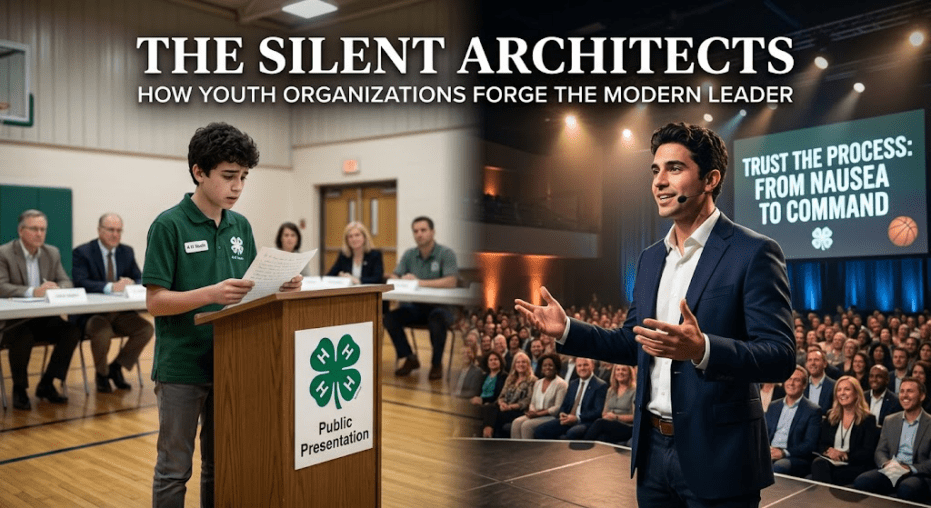
The Evolution of the Voice: From Nausea to Command
The transition from a hesitant adolescent to a confident adult requires a “crucible”—a high-stakes environment where the consequences are real, but the safety net remains intact.
Every seasoned 4-H or Scout leader remembers their first “Public Presentation.” It is a visceral memory. You stand there, gripping a poster board with white knuckles, feeling the very real sensation that you might either vomit or soil yourself right there in front of the judges. Your voice cracks, your knees shake, and the room feels a thousand degrees hot.
But because you are forced to do it again, and then again, that fear begins to calcify into competence. Years later, that same kid stands in front of a crowd of thousands, or a boardroom of executives, and speaks to them with the casual ease of a friend at a kitchen table.
The Precision of the Range and the Court
This same fidelity exists in the subcultures of 4-H Shooting Sports and Youth Basketball.
- In Shooting Sports: A young person learns that safety and precision are non-negotiable. There is no “close enough” on a firing line. It requires a level of discipline, breath control, and emotional regulation that most adults struggle to maintain under pressure.
- On the Basketball Court: The mantra is often “Next Play.” We have all seen the kid who misses the free throw that would have tied the game. That walk back to the locker room is the quietest, heaviest walk a young person can take. However, that failure is exactly why, years later, that same player becomes the one the team wants taking the last shot. They want the person who has felt the sting and didn’t quit.
Junior Leadership: The Corporate Boardroom of Youth
While many see the “Head, Heart, Hands, and Health” as a pledge for children, 4-H Junior Leadership is where those words become a professional reality. Junior Leaders don’t just participate; they facilitate.
When a teenager is tasked with running a meeting using Parliamentary Procedure, managing a budget for an event, or mentoring younger members, they are undergoing executive training. They are learning situational authority—the ability to synthesize chaos into a calm, actionable plan.
The “Unseen” Education: The Gap of the Uninitiated
There is a profound disconnect between those who have participated in these organizations and those who have merely observed them. To the casual observer, 4-H looks like a blue ribbon; youth basketball looks like a trophy. But for the person who has been through the fire, those symbols are merely the visible 10% of a much larger iceberg.
Unless you have stood in that livestock ring, or on that free-throw line, or at that podium with your heart hammering, you cannot truly understand the fidelity of the experience. This creates a unique “shorthand” among those who have been through it. When two former members meet professionally, there is an immediate, unspoken understanding: they know the other person can handle public critique, manage high-stakes failure, and maintain fidelity to a process even when no one is watching.
Conclusion: Trust the Process
To quote many legendary coaches, the secret to this transformation is to simply “trust the process.” The process is designed to be difficult because the difficulty is the point. When you see an adult who can handle a crisis with a smile or deliver a keynote speech without a stutter, you aren’t looking at “natural talent.” You are looking at someone who once felt like they were going to lose their lunch in a middle school cafeteria, but chose to stay at the podium anyway.
They are the ones who have been tested in the “living laboratory” of youth organizations. They know that unless you’ve been in the arena, you can’t truly understand the cost of the win—or the immense value of the man or woman standing before you today.
Call to Action: Pay It Forward
These organizations thrive on the very community service they teach. If you were a beneficiary of these “Silent Architects,” consider how you can support the next generation.
- Volunteer: Your professional experience is the “Expert Judging” the next generation needs.
- Donate: Support the group funds that ensure no child is sidelined by cost.
- Advocate: Ensure your local schools and communities prioritize these “living laboratories.”
