 Written by
 A new study of nearly 20,000 former NFL players just dropped a statistical hammer on the sports world.
The findings are not just concerning. They are an indictment of our safety models. NFL players are dying of neurodegenerative diseases. Specifically, dementia, ALS, and Parkinson’s disease. They are dying at a rate three to four times higher than the general population. This is not a statistical anomaly; it is a systemic slaughter. These are men who entertained millions, now stripped of their memories, their motor functions, and their dignity, dying in the shadows of the game they built.
Experts from Mass General Brigham and Boston University call this the clearest population-level evidence to date. Football is linked to a massive increase in neurological death. The researchers compared this fourfold increase in dementia to the dangers of heavy lead exposure. Let that sink in. We are talking about a neurological toxicant level of danger, normalized as a Friday night pastime.
We have reached the point where the data is indisputable. What is the industry’s response?
For years, the default reaction has been exactly the same. We tweak a concussion protocol. We slap a 5-star rating on a new helmet design. We mandate a brief online awareness video for volunteer coaches. We rely on the Illusion of Armor. We pretend that writing an administrative rule or bolting extra padding onto a polycarbonate shell automatically equates to safety.
This latest study proves the illusion is failing.
The Biomechanics of the Illusion
Players who spent five or more seasons in the NFL had nearly double the risk of neurodegenerative death compared to those who played fewer seasons. The risk compounds with exposure.
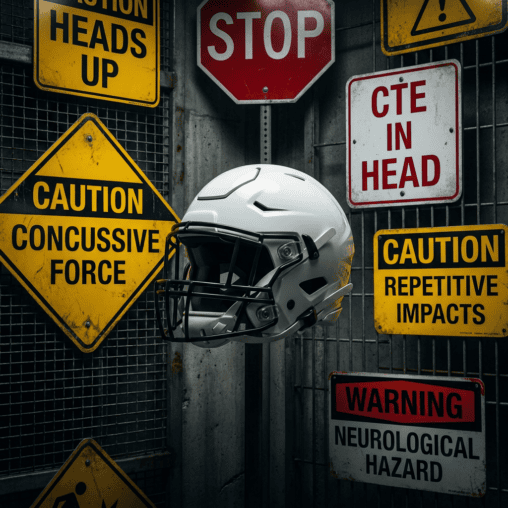
We spend millions of dollars engineering better helmets, but no helmet can defeat physics. Modern helmets are excellent at preventing acute skull fractures from linear impacts. But CTE and neurodegenerative diseases are largely driven by rotational acceleration. When a player takes a high-velocity hit, the skull stops, but the brain’s internal momentum continues. The brain literally twists, stretches, and shears inside the cranial vault. Microtubules snap. Tau proteins begin to clump. A degenerative cascade is triggered that no doctor can reverse. No amount of external padding, no high-tech polycarbonate shell, and no 5-star rating changes that internal, catastrophic biomechanical reality.
“The mechanism ends at the body. The root cause begins with the system.”
When manufacturers weaponize independent lab ratings as marketing leverage, it creates a catastrophic false sense of security. It emboldens athletes to take greater risks because they believe the hardware makes them invincible. This is risk compensation in real time. We are trusting engineered cushions to solve a clinical reality.
The Vulnerability of the Developing Brain
The danger does not begin at the professional level. It begins the moment a child straps on a helmet.
Research from the Boston University CTE Center explicitly tracks the Age of First Exposure (AFE). Their findings are chilling. Starting tackle football before age 12 accelerates the onset of cognitive, behavioral, and mood symptoms by an average of 13 years.
The reasoning is rooted in neurobiology. The brain undergoes rapid, critical maturation between the ages of 9 and 12. This is a peak period for myelination and the development of the brain’s white matter tracts. During a single season, a youth football player can sustain hundreds of subconcussive impacts. Each hit is a micro-trauma. While parents cheer from the bleachers, silent, unseen cellular damage is accumulating. For every year a child takes these repetitive head impacts during this critical developmental window, their brain loses resiliency. The timeline for neurological decline drastically accelerates. We are borrowing against their cognitive future to fund their athletic present.
Yet, at the youth, high school, and collegiate levels, we treat the management of this exposure as an administrative afterthought. We hand out waivers, cross our fingers, and look the other way.
The Legislative Gap: Return vs. Removal
State legislatures love to pass “Return-to-Play” laws. They mandate that a concussed athlete cannot return to the field without written clearance from a licensed healthcare provider. That looks great on paper. But it ignores the most critical point of failure: Who stops the play?
Return-to-play protocols govern the clinical aftermath. But the hazard occurs during live action. State laws are entirely silent on the credential of the person responsible for identifying the warning signs and executing the removal decision in the heat of a game. We have created a system that demands a doctor to clear a child to play on Monday, but relies on a volunteer parent to pull them out of the game on Friday night. The legislative framework is reactive, not preventative.
The Industrial Standard vs. The Athletic Standard
Imagine a factory floor with a known, severe hazard. A hazard that researchers explicitly compare to heavy lead exposure. How would the industrial sector respond?
OSHA standard 29 CFR 1926.32(f) legally requires a “Competent Person” on site. OSHA defines this as someone who is capable of identifying existing and predictable hazards, and who has the explicit authorization to take prompt corrective measures to eliminate them.
They do not hand a foreman a PDF awareness pamphlet and hope for the best. They do not assume an overworked equipment manager can suddenly shoulder the burden of clinical medical liability. They require a designated, credentialed professional. That professional has one mandate: hazard recognition, risk mitigation, and emergency action. If an industrial site fails this standard, they are shut down and fined into oblivion. Yet on the football field, a catastrophic failure is dismissed as an unfortunate “part of the game.”
We have laws for the workplace. We have protocols for hazardous environments. What we do not have is an equivalent standard for the 45 million athletes stepping onto our fields and courts every year. We are asking athletic directors, equipment managers, and volunteer coaches to manage complex clinical liabilities without the proper training or authority.
The DAS: A Credentialed Solution
The narrative that CTE is an acceptable hazard of the game is dead. The narrative that a signed liability waiver or an online certificate solves the problem is dead.
If we expose our athletes to a hazardous environment, we owe them an industrial-grade safety architecture. This is exactly why ProTect Athletics developed the Director of Athletic Safety (DAS) credential.
The DAS serves as the “Competent Person” for the athletic environment. They are trained in biomechanics, systemic risk management, and emergency protocol execution. They do not just hold a binder of emergency action plans; they drill them. They possess the clinical understanding to see through the illusion of armor and the authority to intervene.
We demand trained coaches. We demand certified equipment. We must demand credentialed professionals on the sideline.
The current system is broken. We cannot continue hiding behind the illusion of safety. We must professionalize the safety roles within our programs. We must build the credentialed infrastructure our athletes deserve.
The time for awareness is over. It is time for accountability.
References
Daneshvar, D. H., et al. (2026). Neurodegenerative disease mortality among former professional American football players. eClinicalMedicine, Published July 8, 2026. Mass General Brigham, Boston University, Concussion & CTE Foundation.
Alosco, M. L., et al. (2018). Age of First Exposure to Tackle Football and Later-Life Neurological Symptoms. Boston University CTE Center / VA-BU-CLF UNITE Brain Bank.
Occupational Safety and Health Administration (OSHA). 29 CFR 1926.32(f). Competent person definition.
To learn more about building your organization’s safety culture and the Director of Athletic Safety (DAS) credential, visit protectathletics.org.
