 Written by
 In athletic departments across the nation, “Safety” is often treated as a seasonal transaction. We verify the line items, purchase the five-star rated helmets, invest in the latest supplemental impact caps, and consider the box checked. There is a comforting, yet dangerous, assumption that because the invoice is paid, the athletes are protected.
However, a critical gap exists between buying safety and managing safety. One is a financial event; the other is a rigorous Methodology. To understand where your program truly stands on this spectrum, we invite you to take the following 60-second diagnostic.
The Athletic Safety Culture Audit
Does your program have a sustainable plan, or simply a collection of gear?
- The Consistency Test: After the initial equipment handout, how often is a student-athlete’s helmet and shoulder pad fit-tested by a trained professional?
- A. Only if an athlete complains or gear breaks.
- B. Once mid-season.
- C. Weekly or bi-weekly as part of a formal, recurring protocol.
- The “Add-On” Logic: When using supplemental impact technology (such as Guardian Caps), is there a written policy detailing how these affect the manufacturer’s warranty and NOCSAE certification?
- A. No; we assume more padding is inherently better.
- B. We have discussed it, but nothing is formal or in writing.
- C. Yes; we maintain an Integrated Safety System policy to manage modular risks.
- The Administrative Gap: Who is the single point of contact responsible for tracking equipment high-cycle fatigue, reconditioning cycles, and safety-related task statements?
- A. The Head Coach.
- B. The Athletic Director.
- C. A designated Director of Athletic Safety (DAS) or safety-specific lead.
- The Emergency Standard: During a heat-related event, what specific Methodology triggers automatic practice modifications?
- A. We rely on “perceived exertion” or standard thermometers.
- B. We check a weather app on a smartphone.
- C. We utilize on-site Wet Bulb Globe Temperature (WBGT) devices with pre-set work-to-rest ratios.
- The Documentation Trail: Is there a digital or physical log tracking every fit test, equipment adjustment, and heat-index modification made during the season?
- A. No; we trust the athletes to report issues.
- B. We keep general notes, but no individual, serialized logs.
- C. Yes; we maintain a comprehensive, defensible safety record for every athlete.
Analyzing the Results: The “Checklist” Trap
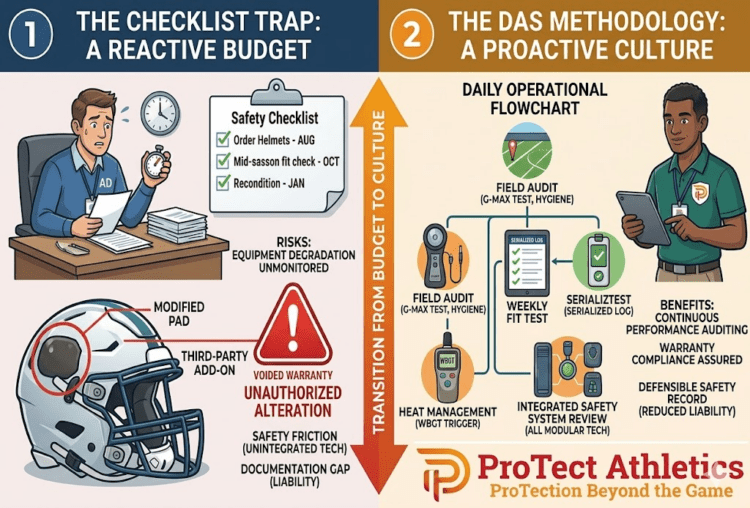
If your audit answers were primarily A or B, your program is likely caught in the “Checklist Trap.” This is a state of administrative complacency where safety is viewed as a destination reached during the preseason rather than a moving target that requires daily recalibration.
The Illusion of “New”
The Checklist Trap relies on the false security of the purchase order. There is a common belief that a “new” helmet is a “safe” helmet. In reality, a helmet’s safety profile begins to degrade the moment an athlete begins a high-impact practice. Without a recurring Methodology, you are managing a fleet of equipment that is functionally different in November than it was in August.
The Risk of “Safety Friction” and Voided Warranties
When a program operates without a Director of Athletic Safety, they often fall victim to “Safety Friction.” This occurs when well-intentioned staff add layers of protection—such as supplemental impact caps or specialized chin straps—without proper training or oversight.
The consequences go beyond physics:
- The Warranty Trap: Most major helmet manufacturers explicitly state that third-party alterations or “add-ons” can void the equipment warranty.
- The Certification Crisis: Modifying a helmet without following the Integrated Safety System can negate its NOCSAE certification. This leaves the school or organization solely liable for any equipment-related injuries.
- The Rotational Risk: Adding weight or changing the surface friction of a helmet can inadvertently increase rotational force on the neck. Without a professional overseeing these modifications, a “safety solution” becomes a legal and physical liability.
Liability and the “Paper Trail”
Perhaps the most dangerous element of the Checklist Trap is the lack of a defensible record. In the event of a catastrophic injury, a “Mostly A” program relies on the defense of standard practice (e.g., “We did what everyone else does”).
A Director of Athletic Safety, however, relies on the defense of documented precision.
- Reactive: “The helmet was fitted in August; we assumed it was still correct.”
- Proactive: “This athlete’s helmet was fit-tested on Tuesday, October 14th, at 3:15 PM, and verified against the manufacturer’s 5-point checklist.”
The Safety Ecosystem: Beyond the Helmet
A true Safety Culture recognizes that protection is not siloed. It is an interconnected ecosystem where a single failure point compromises the entire structure.
- The Interface: Safety is defined by how the helmet interacts with the torso. Poorly fitted shoulder pads can restrict a helmet’s range of motion, contributing to neck injuries or nerve damage.
- The Surface: A helmet’s safety rating is validated against a controlled surface. If a natural grass field is as hard as concrete or a synthetic turf field has lost its shock absorption (G-max rating), the equipment’s effectiveness is neutralized.
- The Hygiene: Biological risks are safety risks. MRSA and Staph outbreaks can sideline a team faster than concussions. A professionalized culture manages sanitation protocols with the same rigor as equipment fitting.
From “Fit” to “Function”
We must transition to viewing athletic equipment as Personal Protective Equipment (PPE). Much like a respirator in an industrial setting requires a specialized “fit test” to be legal and effective, a football helmet requires constant auditing. Air bladders leak, padding compresses, and chinstraps stretch. Without a recurring fit-test protocol, a top-tier helmet eventually becomes little more than a plastic shell.
The Solution: The Director of Athletic Safety (DAS)
The reality of modern sports is that Athletic Directors are overextended. They are not—and should not be expected to be—experts in NOCSAE standards, turf science, or thermal regulation.
This is why ProTect Athletics is pioneering the Director of Athletic Safety (DAS) credential. We are moving away from the “part-time worry” model toward a professionalized, national standard. A DAS doesn’t just buy gear; they own the Methodology. They ensure standardized fit-testing, strict heat management, field safety audits, and a defensible, transparent documentation trail.
The Bottom Line: A budget buys you equipment; a Director of Athletic Safety buys you a culture of protection and reduced liability. It is time to stop asking “What gear should we buy?” and start asking “Who is managing our culture?”
References
- NOCSAE (National Operating Committee on Standards for Athletic Equipment). Standard Performance Specification for Newly Manufactured Football Helmets. ND002.
- Korey Stringer Institute (University of Connecticut). Wet Bulb Globe Temperature Monitoring and Exertional Heat Stroke Prevention Protocols.
- National Athletic Trainers’ Association (NATA). Position Statement: Management of the Athlete with a Suspected Spinal Injury. (For Interface and Helmet-Shoulder Pad interaction).
- ASTM International. Standard Test Method for Impact Attenuation of Playing Surface Systems and Materials (G-max Testing). ASTM F1936.
