 Written by
 The human body is designed to adapt. It responds to load. It gets stronger under stress. This is not a coaching philosophy or an opinion; it is the fundamental law of biomechanics.
We seem to have forgotten this. In our rush to protect athletes and workers, we try to engineer the stress away. We build bigger cushions. We design stiffer braces. We wrap people in external armor and call it safety.
The result is not safety. The result is weakness.
By outsourcing the work of muscles, ligaments, and tendons to plastic and foam, we are dismantling the body’s internal defenses. We are breeding structural failure. The evidence is on every field and in every warehouse in the country.
The Shoe and the Achilles
Look at the modern athletic shoe. The market is dominated by maximalist, high-stack footwear. The foam is incredibly thick. The rocker bottoms are highly engineered. The shoe is designed to absorb every ounce of shock.
That is exactly the problem. When the shoe does the work of the ankle, the calf and the Achilles complex are bypassed. They no longer receive the ground contact feedback they need. They are starved of the mechanical stress required to stay strong. Over time, the natural “spring” mechanism deconditions.
Then a sudden, high-velocity load hits. It strikes the vascular watershed region of the tendon. The compromised structure cannot handle it. It snaps. The highly cushioned shoe did not protect the tendon. It guaranteed its fatigue failure.
The Rigid Work Boot
This forced immobilization does not stop at the ankle. We see the exact same failure on construction sites. Heavy-duty work boots feature rigid midsoles and aggressive arch support. The goal is to protect against crush injuries. The reality is forced immobility.
The rigid sole prevents normal foot flexion. It inhibits the natural tensioning of the plantar fascia. The intrinsic muscles of the foot become lazy and atrophy from underuse. The thick soles severely diminish proprioception from the ground to the nervous system.
Reduced sensory input leads to decreased postural stability. The worker is ironically at a higher risk of slips, trips, and falls. When they finally take the boots off, their weakened foot muscles cannot handle natural stress.
The Fatigue Mat Band-Aid
Even when the footwear is not the primary issue, the ground surface often is. Walk onto any factory floor, retail line, or barber shop, and you will see workers standing on anti-fatigue mats. The intention is to relieve the strain of static standing. The reality is often accelerated musculoskeletal breakdown.
When a mat is too plush or soft, it creates a “sand effect.” The surface becomes excessively unstable. The body is forced into a constant balancing act. The stabilizing muscles in the ankles, knees, hips, and lower back are overworked just to maintain an upright posture.
Worse, the mat acts as a systemic band-aid. It creates a false sense of security for employers. They assume the mat solves the problem of prolonged standing. They ignore the true root causes. They fail to implement actual ergonomic solutions like varying work tasks or providing opportunities for active movement.
The Prophylactic Knee Brace
When the foot and ankle are compromised by shoes and surfaces, the knee is forced to absorb the excess load. In athletics, we try to solve this by bolting armor directly onto the joint. Rigid, hinged knee braces are worn by healthy athletes in football and skiing.
Many argue that the “big guys”—the linemen—absolutely need these braces due to the sheer mass and lateral forces in the trenches. This is a biomechanical misunderstanding. You cannot cheat physics.
When a 300-pound athlete gets rolled up on, the kinetic energy is massive. The brace acts as a rigid lever. It cannot make the force vanish. It just shifts the fulcrum. Instead of the knee taking the hit, the force transfers down the path of least resistance to the ankle, or up to the hip. We do not prevent the injury. We just move it to a joint not built to take that specific load.
Worse, it creates massive muscle dependency. By wearing these hinges every day at practice, the body stops doing the work. The nervous system stops sensing position and firing muscles to stabilize the joint. The medial and lateral stabilizers get lazy. Neuromuscular response times slow down. The athlete develops a false sense of invincibility. When a real, awkward load hits on the field, their natural muscular defense mechanism is asleep. The brace gives them permission to put their body in positions it is not internally prepared to handle.
The Back Belt Illusion
When the lower body fails to provide a stable base, workers instinctively reach for external support for the core. Warehouses are full of workers wearing heavy back belts. The intention is lumbar support. The reality is muscle atrophy.
A back belt provides artificial mechanical compression. It does the job meant for the deep abdominal and paraspinal stabilizers. When the belt carries the load, the core shuts off. Prolonged use leads directly to a weakened foundation.
The National Institute for Occupational Safety and Health does not recommend back belts for healthy workers. The belts create a dangerous false sense of security. A worker lifts a heavier load. They use poorer mechanics. They rely completely on an external crutch while their internal stabilizers rot away.
The Vibration Glove Paradox
This reliance on external bracing extends from the core all the way to the extremities. Manufacturing plants hand out thick, gel-padded gloves to prevent vibration syndrome. The padding is supposed to absorb the shock of power tools.
Instead, the thick padding blunts tactile sensitivity. The worker cannot feel the tool properly. To maintain control, they are forced to exert a significantly higher grip force. This over-gripping causes accelerated muscle fatigue. It increases the risk of other musculoskeletal disorders.
The Boxing Glove and the Brain
This paradox of padding the hands reaches its most tragic extreme when we try to protect the extremities at the expense of the head. Padded boxing gloves were introduced to protect fighters.
They work perfectly for their intended mechanical purpose. They distribute force and protect the fragile bones of the hand. But they override the body’s ultimate natural defense mechanism: pain.
In bare-knuckle fighting, the hand acts as a natural brake. You cannot throw full-force punches at a hard skull without breaking your hand. The fight stops early.
Gloves remove this limitation. Fighters no longer break their hands. As a result, bouts last significantly longer. Fighters throw and absorb an exponentially higher volume of heavy head strikes. By solving the acute mechanical problem of broken hands, the padding shifted the trauma directly to the brain, driving the epidemic of chronic traumatic encephalopathy.
The Cowboy Collar
This epidemic of head and neck trauma extends directly to the football field. The urge to bolt on armor reaches the most vulnerable areas of the body. Neck rolls and cowboy collars have been bolted onto shoulder pads for years.
The theory is that a piece of foam will stop a catastrophic cervical injury. It will not. These collars restrict the natural range of motion required for players to maneuver their heads out of danger. But the real danger is psychological.
The collar creates a false sense of security. Players wearing them often engage in riskier behaviors. They lower their heads. They lead with the crown. They assume the equipment will save them. The only true protection for a cervical spine is year-round, targeted strengthening of the neck and trapezius muscles. The collar replaces the proactive physiological conditioning that actually keeps a player safe.
The Football Helmet
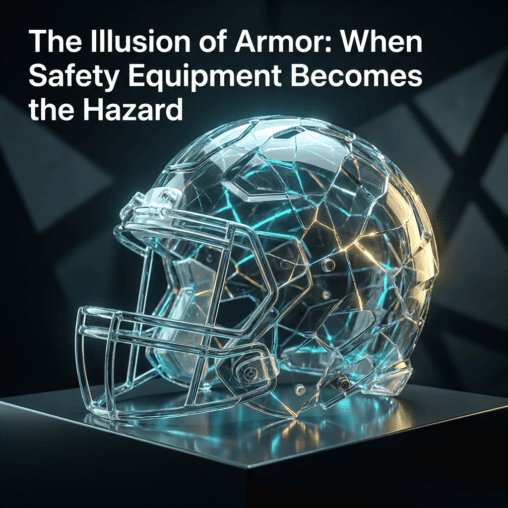
This false security at the neck is magnified by what is bolted on above it. The modern football helmet—with its hard polycarbonate shell and advanced internal suspension—was engineered to solve a specific problem. It was designed to eliminate acute skull fractures.
It worked. But the unintended consequence was catastrophic risk compensation.
When humans feel perfectly protected by advanced armor, their behavior unconsciously shifts. They take greater risks because the perceived cost of a collision is lowered. The helmet created a false sense of invincibility. It transformed the head from a vulnerable part of the body that athletes naturally protect, into a battering ram.
We try to solve this by engineering even more false security. We rely on independent, university-backed 5-star helmet rating systems. The researchers running these labs did not intend to create a false sense of security. They are simply measuring a helmet’s ability to reduce acceleration forces in a controlled environment. But the nuance is lost on the public.
Manufacturers weaponize these ratings as marketing leverage. Companies pushing ultra-lightweight helmets slap a 5-star sticker on their product to sell parents the illusion of absolute safety. To the public, that sticker implies the helmet prevents concussions. It cannot. No helmet can defeat physics. It may reduce the force transferred to the skull, but it cannot stop the brain’s internal momentum. Because the true nature of the test is misunderstood and aggressively marketed, athletes are emboldened to hit with greater velocity. They mistakenly believe they are shielded.
Now we are bolting extra padding onto the outside. Enter the external soft-shell helmet cover.
These covers are designed to dissipate energy. But they add mass and physical volume to the head. Biomechanically, increasing the size and weight of the head increases the moment of inertia. When struck, this added mass increases rotational acceleration—the exact twisting forces responsible for concussions and severe neck strain. Furthermore, the soft material creates friction. Helmets “catch” instead of “glancing” off one another, forcing the cervical spine to absorb violent torque.
Beyond the biomechanical failures, these bolt-on solutions introduce secondary hazards. Wrapping the helmet in a thick layer of foam covers the ventilation ports. This drastically increases the internal temperature of the helmet, accelerating athlete fatigue and raising the risk of heat illness. Furthermore, modifying a certified helmet by strapping an aftermarket product to its exterior often voids the manufacturer’s warranty. If a catastrophic failure occurs, the liability shifts entirely off the manufacturer and directly onto the school or organization that mandated the modification.
Worse, it is a highly visible manifestation of safety. Wearing extra padding on the outside sends a subconscious signal to the athlete: “I am heavily protected.” Just like the hard shell before it, this psychological armor encourages the player to hit harder, neutralizing any theoretical benefit. The natural defense mechanism—avoiding head contact—is completely destroyed.
The Participation Trophy: Psychological Padding
This physical failure mechanism—where padding eliminates the necessary friction of stress—does not just destroy the body. We have taken this exact same failure mechanism and applied it to the minds of our youth.
Society has become obsessed with psychological padding. We hand out participation trophies. We shield young athletes from the sting of a loss. We intervene to eliminate the friction of a difficult challenge. We treat failure as a hazard that must be engineered away.
It is the psychological equivalent of a heavy back belt. By constantly offloading the critical work of emotional regulation, we ensure their internal coping mechanisms never activate. They never develop psychological bone density. Their distress tolerance remains dangerously low.
By shielding them from the natural friction of failure, we also rob them of a fundamental truth: actions have consequences. In a functional system, a poor decision or lack of effort yields a negative outcome. That negative outcome is data. It is the painful but necessary feedback that forces an individual to reassess their approach.
When that consequence is constantly cushioned by adult intervention, the feedback loop is severed. The youth never experiences the hard cause-and-effect relationship required to develop internal accountability. They learn to expect a rescue instead of learning to correct their course. We are breeding a generation that believes the rules of physics, economics, and human relationships will bend to accommodate their intentions. They will not.
We see the terminus of this pipeline at the professional level every day. When an athlete’s entire developmental trajectory has been padded—when they have been treated as an exception to the rules because of their talent or their name—they lose the ability to accept objective reality. They argue every call. They genuinely believe they are above the rule set. They cannot process the friction of being told “no.” And the system reinforces this delusion. Officials frequently allow it, giving the established veteran the favorable call while the rookie gets beat up for the exact same action. It is the ultimate manifestation of subjective, engineered safety over objective consequence.
When they inevitably enter the real world, the environment will not yield to their feelings. The padding is gone. What should be a routine setback is perceived as a catastrophic threat. They buckle under the weight of normal adult life because we engineered a childhood that never conditioned them to carry it. This manufactured fragility is a direct driver of the current youth mental health crisis.
Building True Resilience: The CAD Solutions
To be clear, ProTect Athletics is not opposed to bracing or padding as a temporary medical intervention following an acute injury. A cast is necessary to heal a broken bone. A brace is required to protect a torn ligament during rehabilitation. But a medical intervention is not a permanent uniform. When a temporary fix becomes chronic armor, the biological foundation rots.
When we over-engineer safety equipment, we create armor that weakens the very person it is designed to protect. The Correct, Accurate, and Defensible (CAD) approach to safety does not rely on passive crutches. It builds true resilience by applying three foundational principles:
- The Hierarchy of Controls: Engineering the environment or eliminating the hazard entirely, rather than defaulting to Personal Protective Equipment (PPE).
- Physiological and Psychological Conditioning: Building internal capacity, strength, and proprioception to meet and exceed the demands of the environment.
- Load Management and Adaptation: Gradually exposing the body and mind to stress to trigger structural adaptation, rather than suddenly removing support.
Here is the correct way to address the false-security traps we have created:
Highly Cushioned Shoes
Adjust training volume and correct running mechanics rather than trying to out-cushion poor form. Strengthen the intrinsic muscles of the foot and the stabilizers of the lower leg to restore the foot’s natural spring. Do not suddenly drop to zero-drop shoes. Gradually decrease the stack height over months, allowing the Achilles tendon and plantar fascia to adapt safely.
Rigid Work Boots
Improve job site housekeeping and terrain management to reduce the need for ultra-rigid, puncture-proof shanks in non-hazardous zones. Actively train ankle dorsiflexion and calf mobility outside of work hours to counteract the cast-like restriction of the boot. Rotate footwear based on the specific task.
Anti-Fatigue Mats
Redesign the workstation or implement task rotation so the worker is not standing statically in one place all day. Movement is the cure for static fatigue. Build posterior chain endurance and core stability to handle standing loads without relying on an unstable mat. Transition from excessively soft mats to firm, supportive surfaces.
The Prophylactic Knee Brace
Bolting on hardware is a lazy fix. The CAD approach starts with rule enforcement. Officials must strictly penalize illegal low blocks and chop blocks to keep the trenches clean. Next is targeted strength conditioning. Linemen must build biological armor through heavy unilateral leg work and balance training. Train the VMO, hamstrings, and hip abductors to fire instantly under heavy loads. Gradually wean athletes off prophylactic braces during non-contact practices to restore natural joint kinematics. You protect the knee by building the athlete. You do not do it by strapping a piece of plastic to their leg.
Back Belts
Eliminate the heavy lift using mechanical hoists, or engineer the environment to raise the load to waist level. Train proper bracing mechanics to build a natural internal foundation. Strengthen the transversus abdominis and erector spinae. Restrict belt usage strictly to near-maximal, high-risk lifting events. Wean workers off belts for daily tasks so their core muscles re-engage.
Anti-Vibration Gloves
Maintain tools to reduce vibration at the source. Implement administrative controls to limit continuous trigger time. Improve grip strength and forearm endurance. A naturally stronger grip requires less relative exertion to control the tool. Gradually condition workers to tool use with adequate recovery periods.
Padded Boxing Gloves
Modify sparring rules to limit head strikes and prioritize technical body sparring. The hazard is the rule set, not the glove. Strengthen the neck to resist rotational forces. Condition the hands and wrists through proper bag work to ensure perfect structural alignment on impact. Strictly limit full-contact sparring sessions. The brain does not adapt to trauma. It accumulates it.
The Cowboy Collar
Enforce rules against targeting and spear-tackling. Emphasize “heads-up” tackling techniques that remove the head from the impact equation. Implement dedicated, progressive neck and trapezius strengthening protocols. A robust, muscular neck acts as a dynamic shock absorber. Expose athletes to controlled, progressive contact in practice to build spatial awareness.
The Football Helmet
We cannot engineer a helmet that stops the brain from moving inside the skull. We must change the environment. Mandate rugby-style tackling where the shoulder leads and the head is kept completely out of the equation. Strictly enforce targeting rules. Drastically limit the number of full-contact practices during the week to reduce the sheer volume of subconcussive impacts. Protect the brain’s capacity by managing the load.
Psychological Padding
Strip away the artificial padding. Expose youth to age-appropriate adversity. Let them lose. Stop handing out unearned praise. Exposure is only half the equation. The real conditioning happens in the recovery phase. Instead of distracting them from the pain of a loss, guide them to process it. Teach them how to analyze the failure, extract the lesson, and adapt. You cannot truly win unless you lose first. When you overcome that loss, you see the truth. It is not actually failure. It is learning. It is growth. This controlled overload forces the psyche to adapt, building authentic confidence.
At ProTect Athletics, we do not define safety by the thickness of the padding or the rigidity of the brace. We define safety by the objective resilience of the system. Every time we bolt on a piece of armor, we inhibit the safety of our workforce and our athletes by shutting down their natural, biological defenses.
When we introduce these administrative and physiological controls, we inevitably hear the same objection from employees and coaches: “This is how we have always done it, and nothing has happened yet.”
That is the definition of a false sense of security. Just because the catastrophic failure has not occurred yet does not mean the foundation is not rotting from the inside out. You are not safe; you are just lucky.
True safety is never a passive pursuit. You cannot strap it on. You cannot lace it up. Real resilience requires stripping away the illusions, applying objective consequence, and putting in the work to build an internal foundation that can actually carry the load.
If your organization is ready to stop bolting on band-aids and start building true, systemic resilience in your athletes or workforce, we can help. ProTect Athletics is a 501(c)(3) dedicated to this exact mission. Contact us to learn how to implement the Correct, Accurate, and Defensible (CAD) approach.
References and Resources
To ensure the Correct, Accurate, and Defensible (CAD) standard, the biomechanical principles and physiological mechanisms discussed in this article are supported by the following foundational resources and consensus statements:
- National Institute for Occupational Safety and Health (NIOSH): Guidelines on the use of back belts in occupational settings, which conclude that back belts do not mitigate the risk of back injury in healthy workers and may induce a false sense of security.
- Concussion in Sport Group (CISG): The 6th International Conference on Concussion in Sport (Amsterdam Consensus, 2023), establishing the updated physiological approach to concussion management, including the shift from “complete rest” to “relative rest” and graduated return-to-play protocols.
- Centers for Disease Control and Prevention (CDC): “Heads Up” Initiative and guidelines on sports-related concussions, detailing the biomechanics of rotational acceleration and brain trauma.
- American Academy of Orthopaedic Surgeons (AAOS): Position statements on prophylactic knee bracing, emphasizing that there is insufficient scientific evidence to recommend the universal use of prophylactic knee braces and that they do not replace the need for comprehensive strength and neuromuscular conditioning.
- American Psychological Association (APA) & Self-Determination Theory: Psychological frameworks demonstrating that “overparenting” and shielding youth from age-appropriate failure frustrates the development of autonomy and competence, directly impairing the formation of long-term distress tolerance and psychological resilience.
- Occupational Safety and Health Administration (OSHA): The Hierarchy of Controls, the foundational safety framework mandating that hazards be engineered out or administratively controlled before resorting to Personal Protective Equipment (PPE) as a last line of defense.
- Virginia Tech Helmet Lab: While providing objective data on linear and rotational acceleration reduction, these ratings explicitly state that no helmet can prevent concussions, highlighting the danger of risk compensation when athletes misinterpret safety ratings.
