
 Written by
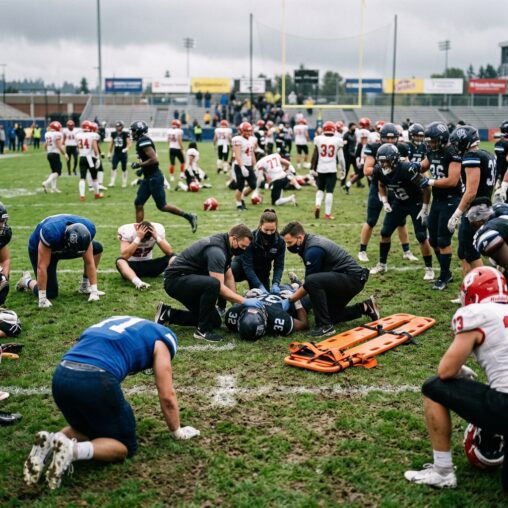
 You have seen it a thousand times. A player goes down. The whistle blows — or maybe it doesn’t, because everyone on both sides of the field has already stopped. Helmets come off. Teammates drop to one knee. Fans rise slowly from their seats. Coaches pace. Medical staff run.
The world pauses.
In that silence — in the portrait drawn by a thousand bended knees — something profound is happening. It is an act of collective humanity that says, without a single word: the person matters more than the play. It is one of the most honest moments in sports.
But when everyone stands back up, the questions begin. And the questions we ask in those moments — far more than the gear we purchase or the policies we print — determine whether the next portrait ever gets drawn.
Two Paths from One Whistle
When an athlete goes down, two questions compete for the room’s attention. The first is how — the mechanism, the physics, the freeze-frame moment we can analyze on film. The second is why — the systemic failure upstream of the play that created the conditions for injury to occur.
I have addressed the clinical distinction between mechanism and root cause in previous articles on this platform. If you haven’t read them, I encourage you to start there. The short version is this: the mechanism tells you what the camera saw. The root cause tells you what the organizational calendar, the equipment log, and the practice schedule said for the six weeks before the camera started recording.
This article is not about re-explaining that distinction. It is about asking why — after years of research, after decades of athletic training, after every stadium has gone quiet at least once — we still cannot get most programs to ask the second question.
‘It’s Part of the Game’ Is Not an Explanation. It’s a Surrender.
The most dangerous phrase in American athletics is not uttered by a reckless coach or an uninformed parent. It is spoken by well-intentioned people who have simply stopped asking.
“It’s part of the game.”
Sociologist Diane Vaughan studied the organizational factors behind the 1986 Space Shuttle Challenger disaster. Her conclusion was not that NASA was negligent. It was something more troubling: NASA was normal. The engineers had watched the O-rings perform inadequately in cold temperatures not once, but repeatedly — and each time nothing catastrophic happened, the deviation became slightly more acceptable. Over time, the abnormal became the baseline. Vaughan called this the ‘normalization of deviance’ — the process by which risky behaviors become standard operating procedure simply because they have not yet produced a catastrophe (Vaughan, 1996).
Athletic programs normalize deviance every single season.
A player limps through a practice because ‘he’s a tough kid.’ A turf field fails its G-max assessment but gets cleared anyway because the budget cycle doesn’t allow a replacement. A pitcher reaches 110 throws in a game because it’s the playoffs and ‘he’s on.’ A return-to-play timeline gets compressed because the team needs him on Friday.
None of these decisions produce a catastrophe the first time. Or the second. That is exactly what makes them so dangerous.
Every time an injury happens and we answer with ‘it’s part of the game,’ we are not being pragmatic. We are actively choosing not to learn. We are stamping a closed file on a case that deserved an investigation — and sending the same system back onto the field to produce the same outcome.
The Portrait Nobody Sees
When a player is down and teammates take a knee, every eye in the stadium is on the athlete on the turf. As it should be. That is an act of grace.
But there is a second portrait being drawn in that same moment — one no camera captures. It is the portrait of every decision that preceded that injury: the surface that was not audited, the equipment that was not reconditioned, the protocol that existed on paper but never in practice, the heat index that was checked on a phone app instead of a calibrated WBGT device, the return-to-play protocol that was accelerated because the lineup was thin.
That portrait — the invisible one — is precisely what a Director of Athletic Safety is trained to see.
The research supports this. In 2006, Dr. Caroline Finch introduced the TRIPP framework — Translating Research into Injury Prevention Practice — which identified a critical gap not between what we know and what we study, but between what we study and what we actually do (Finch, 2006). The science of injury prevention has been advancing for decades. Our implementation culture has not kept pace. We have the knowledge. What most programs lack is a professional, accountable structure for deploying it — consistently, defensibly, and without exception.
That gap is not a knowledge problem. It is an organizational problem.
When Play Resumes, the Work Begins
Here is what I want every athletic director, head coach, and program administrator to consider: in the thirty seconds that everyone is on their knee, something is already being decided.
In most programs, it is being decided implicitly — by inaction. The incident will be logged as a mechanism, filed under the athlete’s name, and used primarily to inform the rehabilitation protocol. The system that produced the injury will remain untouched.
In a program with a true safety culture, something different is happening. Someone is already beginning the process that Meeuwisse and colleagues (2007) formalized as the dynamic, recursive model of injury etiology — the recognition that an athlete’s risk profile is not static, and that each incident modifies the conditions for the next one. Someone is pulling the thread that leads from the ACL on the turf back to the policy decision in August, the equipment log from October, the environmental audit that was scheduled but never conducted.
That person is the Director of Athletic Safety. And in most programs at the high school and collegiate level, that person does not exist.
They are not the athletic trainer, who is already managing the immediate medical response. They are not the athletic director, who is managing liability, communication, and scheduling simultaneously. They are not the head coach, who is — understandably — focused on the rest of the game.
The Safety Quarterback — the one whose job is to ask why when everyone else is asking how — is the missing role in recreational, scholastic, and collegiate athletics. The Director of Athletic Safety credential was built to fill exactly that organizational gap (Emery & Pasanen, 2019; Gabbett, 2016).
What the Knee Actually Promises
Taking a knee means something. In athletic culture, the gesture is rarely casual. A team that stops play and kneels when a player goes down is making a declaration: this person matters more than this game.
That declaration is beautiful. It is worth protecting.
But a declaration made in the moment demands to be backed by a system in the off-season. You cannot promise, through the gesture of a bended knee, that an athlete’s safety matters — and then walk back into an organization that normalizes deviation, shortchanges equipment protocols, skips surface audits, and has no defined role for safety leadership.
Research consistently shows that prior injury is one of the strongest predictors of future injury (Toohey et al., 2017). The athlete who goes down today is statistically more vulnerable tomorrow. What protects that athlete tomorrow is not the gesture made in the stadium. It is the protocol written in the room where no one is watching: the policy meeting, the pre-season audit, the reconditioned equipment inventory, the emergency action plan that has been not just written, but rehearsed.
The bended knee is the how of the moment — the visible response to a visible event. The work of athletic safety is the why that follows it home and demands a better answer.
Conclusion: From Gesture to Standard
The Inter-Association Task Force for Preventing Sudden Death in Secondary School Athletics Programs has been clear: the most preventable catastrophes in athletics are not the result of bad luck (NATA, 2013). They are the result of broken systems, unexamined norms, and a cultural tolerance for deviance that has been in place so long it no longer feels like deviance at all.
We know how to prevent injuries. The science exists. The protocols exist. What we are still building — at the scholastic and collegiate level — is the organizational will and professional infrastructure to implement them every day, not just after something goes wrong.
The bended knee is a powerful symbol. But a symbol without a system is just theater.
Build the system. Ask why. And the next time everyone takes a knee, let it be the exception rather than the rule.
References
Emery, C. A., & Pasanen, K. (2019). Current trends in sport injury prevention. Best Practice & Research Clinical Rheumatology, 33(1), 3-15. https://doi.org/10.1016/j.berh.2019.02.009
Finch, C. (2006). A new framework for research leading to sports injury prevention. Journal of Science and Medicine in Sport, 9(1-2), 3-9. https://doi.org/10.1016/j.jsams.2006.02.009
Gabbett, T. J. (2016). The training-injury prevention paradox: should athletes be training smarter and harder? British Journal of Sports Medicine, 50(5), 273-280. https://doi.org/10.1136/bjsports-2015-095788
Meeuwisse, W. H., Tyreman, H., Hagel, B., & Emery, C. (2007). A dynamic model of etiology in sport injury: The recursive nature of risk and causation. Clinical Journal of Sport Medicine, 17(3), 215-219. https://doi.org/10.1097/JSM.0b013e3180592a48
National Athletic Trainers’ Association (NATA). (2013). Inter-Association Task Force for Preventing Sudden Death in Secondary School Athletics Programs: Best-Practices Recommendations. Journal of Athletic Training, 48(4), 546-553. https://doi.org/10.4085/1062-6050-48.4.12
Toohey, L. A., Drew, M. K., Cook, J. L., Finch, C. F., & Gaida, J. E. (2017). Is subsequent lower limb injury associated with previous injury? A systematic review and meta-analysis. British Journal of Sports Medicine, 51(23), 1670-1678. https://doi.org/10.1136/bjsports-2017-097500
Vaughan, D. (1996). The Challenger Launch Decision: Risky Technology, Culture, and Deviance at NASA. University of Chicago Press.
