 Written by
Every fall and spring, athletic directors, equipment managers, youth league presidents, and worried parents are bombarded by glossy marketing campaigns promising the holy grail of sports safety: equipment that stops concussions.
From neck collars claiming to “lock” the brain in place to padded helmet covers, custom dental guards, and ultra-lightweight space-age helmets, marketing teams lean heavily into parent anxiety and coach liability concerns. Bold words like “scientifically proven,” “FDA cleared,” and “ultimate protection” are plastered across promotional videos and sales decks.
I have spent my life in athletic equipment management, occupational safety, and sports safety curriculum. My message to every coach, parent, and administrator is simple:
“Don’t believe the hype. They say it to sell it.”
Let me state the unassailable scientific fact up front:
The Non-Negotiable Baseline
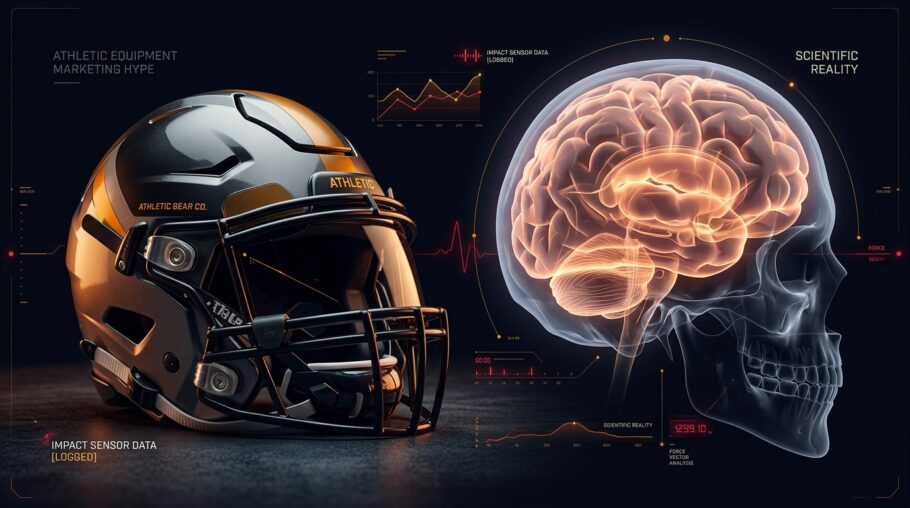
There is no piece of athletic equipment, helmet add-on, neck device, or mouthguard on the planet that prevents concussions. Period.[1]
The physics and anatomy are absolute. The human brain floats inside the skull in cerebrospinal fluid (the clear liquid cushion that surrounds and protects the brain). When a head or body experiences rapid acceleration or deceleration, the brain moves and shears inside the cranium. No external helmet, padded shell, or neck strap can stop that inertia.
In 2014, a landmark medical case report published in The Lancet documented a 50-year-old fan who presented to neurosurgeons with a severe, two-week headache after attending a Motörhead concert.[11] CT scans revealed a chronic subdural hematoma (a serious and potentially fatal bleed caused by blood pooling between the brain and the inner wall of the skull): caused entirely by violent headbanging.
The patient had zero direct blows or impacts to his head.
The brain bleed occurred purely because rapid, un-impacted rotational whiplash (the violent spinning and snapping motion of the head) snapped the bridging veins (the small blood vessels that connect the surface of the brain to the inner skull wall) between his brain and inner skull wall.[11]
While a single case report cannot establish population-level standards, the Islamian et al. (2014) finding powerfully illustrates what sports medicine literature has confirmed across large epidemiological studies: rotational whiplash, not direct contact alone, is a primary driver of brain injury. Modern neurology has proven that subconcussive loading (repeated smaller hits that do not result in a diagnosed concussion but accumulate damage over time), rotational acceleration, and whiplash forces cause progressive brain trauma regardless of how tough an athlete feels or how shiny their helmet looks.
If a 50-year-old man can tear bridging veins and suffer a brain bleed at a Motörhead concert without striking his head on a single object, no external helmet, soft pad, or neck strap on Earth can stop brain inertia during a game collision.
One of the most persistent and dangerous misconceptions in sports safety is the belief that an athlete must take a direct blow to the head to suffer a concussion. Parents, coaches, and administrators see no helmet-to-helmet contact and assume the athlete is safe.
That belief is scientifically false. And it gets kids hurt.
Under international sports medicine consensus (Consensus Statement on Concussion in Sport, Amsterdam 2023):[1]
“A concussion can be caused by a direct blow to the head, face, or neck, OR an impulsive force transmitted to the head from an impact elsewhere on the body.”
When an athlete takes a violent tackle to the torso, a blind-side hit to the shoulder, or a sudden trunk collision, the resulting whiplash causes the head to rapidly snap and rotate. The brain sloshes, twists, and shears against the inner cranial walls. This happens even if the athlete’s head never touches another player, the turf, or any object.[1]
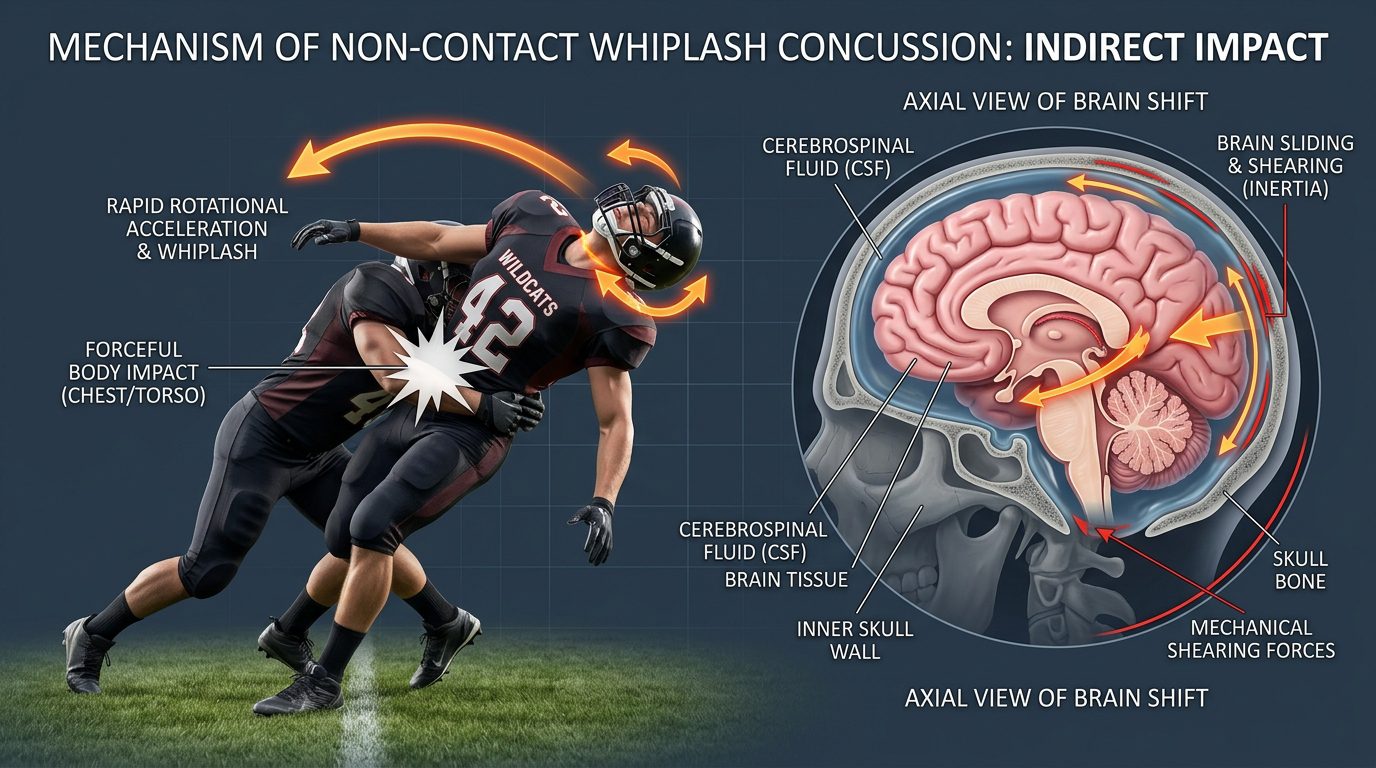
If a concussion can be caused by a hit to the chest, back, or waist, how could any helmet, padded shell, or neck band possibly prevent it?
While marketing teams focus entirely on concussion claims, they completely ignore how their gadgets interfere with one of the body’s most critical survival systems: cranial thermoregulation (the body’s ability to control and release heat from inside the skull).[9,10]
Here is what every parent and coach needs to understand. The human brain generates roughly 20% of the body’s total resting heat despite representing only 2% of total body mass.[9] Think about that for a moment. A 3-pound organ produces one-fifth of everything your child’s body needs to cool. During intense athletic exertion, especially in hot and humid environments, brain temperature rises even faster than the rest of the body.
The body relies on two primary mechanisms to pull that heat out:
- Convective and Evaporative Cooling: Air moves through the helmet’s vent channels and evaporates sweat off the scalp, carrying heat away with it.
- Venous Radiator Drainage: Hot blood flows out of the skull through the jugular veins in the neck, carrying metabolic heat back to the heart to be cooled and recirculated. Think of it as the drain on a radiator.
A Parent’s Guide to Head Cooling: The Car Radiator & Garden Hose Analogy
Your child’s brain cools exactly like a car engine. Cool blood flows UP through the neck arteries to absorb brain heat. Hot blood drains DOWN through the two large jugular veins (the two prominent veins you can feel on either side of your child’s neck) back to the heart.
Devices that apply compression to the internal jugular veins restrict that drainage. Imagine kinking a garden hose or blocking a car’s radiator drain. The hot coolant has nowhere to go. It builds up.
In 90-degree summer practices, restricting the jugular veins traps hot, stagnant blood inside your child’s skull longer. That does not prevent concussions. It traps heat and directly increases the risk of Exertional Heat Stroke (a life-threatening medical emergency where the body’s core temperature rises beyond what the brain can survive), one of the leading preventable causes of sudden death in youth sports.
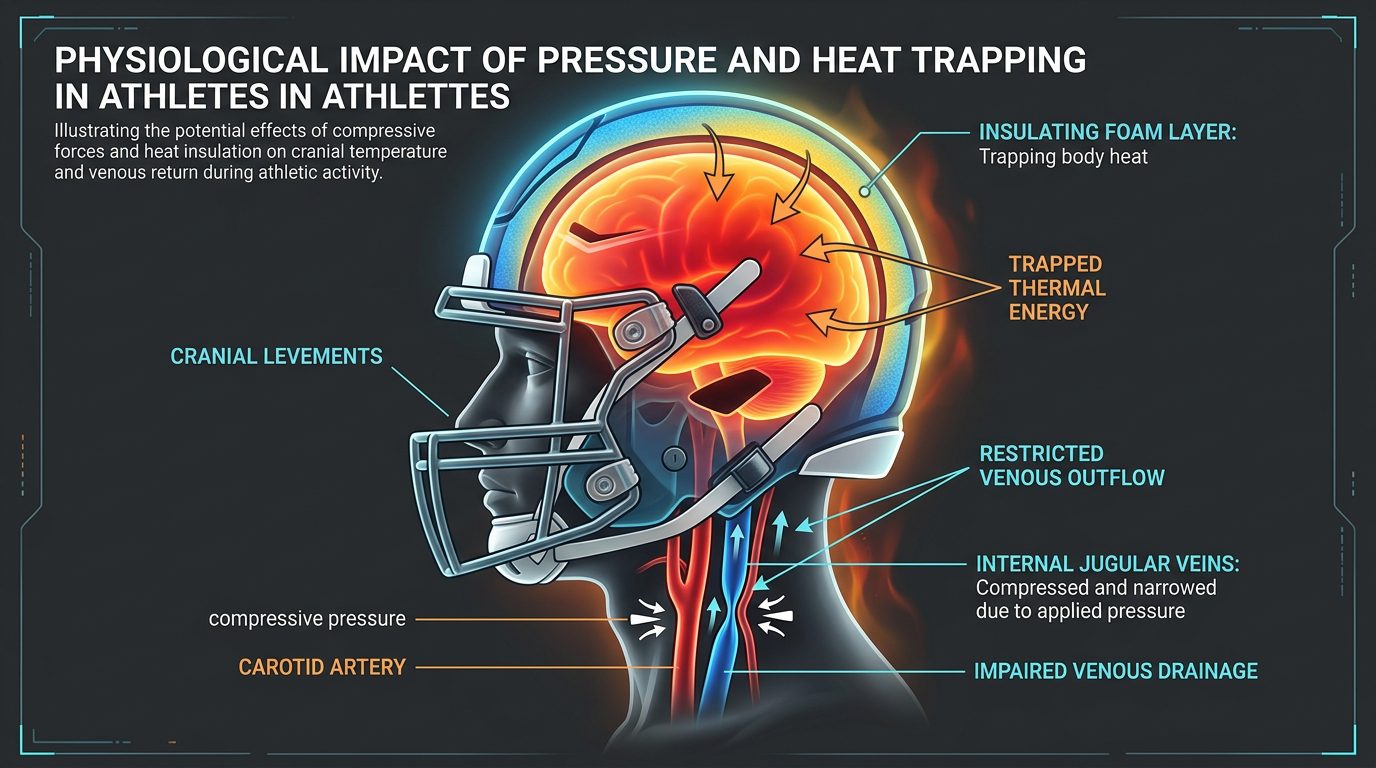
When equipment vendors add insulating layers, restrict blood flow, or block ventilation, they create a major thermal hazard: a dangerous buildup of heat inside the body that the athlete cannot release fast enough.[9,10]
Market Category: External Helmet Soft Caps & Padded Covers
- Concussion Reality: Lab tests show soft outer caps reduce peak linear G-forces (the straight-line impact force measured in gravity units) during controlled drop tests.[3] Real game collisions are dominated by violent rotational acceleration (the spinning, twisting force that actually tears brain tissue). Telemetry studies in game conditions show no proven reduction in actual concussion incidence rates.[3,5]
- Inspection Breakdown: Football helmets must be visually inspected after every hard hit for cracks and structural damage. A foam cover makes that inspection impossible. Additionally, adding any aftermarket product to a certified helmet voids the helmet’s NOCSAE certification (the national safety standard that certifies your child’s helmet meets minimum protective requirements) unless the new configuration is re-tested by the manufacturer.[4]
- The Heat Trapping Factor: Helmet shells are precision-engineered with vent channels to release scalp heat. A thick foam cover seals those channels shut, turning the helmet into a thermal insulator: trapping solar radiation and body heat directly against your child’s head during hot-weather practices.[9,10]
Market Category: Internal Jugular Vein Compression Devices
- Concussion Reality: In clinical trials involving high school and collegiate athletes, jugular compression collars demonstrated no proven clinical reduction in actual concussion incidence rates.[2,5] The FDA granted De Novo clearance (a type of FDA authorization for new medical devices) (DEN200017) based on subconcussive white matter imaging data (brain scan changes in athletes, not actual concussion prevention outcomes in people). Mandatory labeling states the device does NOT prevent concussions or serious brain injuries.[2,6]
- The Heat Risk: Applying compression to the internal jugular veins restricts the brain’s primary heat-clearance pathway. While direct clinical trials measuring cranial heat accumulation from jugular compression in athletic conditions remain limited, the theoretical thermal mechanism is consistent with established venous cooling physiology. During exertion in high heat, restricting jugular drainage traps heated blood inside the cranium longer, potentially elevating thermal strain and heat illness risk.[9,10]
Market Category: Novel Composite Lightweight Shells
- Concussion Reality: Lighter helmets are more comfortable. But concussion safety is governed by energy attenuation (how effectively the inner foam liner absorbs and spreads the force of a hit so less of it reaches the brain).[4] Shaving weight from the outer shell does nothing to change what the brain experiences inside the skull during a high-velocity collision.
- Ventilation Trade-Offs: Designs that sacrifice vent channels for a lighter profile, or use dense non-breathable impact foams, trap heat and sweat against the scalp. Without active airflow, evaporative cooling (the body’s primary way of releasing head heat through sweat) fails during high-exertion play.[9,10]
Market Category: “Shock-Absorbing” Dental Guards
- Concussion Reality: Every major sports medicine association, including NATA, AMSSM, and AAP, has examined mouthguard concussion claims. No device eliminates concussion risk.[7,8] The protective value of a mouthguard lies in proper fit and retention — protecting teeth, jaw joints, and oral tissue. It is not a brain injury shield. A mouthguard that claims to prevent concussions is selling you something the science does not support.
- Airflow & Heat: A bulky, poorly fitted mouthguard forces athletes to breathe with their mouths partially blocked during sprints and high-effort plays. Restricting oral airflow reduces the body’s ability to exhale heat, compounding thermal strain exactly when the athlete is working hardest.[9,10]
The biggest safety hazard of gadget-based marketing isn’t just wasted budget. It’s Risk Compensation (the well-documented human behavior of taking greater risks when we feel more protected) and Neuromuscular Suppression (the dampening of the nerve signals between the brain and muscles that teach the body how to protect itself).[8]
As detailed in The Illusion of Armor, when we over-pad an athlete or rely on external PPE as a crutch, we create two dangerous breakdowns:
- Dampening the Body’s Natural Adaptive System: The human body is built to adapt and strengthen itself through sensory feedback. When an athlete experiences natural impact forces, the central nervous system learns proper head placement, trunk stability, and rapid neck muscle co-contraction (when the neck muscles fire simultaneously to stabilize the head and absorb a hit) to brace against whiplash. Artificial padding robs the body of the natural cues it needs to build neck strength, refine motor patterns, and develop instinctive protective bracing. The body never learns to protect itself because the gear is doing it — poorly.
- The False Sense of Invulnerability: Over-padding tricks an athlete’s mind into believing they are wearing an impenetrable shield. Muting self-preservation instincts shifts behavioral dynamics catastrophically:
- Altered Tackle Technique: Players lead with their helmets or drive with their crowns, believing the gear makes them untouchable. That is where catastrophic spinal and brain injuries happen.
- Aggression Escalation: Coaches reward more violent collisions. Scouts value players willing to take bigger hits. The gear becomes a license to be reckless.
- Delayed Medical Response: Coaches and parents dismiss post-hit symptoms because “they were wearing protective gear.” That delay is how Second Impact Syndrome becomes fatal.
Stripping away natural sensory feedback while providing false armor leaves young athletes weaker, less prepared, and far more exposed to catastrophic injury. Proper technique and natural strength will always trump tools in player safety.
If no equipment prevents concussions and some gear risks trapping heat, how do we keep athletes safe?
At ProTect Athletics and within our Director of Athletic Safety (DAS) and Youth Safety Officer (YSO) credentials, we teach the strict scientific distinction between what equipment can and cannot do. A credentialed DAS or YSO is trained to evaluate commercial equipment claims against peer-reviewed evidence, protecting programs from pseudo-science spending and redirecting budgets toward real safety infrastructure.
1. Equipment Prevents Structural Fractures & Fatal Hemorrhages — NOT Concussions: NOCSAE standardized football helmets to prevent skull fractures, scalp lacerations, and fatal brain bleeds called subdural and epidural hematomas (dangerous accumulations of blood between the brain and skull that can cause death within minutes).[4] That is what helmets do. Mouthguards protect teeth, jaw joints, and oral tissue.[7] That is what mouthguards do. Neither prevents concussions.
2. Mandatory Thermal Management: Equipment staff and coaches must actively manage heat during practice. Unbuckle chinstraps. Remove helmets during rest breaks. Loosen shoulder pads. Restore airflow to the scalp. Practice schedules must follow Wet Bulb Globe Temperature (WBGT) (a heat safety measurement that accounts for temperature, humidity, sun exposure, and wind — the gold standard for safe practice decisions) thresholds.[9,10]
3. Exposure Reduction & Technique: Coaches lower concussion risk by teaching heads-up shoulder tackling, enforcing rules that penalize head contact, and limiting full-contact practice repetitions.[1,5]
4. Qualified Sideline Recognition & Emergency Action: Having a Certified Athletic Trainer (ATC), Director of Athletic Safety (DAS), or Youth Safety Officer (YSO) on the sideline ensures immediate execution of the Recognize, Remove, Refer, and Document protocol. This prevents Second Impact Syndrome (a rare but often fatal condition where a second concussion occurs before the brain has fully healed from the first).[1,7,8]
That is how we protect kids beyond the game.
Conflict of Interest Disclosure
The author is the COO, Co-Founder, and lead curriculum architect of Athletic Safety Organization dba ProTect Athletics, a 501(c)(3) non-profit organization, and the developer of the Director of Athletic Safety (DAS) credential, the Youth Safety Officer (YSO) credential, and the Sports Safety Essentials (SSE) compliance curriculum referenced in this article. This relationship is disclosed in full. All legislative, workforce, and injury data cited are drawn from publicly available statutory records and peer-reviewed or government-published sources independent of ProTect Athletics.
Jerry D. Fife is the Co-Founder and COO of Athletic Safety Organization dba ProTect Athletics, a 501(c)(3) nonprofit dedicated to research-based athletic safety education. A former Head Equipment Manager at the College of William & Mary and founding Equipment Manager at Old Dominion University, Fife is the lead curriculum architect of the DAS credential, the YSO credential, and the SSE compliance curriculum framework. He can be reached at jerry@protectathletics.org | protectathletics.org
- Patricios, J. S., Schneider, K. J., Dvorak, J., et al. (2023). Consensus statement on concussion in sport: the 6th International Conference on Concussion in Sport, Amsterdam, October 2022. British Journal of Sports Medicine, 57(11), 695–711. (DOI: 10.1136/bjsports-2023-106898).
- U.S. Food and Drug Administration (FDA). (2021). De Novo Classification Order for the Q-Collar (DEN200017). FDA Center for Devices and Radiological Health.
- Stark, A., et al. (2024). On-field and laboratory evaluation of soft-shell padded helmet covers on head impact kinematics in collision sports. Annals of Biomedical Engineering, 52(4), 981–994.
- National Operating Committee on Standards for Athletic Equipment (NOCSAE). (2024). NOCSAE Policy Statement on Aftermarket Add-On Products for Helmets. NOCSAE Standards Committee.
- Eliason, P. H., et al. (2023). Prevention strategies in sport-related concussion: a systematic review and meta-analysis. British Journal of Sports Medicine, 57(11), 740–748.
- Myer, G. D., et al. (2021). Evaluating jugular vein compression for mitigating neurostructural changes in contact sports athletes. Journal of Neurotrauma, 38(14), 1955–1967.
- National Athletic Trainers’ Association (NATA). (2024). Bridge Statement: Management of Sport-Related Concussion. Journal of Athletic Training.
- American Academy of Pediatrics (AAP) Council on Sports Medicine and Fitness. (2022). Sport-Related Concussions in Children and Adolescents. Pediatrics, 150(5), e2022059580.
- Grundstein, A. J., et al. Thermoregulatory responses and microclimate evaluation during protective headgear use in collision sports. Sports Engineering. [Citation pending final verification of volume, issue, and page numbers.]
- Casa, D. J., et al. (2015). National Athletic Trainers’ Association Position Statement: Exertional Heat Illnesses. Journal of Athletic Training, 50(9), 986–1000.
- Islamian, A. P., Polemikos, M., & Krauss, J. K. (2014). Chronic subdural haematoma secondary to headbanging. The Lancet, 384(9937), 102. (DOI: 10.1016/S0140-6736(14)60923-5).
