 Written by
 More Than a Checkbox: Reaching Every Adult Learner in Online Safety Training
Why standard compliance training fails to protect adult workers, and how to build online courses that actually save lives.
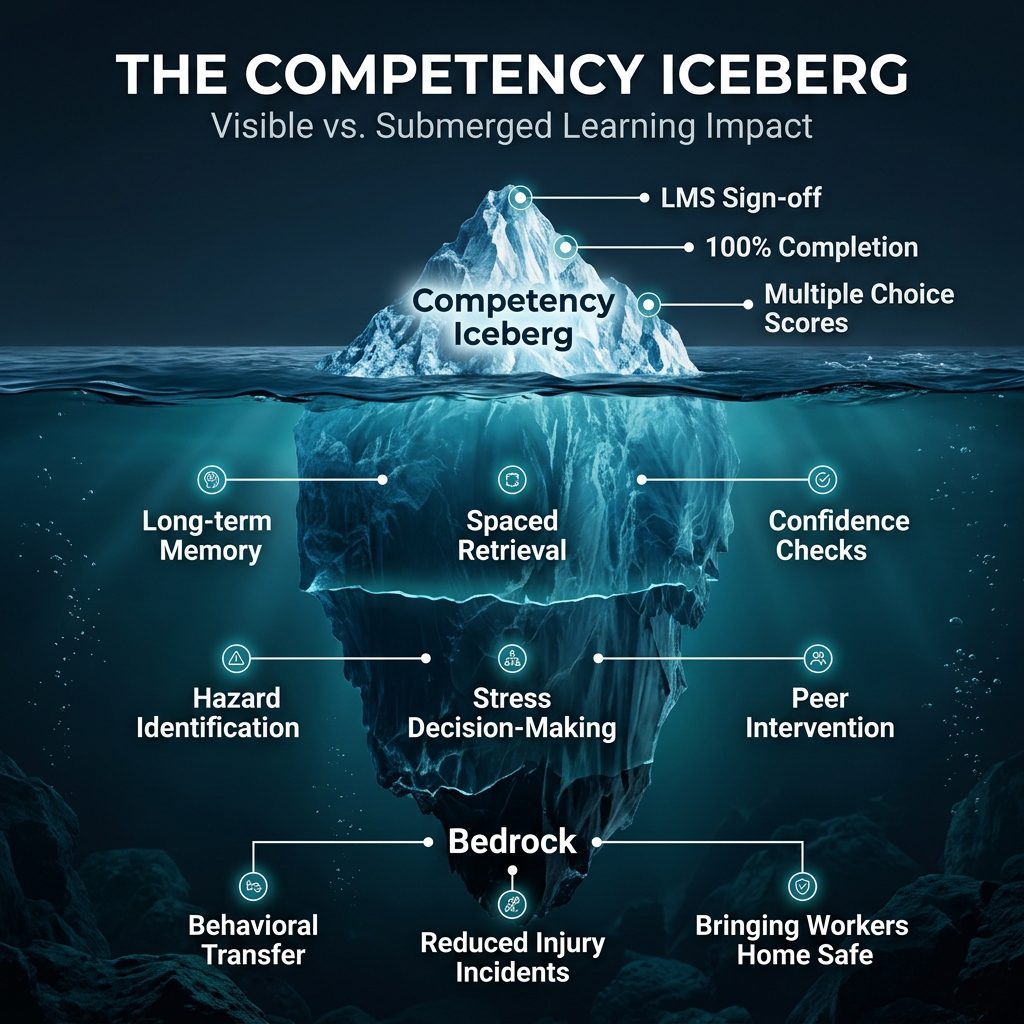
Marco has worked on construction sites for eleven years. He’s done the fall protection training module six times, once at every new employer. He knows the drill. He clicks “Next.” He clicks “Next.” He watches the four minute video at 2x speed. He gets to the quiz. Option B looks right. Option B is always right. He clicks “Submit.” 100%. Certificate generated.
Three weeks later, Marco falls from an improperly secured scaffold.
The training records show he was certified.
This is not a story about a careless worker. Marco was not reckless. He was rational. He had been taught, through six consecutive compliance modules, that safety training is a procedure you complete, not knowledge you actually acquire. The course never reached him. It processed him.
And in American workplaces right now, that gap between processed and actually reached is costing us far more than most people realize.
The Numbers We Know and the Ones That Should Keep Us Up at Night
The U.S. Bureau of Labor Statistics reported 5,283 fatal work injuries in 2023, roughly one death every 99 minutes of every workday. Approximately 2.5 million nonfatal workplace injuries occurred in 2024 alone. The average cost of a single medically consulted injury runs to roughly $42,000. A fatality claim exceeds $1.2 million. Across the economy, workplace injuries and illness cost the United States more than $1.3 trillion every year. Research tells us that 80 to 95% of all workplace incidents involve human behavior as a contributing factor, and that comprehensive, well designed safety training can reduce injuries by up to 50%, returning approximately $4.20 for every dollar invested.
These are the numbers we can count. They come from regulated industries where employers are legally required to report incidents, where OSHA has jurisdiction, where insurance claims leave a paper trail.
But think about the environments we don’t count.
The high school football coach who completed a concussion awareness certification online three years ago, clicking through slides and passing a multiple choice quiz, now stands on a sideline not quite sure what he saw when his quarterback took that hit. The volunteer running the 5K race medical tent. The community pool lifeguard who passed a test but has never faced a real emergency. The weekend construction crew working on a neighbor’s deck. The youth soccer referee who learned the heat illness protocol by clicking “Next” during a mandatory online module.
These people don’t appear in the BLS data. Their near misses aren’t reported to OSHA. Their training failures don’t generate a workers’ compensation claim. But they are real. Youth sports injuries alone affect an estimated 3.5 million children annually, and behind each one of those is a coach, a volunteer staff member, or a referee who received safety training in the form of a click through course and a passing score. The gig economy worker receives online onboarding that is entirely self administered, with no enforcement and no follow up. The agricultural and seasonal worker, one of the most endangered populations in any labor sector, often receives safety information in a language they don’t fully understand, if they receive it at all. The domestic worker, the disaster relief volunteer, the summer camp counselor, the adventure tourism guide all exist outside the formal data. All of them have been handed an online course and sent on their way.
The numbers we know are alarming enough. The numbers we don’t know should fundamentally change how seriously we take the design of safety training for every adult learner, in every context where risk exists.
“A completion rate of 100% is not a safety metric. It is an administrative metric. The safety metric is whether your workers actually know what to do when the moment arrives.”
People Learn Differently, and That Is Something Worth Celebrating
Before we talk about assessment or course design, we need to confront a basic reality: adults do not all learn the same way. They process information through different channels, connect new knowledge through different pathways, and demonstrate understanding in different ways. This is not a flaw in the worker. It is human cognitive diversity, and it is the first thing effective safety training must be built to honor.
Malcolm Knowles taught us the core truth of adult learning. Adults are not blank slates waiting to be filled. You cannot talk down to an experienced worker like he is sitting in circle time. He brings a warehouse of prior experience to every screen he looks at. He needs to know why something matters right now before he will invest a single second in learning it. He wants problem centered knowledge he can put to work on his next shift, not abstract theory stored for a hypothetical exam.
When a safety course opens with forty slides of dense regulatory text before ever explaining what can go wrong in a worker’s actual role, it violates every principle of adult learning. It treats experienced professionals like first graders.
When you look across a workforce, you are looking at seven distinct learning pathways. Every single one of them sits at the screens of your safety courses. Every single one of them deserves training designed for how their brain actually works.
The Seven Learning Styles in Safety Training
Visual Learners
Visual learners process the world through seeing. They think in pictures. They are drawn to color, spatial arrangement, graphics, and visual systems. In a safety context, they grasp hazard zones through color coded floor maps, absorb procedures through clear video demonstrations, and retain warnings through infographics. A course that delivers wall to wall paragraphs of regulatory text gives a visual learner almost nothing to hold onto.
Auditory Learners
Auditory learners learn best by hearing and vocalizing. They remember what they hear, benefit from clear spoken instructions, and internalize concepts by hearing them explained out loud. Narrated video walkthroughs, actual incident audio recordings, and podcast style audio explanations of why procedures exist reach these workers in ways that silent slide decks never will. They are the ones who actually benefit from hearing a real human voice.
Linguistic Learners
Linguistic learners need direct human communication. They learn best when they can see a speaker’s face, read body language, and catch the tone in a voice. They are often exceptional at breaking complex concepts into clear explanations and make some of the best peer trainers on any crew. A real instructor on video, speaking directly to them, reaches this learner in ways that automated narration and bulleted slides cannot touch.
Logical Learners
Logical learners analyze information by taking it apart and assembling it into a clear system. They thrive on structure, clear learning paths, cause and effect relationships, and procedural sequences. “If this hazard appears, then execute this step” decision frameworks speak directly to how they solve problems. Show them the logic behind the protocol, and they will master it.
Interpersonal Learners
Interpersonal learners are energized by connection with peers. They learn through discussion, shared experiences, and collaborative problem solving. In safety training, these are the workers who shine in peer discussion boards about near misses, who engage deeply in team scenario exercises, and who take the most away from a debrief conversation with a supervisor. A course that locks them in a silent room with a screen leaves them cold.
Intrapersonal Learners
Intrapersonal learners seek understanding through self reflection. They are independent, introspective, and self directed. They don’t want rigid group formats. Give them space to think, connect content to their own experience, and process at their own pace. Reflective journaling prompts, self paced modules, and honest competency self assessments reach them where lecture courses fail.
Kinesthetic Learners
Kinesthetic learners must do in order to learn. Watching is not enough. Listening is not enough. They internalize safety information when they are in motion: navigating a scenario, making a decision, experiencing a consequence, or physically practicing a procedure. Interactive simulations, branching decision trees, and procedure exercises are not optional extras for these workers. They are the bare minimum for engagement. Kinesthetic learners dominate skilled trades, manufacturing, and physical labor. These are the exact industries where safety training matters most, and where passive click through delivery fails most completely.
“Acknowledging that people learn differently isn’t a soft idea; it’s the foundation of effective instruction. The question isn’t whether your workers learn differently. They do. The question is: does your safety training know that?”
Designing for All Seven: A Direct Map
To reach visual learners, replace text heavy slides with color coded hazard diagrams, clear video demonstrations, and process maps. Assess them with image based situational judgment tests and virtual simulations where they demonstrate competency without relying on text recall.
For auditory learners, build narrated walkthroughs and audio explanations. Assess them through discussion prompts and oral walkthroughs where they verbalize their understanding. For linguistic learners, put real instructors on video. Use discussion modules and peer explanation tasks where they articulate safety concepts to others.
Logical learners need structure. Build clear procedural sequences and decision trees. Assess them through branching scenarios and structured problem solving tasks. For interpersonal learners, use team scenarios and cohort discussions. Let them validate understanding through peer interaction.
Intrapersonal learners need self paced navigation and reflective prompts. Use confidence based self assessments and reflective writing to measure their engagement. Finally, kinesthetic learners must interact with the material. Give them interactive simulations and branching scenarios. Assessment for this group must move toward performance simulation and supervisor sign off on demonstrated physical procedures.
The Full Picture of Learner Diversity
Learning style is only one piece of the puzzle. On any job site, you also face massive experiential diversity. A veteran with twenty years on the floor and a new hire on day one are not the same learner. The veteran will tune out content that talks down to him; your design must honor and build on his expertise. The newcomer will drown in unexplained jargon; plain language and worked examples are not remedial, they are competent design.
Language and literacy diversity are equally critical. In construction, agriculture, manufacturing, healthcare, and logistics, multilingual crews are standard. Workers whose primary language is Spanish, Haitian Creole, Tagalog, Somali, or Arabic face dense English text, figure out how to click through to keep their jobs, and return to the floor carrying the exact same safety risks. A course that exists only in English text is not a safety program. It is a compliance shield for the employer.
Technological comfort must also be addressed. Digital natives navigate interfaces effortlessly. Other workers struggle just to navigate a learning portal. If a worker uses all his cognitive energy trying to figure out how to click to the next screen, he has zero bandwidth left for the safety lesson. Mobile first design that is clean, responsive, and easy to use on a phone during a shift break is essential.
Physical accessibility is non negotiable. Video captions, audio descriptions, clear contrast, and keyboard navigation are not extra features. They are safety critical design requirements. A worker who cannot access a safety course because of an accommodation gap has not been trained. He has been handed a liability.
The Problem with Picking the Right Answer
Experienced workers learn very quickly how to game compliance quizzes without ever genuinely engaging with the content. You look for the most conservative sounding answer. You eliminate the obviously reckless options. You recall that safety courses never reward calculated risk. The algorithm is simple. It takes about three modules to internalize it.
This is not a failure of integrity. It is a rational response to a poorly designed system.
Multiple choice assessments measure exactly one thing: the ability to recognize a correct answer in a controlled testing environment. They cannot measure whether a worker can apply knowledge under pressure, spot a hazard in a messy real world context, understand why a procedure exists, or make a life saving judgment call in an unexpected moment.
The Ebbinghaus Forgetting Curve shows us the stark truth: without retrieval practice, adult learners lose approximately 70% of new information within 24 hours. A quiz given at the end of a module measures memory at its temporary peak. What the worker retains three weeks later on the job site is a completely different story.
With 80 to 95% of workplace incidents involving human behavior as a contributing factor, a testing model that leaves behavior untouched isn’t solving the problem. It is documenting exposure to the problem.
“There is a difference between recognizing the right answer in a controlled environment and being able to generate the right response in an uncontrolled one.”
OSHA doesn’t require that workers pass a quiz. It requires demonstrated competency. A completed training record is not proof of competency. It is proof that a worker sat in front of a screen.
The Assessment Toolkit: 9 Methods That Actually Measure Understanding
If we want real competency, we have to stop relying on multiple choice quizzes. Here are nine assessment methods that actually measure whether a worker understands how to stay safe.
1. Scenario Based Branching Assessments
A worker encounters a chemical spill near electrical equipment. A coworker wants to skip lockout tagout because the machine is “almost off.” The learner makes a choice, and the scenario branches based on that choice, showing the realistic outcome. Wrong choices don’t just display a red “Incorrect.” They show the actual consequence to the worker, his crew, and the site. This creates a safe to fail environment: workers experience the impact of their decisions before facing them on the job.
2. Situational Judgment Tests
Validated in aviation, nuclear operations, and healthcare, these tests show a video clip or photograph of a real workplace scene and ask learners to rank response options from best to worst. The image might show a crew working near a roof edge without fall protection, a forklift navigating a crowded aisle, or a nurse preparing medication in poor light. Workers must defend the reasoning behind their ranking, proving their critical thinking.
3. Confidence Based Marking
Learners select an answer and state their confidence level: low, medium, or high. Standard multiple choice is completely blind to the most dangerous person on any job site: the worker who is completely wrong but 100% confident he is right. That worker will act on false certainty without hesitation. Confidence based marking surfaces that dangerous profile before the worker steps onto a hazardous job site.
4. Reflective Writing Prompts
Ask a worker to describe a situation on his own job site where he encountered a specific hazard. This activates his prior experience, forces meaningful connection to the material, and produces clear proof of understanding that no multiple choice test can touch.
5. Spaced Retrieval Checks
A single end of course quiz is one of the worst ways to build memory. Short knowledge checks delivered over time—on Day 3, Day 14, and Day 30 after training—use spaced repetition to lock in learning. Research proves this approach improves long term retention by as much as 82% over a single cram session.
6. Peer and Social Learning Verification
Teaching a concept to someone else is one of the fastest ways to solidify learning. Forced peer explanation demands retrieval, organization, and clear communication. If a worker explains a procedure incorrectly to a peer, you spot the safety gap immediately before it causes an incident on the job.
7. Supervisor and Observer Sign Off
No digital assessment can fully replace real world observation. A supervisor checklist verifying that a worker executes the correct procedure on the actual floor provides the ground truth that digital courses cannot. This is Kirkpatrick Level 3 evaluation in its purest form.
8. Performance Simulation and Virtual Labs
Aviation and healthcare require learners to demonstrate skills in simulated environments. 3D virtual simulations can put a construction worker through a scaffolding inspection, walk a warehouse worker through a forklift maneuver, or require a lab technician to execute a spill response, tracking every decision and omission.
9. Before and After Behavioral Intention Surveys
Ask workers before training how likely they are to speak up when they see an unsafe condition. Ask them again 30 to 60 days after training. This evaluates behavioral shift, measuring not whether they memorized a rule, but whether their readiness to act safely has actually changed.
When you compare these tools to a standard quiz, the difference is night and day. A multiple choice test measures answer recognition, serving only those who read and write well. Scenario branching measures decision making under pressure while engaging kinesthetic, visual, and logical learners simultaneously. Situational judgment tests measure hazard identification in real context. Confidence based marking catches dangerous false certainty. Reflective writing and peer verification prove a worker can articulate safety. Supervisor sign off and performance simulation confirm real world behavioral transfer. Stop testing compliance. Start measuring competency.
Designing for Every Learner: The Multimodal Approach
Better assessment requires better content to support it. Universal Design for Learning gives us a practical rule: provide multiple ways to represent information, express understanding, and engage learners. You don’t need three separate courses. You need one rich experience layered for all learners.
In practice, layer your content. Pair a short, focused video with a written summary. Place a labeled process diagram next to a narrated explanation. Build a branching scenario that forces a choice, not passive viewing. Well designed online learning improves retention by 25 to 60% over passive delivery, and multimodal design is what makes it happen.
For time constrained workers, chunk your content. Build 10 to 15 minute modules with clear stopping points and mobile access. Respect the reality of adult lives. Work, family, and training overlap. A course demanding 90 continuous minutes will be rushed, clicked processing, and forgotten.
For multilingual workforces, design for visual clarity first. If your core safety message can be communicated through a clear visual, a short narration, and a simple checklist, it will reach far more workers than a block of regulatory text.
For veteran workers who have taken the same training six times, provide adaptive tracks that jump straight to complex scenarios and updated standards. Respecting their experience isn’t a favor. It is sound instruction.
The Certificate Isn’t the Goal. Coming Home Safe Is.
Let’s look back at Marco.
What if that fall protection module had been built differently? What if it started not with thirty slides of OSHA citations, but with a short, honest video of an actual near miss on a scaffold just like his? What if it asked him to make choices as the scenario unfolded, showing him the real consequences of every decision?
What if the system recognized that Marco had taken fall protection six times already, offering him a veteran track that honored his experience and challenged him with complex scenarios where even experienced workers make mistakes? What if it asked him to describe a time he saw bad scaffolding, and what he would do if he saw it today?
What if, three weeks later, a five question check popped up on his phone to refresh the key concepts before they faded? What if his supervisor got a simple notification showing that Marco answered a critical safety question with high confidence but got it wrong, prompting a quick five minute conversation before he stepped onto the next scaffold?
That is not a dream. Every single piece of that training exists and can be deployed today.
Every worker sitting in front of a safety course learns differently. Some need to see it. Some need to hear it. Some need to do it. Some need to connect it to twenty years of floor experience. Some need it in a different language, with captions, in 10 minute segments on a phone.
Great online safety training reaches all of them. It does not just process them.
The difference between those two approaches is the difference between a compliance certificate and a worker coming home safe.
“We are not in it for the headlines, but for the heartbeats.”
- U.S. Bureau of Labor Statistics (Census of Fatal Occupational Injuries): This government agency provides the official annual count of workplace fatalities that demonstrates why compliance alone fails to prevent fatal incidents.
- U.S. Bureau of Labor Statistics (Nonfatal Occupational Injuries): This federal dataset tracks nonfatal workplace injuries and illnesses to document the true scale of incidents occurring outside standard administrative reporting.
- National Safety Council (Injury Facts): This organization calculates the financial and societal costs of occupational injuries, providing the economic justification for investing in effective safety instruction.
- H.W. Heinrich / McGraw Hill (Industrial Accident Prevention): This foundational text established that human behavior is a factor in 80 to 95% of workplace incidents, underpinning the necessity for behavioral safety training.
- Malcolm S. Knowles / Cambridge Adult Education (The Modern Practice of Adult Education): This seminal work defined the principles of adult learning theory, proving that adult learners require self direction, immediate relevance, and problem centered instruction.
- American Psychological Association (Distributed Practice Synthesis): This scientific review proves that spaced retrieval practice improves long term memory retention by up to 82% compared to single massed reviews.
- Research Institute of America (The Power of e Learning): This empirical study documents that interactive online learning increases knowledge retention by 25 to 60% over passive information delivery.
- Hermann Ebbinghaus / Columbia University (Memory Decay Study): This classic experimental study established the Forgetting Curve, demonstrating that adults lose approximately 70% of unreinforced knowledge within 24 hours.
- Donald L. Kirkpatrick and James D. Kirkpatrick (Evaluating Training Programs): This definitive book created the four level evaluation framework, establishing that true training success is measured by Level 3 behavioral change on the job rather than Level 1 course completion.
- CAST (Universal Design for Learning Guidelines): This consensus organization established the UDL framework, prescribing multiple means of engagement, representation, and expression to reach diverse learners.
