 Written by
  Athletic Safety
Athletics is spending billions at the bottom of the safety ladder while ignoring everything above it.
This week, Science magazine published a deep-dive on the evolution of the modern football helmet. “Inside the quest to make a safer football helmet” by Adrian Cho is worth your time. The engineering is real. 3D-printed liners. Energy-absorbing flexible shells. Computer-modeled crumple zones. The four helmet manufacturers in this country have genuinely gotten better at their jobs, and that matters.[1]
But the most important sentence in the entire piece did not come from an engineer. It came from Dr. Allen Sills, the NFL’s own Chief Medical Officer. When the conversation turned to concussion prevention, Dr. Sills said this:
“By far, the best concussion prevention is don’t get your head involved in contact.”
Read that again. The top medical officer of the most powerful sports league in the world just told you the helmet is the last resort — not the solution.
This is not an indictment of helmet manufacturers. The brain floats inside the skull in cerebrospinal fluid, and a helmet protects the bone around it. It cannot stop what happens to the tissue inside when the head snaps at rotational velocity. The Science article is explicit: rotational acceleration stretches brain tissue by 20 percent or more, and no rating system, no star system, and no 3D-printed liner changes the physics of what happens inside that cranium on impact.[1,4]
In a previous article, we established why Personal Protective Equipment sits at the bottom of the safety ladder and why over-relying on it creates a false sense of invulnerability. This article addresses the harder question: what belongs at the top?
So why is helmet technology still the dominant conversation in athletic safety?
We Are Running the Pyramid Upside Down
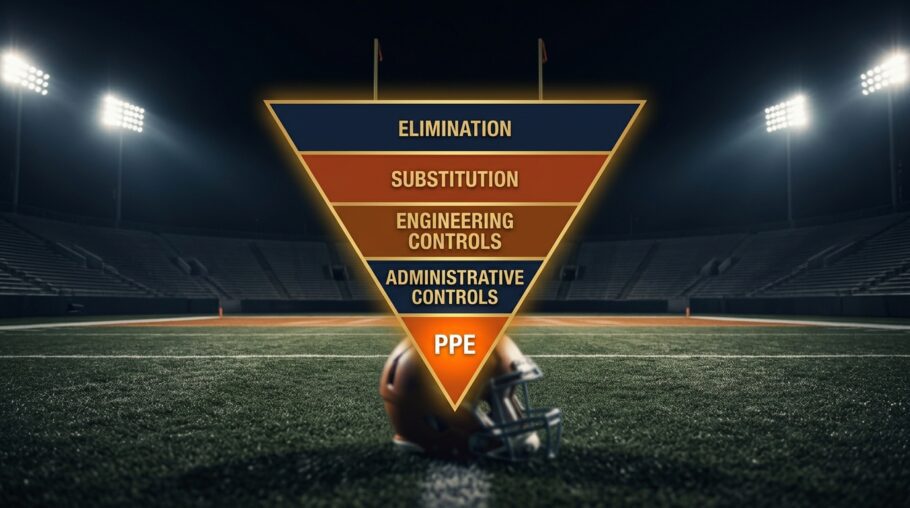
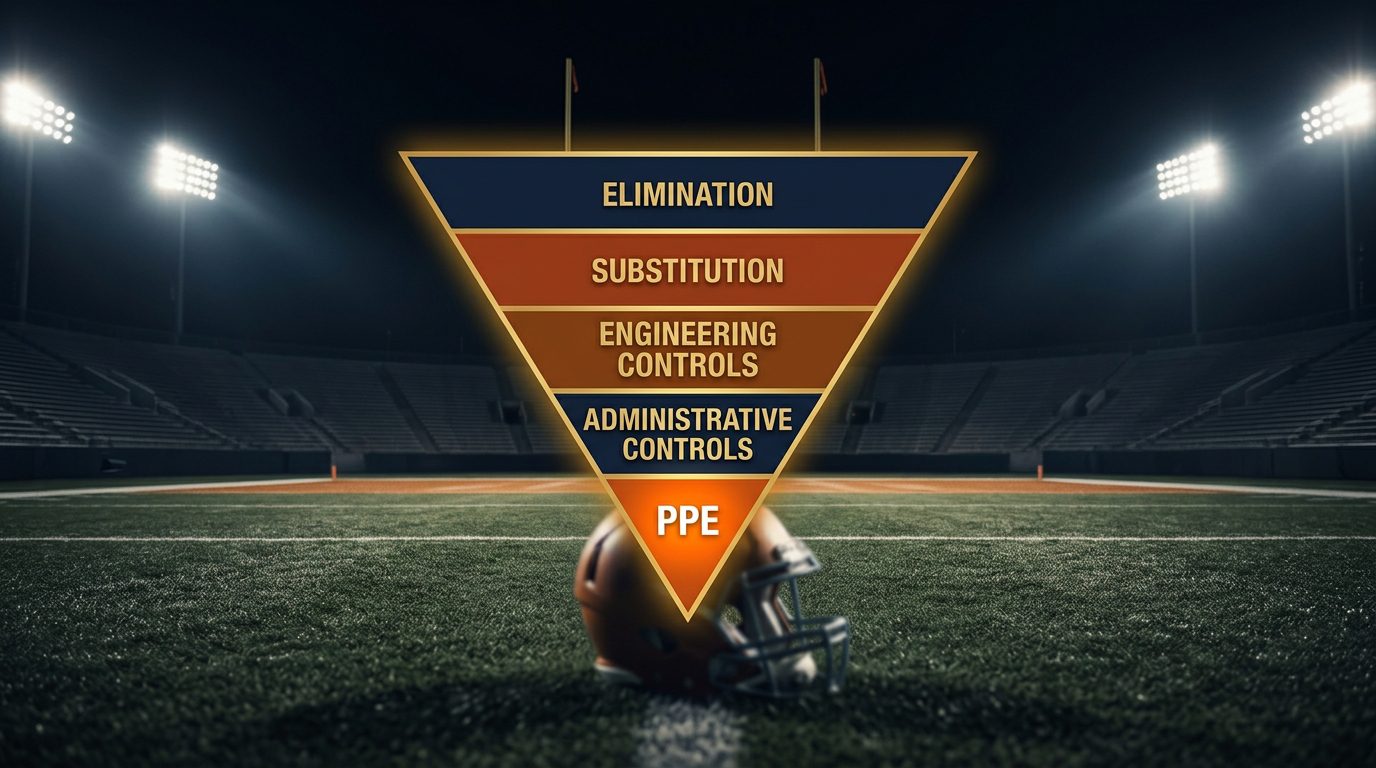
Every safety professional in America learns the OSHA Hierarchy of Controls on day one. It is an inverted pyramid that ranks protective measures from most effective to least effective:
In construction, manufacturing, aviation, and healthcare, every serious industry works from the top of that pyramid down, because safety professionals in those fields understand a foundational principle: you cannot gear your way out of a systemic hazard. PPE is the final layer of protection, not the primary one.
Football has inverted the pyramid completely.[2]
We spend hundreds of millions of dollars obsessing over PPE while refusing to build the human infrastructure required to execute everything above it. We hand parents a helmet rating system and tell them their child is protected. We print fact sheets and distribute them to coaches. We add a Guardian Cap to practice and call it progress. None of that is wrong. All of it is insufficient. Because here is the question nobody is asking: who is managing the top of the pyramid?
You Cannot Have Administrative Controls Without an Administrator
Administrative Controls in athletics are not complicated to define. They are monitoring cumulative hit counts across a week of practice and a game day. They are enforcing non-contact days when a player has shown neurological stress. They are identifying whether an athlete showed up with a pre-existing condition that makes a sub-concussive hit genuinely dangerous. They are standing, without apology, between a coaching staff and a return-to-play decision that should be medical rather than motivational.
Every one of those functions requires a credentialed, independent professional whose only accountability is to the safety of the athlete.
Right now, we are asking the Head Coach to do it — the same person whose job security depends on winning, who is managing dozens of other variables on the sideline, and who is watching the scoreboard at the exact moment someone needs to be watching the player. Asking that person to objectively self-regulate against their own professional incentives is not a criticism of coaches. It is a structural conflict of interest, and we have understood this principle in every other high-risk industry for decades.
The NFL understood it too. They now deploy Unaffiliated Neurotrauma Consultants on the sideline during games — physicians with no club affiliation whose only job is independent observation and decision-making. That infrastructure exists because the league learned the hard way that team-affiliated personnel cannot always be objective when the game is on the line.[6]
High school programs are not the NFL. They cannot fund a neurologist on the sideline for a Friday night varsity game. But they can build toward a standard. They can demand that a credentialed professional be responsible for their safety infrastructure, and that is precisely what the Athletic Safety Organization was built to create.
A Compliance Ladder That Scales With the Athlete
The ASO program was designed to meet programs where they are. Not every organization is a large suburban school district with a full-time athletic staff and a dedicated training room. Not every youth league has the infrastructure to support a fully credentialed safety director from day one. We understood that from the beginning, and we built accordingly.
This is not a replacement for Athletic Trainers. The ATC is the clinical standard, and the ASO Non-Replacement Principle is explicit on this point. The DAS is the administrator who ensures the ATC’s medical protocols are actually enforced when the pressure of the scoreboard is bearing down on everyone else in the building. These roles are not in competition. They are a system, and a system is exactly what the current model is missing.[5]
The Real Call to Action
Every week, someone publishes new data on brain trauma in athletes and issues a call to action. The urgency is real, and the research matters. But the call keeps pointing to the bottom of the pyramid: better helmets, better diagnostics, better educational materials for the same volunteer coaches who have always been asked to carry too much.
None of it addresses the foundational structural failure — which is that there is no one in charge of safety who is structurally independent from the people who need athletes on the field.
Dr. Allen Sills told you the helmet is the last resort. He is right. The question the industry needs to answer is what comes before it. The answer is credentialed human infrastructure, built on a defined standard, and completely independent from the competitive pressures of the sideline.
The pyramid has to be right-side up.[2,5]
Build the Infrastructure. Protect the Athlete.
Learn how the ASO compliance ladder — SSE, YSO, ASM, and DAS — gives every program a path to real, independent safety oversight.
Learn More at ProTectAthletics.org- Cho, A. (2026). Inside the quest to make a safer football helmet. Science. https://www.science.org/content/article/inside-quest-make-safer-football-helmet — Primary source for the Science magazine article, Dr. Allen Sills quote, and rotational acceleration data cited throughout.
- U.S. Department of Labor, Occupational Safety and Health Administration (OSHA) / National Institute for Occupational Safety and Health (NIOSH). (2015). Hierarchy of Controls. Centers for Disease Control and Prevention. https://www.cdc.gov/niosh/topics/hierarchy/default.html
- Peltzman, S. (1975). The effects of automobile safety regulation. Journal of Political Economy, 83(4), 677–725. (DOI: 10.1086/260352) — Foundational paper establishing risk compensation theory.
- Rowson, S., & Duma, S. M. (2013). Brain injury prediction: assessing the combined probability of concussion using linear and rotational head acceleration. Annals of Biomedical Engineering, 41(5), 873–882. (DOI: 10.1007/s10439-012-0731-0)
- Patricios, J. S., Schneider, K. J., Dvorak, J., et al. (2023). Consensus statement on concussion in sport: the 6th International Conference on Concussion in Sport — Amsterdam, October 2022. British Journal of Sports Medicine, 57(11), 695–711. (DOI: 10.1136/bjsports-2023-106898)
- National Football League (NFL). (2023). Unaffiliated Neurotrauma Consultant (UNC) Program. NFL Football Operations. https://operations.nfl.com/the-game/player-health-safety/
- Fife, J. D. (2026). The Illusion of Armor: When Safety Equipment Becomes the Hazard. ProTect Athletics. https://protectathletics.org/2026/07/07/the-illusion-of-armor-when-safety-equipment-becomes-the-hazard/
