
 Written by
 A ProTect Athletics Safety Briefing for Parents and Coaches
In the world of youth sports, we often equate “better gear” with “better safety.” As parents and coaches, we want to believe that if we buy the $600 helmet or the latest padded accessory, we are shielding our athletes from brain injury.
However, the science of 2026 is delivering a hard truth that marketing departments aren’t ready to face: There is no piece of equipment on earth—no helmet, headband, or guard—that can prevent or even reliably “lessen the chance” of a concussion.
To protect our children, we must stop looking at the plastic on the outside of their heads and start understanding the physics of the gelatinous organ on the inside.
I. The Anatomy of a “Slosh”: Why Helmets Fail
To understand why equipment fails, we must define what a concussion actually is. It is not a bruise or a “cracked hard drive.” It is a functional metabolic crisis.
Your brain sits inside your skull, surrounded by cerebrospinal fluid. When an athlete’s body is struck—or even when they experience a violent jolt without any head contact—the brain “sloshes” and rotates violently.
- The Rotational Reality: Modern helmets are designed primarily to prevent linear acceleration—the straight-on force that causes skull fractures. However, concussions are largely driven by rotational acceleration.
- The Microscopic Stretch: When the head is whipped or spun, the brain’s delicate nerve fibers (axons) are stretched and sheared. This creates a chemical imbalance, leading to an “energy crisis” where the brain requires more energy to fix itself but receives less blood flow.
II. The “Headbanger” Proof: From Concussions to Brain Bleeds
If you need proof that a concussion is a movement injury, look back at the 1980s. Biomechanical research has proven that “headbanging” to heavy metal at high speeds (approx. 146 BPM) creates enough rotational acceleration to cause mild traumatic brain injury.
The Danger is Real: This isn’t just theoretical. The Lancet and other medical journals have documented severe cases where “excessive headbanging” led to chronic subdural hematomas (brain bleeds). In one famous case, a 50-year-old fan developed a brain bleed after a Motörhead concert despite never actually hitting his head. The repeated “whip” of the brain was enough to tear the tiny bridging veins between the brain and the skull.
Why didn’t we see an epidemic then? In the 80s, feeling “dazed and confused” was a badge of honor. We now know those fans were suffering from undiagnosed injuries. If a fan can bleed on the brain just from dancing, no helmet can stop the brain from moving on the football field.
III. Awareness Over Armor: The “Protect Your Melon” Shift
The disconnect between gear and safety is so significant that national awareness campaigns have shifted their entire focus. You may have seen the “Protect Your Melon” (part of the Concussion Awareness Now initiative) commercials on TV.
- The Core Message: These ads focus on recognition, not prevention. By using the “melon” analogy, they emphasize that the brain is fragile and easily jarred.
- Beyond the Big Hits: The campaign highlights that concussions don’t just happen during highlight-reel collisions. They happen from “little accidents” trips, falls, or body jolts.
- The Goal: These campaigns aim to undo the 1980s “tough it out” culture. They teach us that since we cannot prevent the internal “slosh” with gear, our only defense is to recognize the symptoms and “check the melon” immediately.
IV. The “Military Grade” Marketing Trap
Modern helmet companies often use “space-age” materials like Kevlar, carbon fiber, and advanced composites to sell you on safety. While these materials sound impressive, it is important to understand what they actually do:
- The Shell (The Hardware): Military-grade composites are excellent at preventing shell deformation and penetration. They are designed to stop shrapnel or prevent a helmet from crushing.
- The Internal Physics (The Software): Carbon fiber is incredibly rigid. While this makes the helmet light, rigidity does not stop the “slosh.” In fact, a shell that is too stiff can sometimes transfer more energy to the interior padding.
- The Material Myth: Using “fighter jet materials” for a helmet shell is like putting a glass vase inside a steel safe and dropping it off a building. The safe won’t break, but the vase inside—your athlete’s brain—will still shatter from the jolt.
V. The “5-Star” Illusion and the Numbers Race
Many parents use the Virginia Tech (VT) STAR Rating as the ultimate guide. While the VT Helmet Lab has revolutionized safety, the ratings are often oversimplified by marketing teams.
- The Decimal Point Trap: Manufacturers claim “The Highest Rated Helmet Ever” because it scored a 0.73 instead of a 0.85. In a real-game collision, that 0.1 difference is negligible compared to player neck strength or anticipation.
- The “Lighter is Safer” Propaganda: Marketing suggests “less mass” means less brain movement. This is a half-truth. While it reduces neck fatigue, a lighter helmet has less inertia, meaning it takes less force to get the head moving rapidly during a collision.
VI. The Expansion of Safety: The Hierarchy of Hazard Control
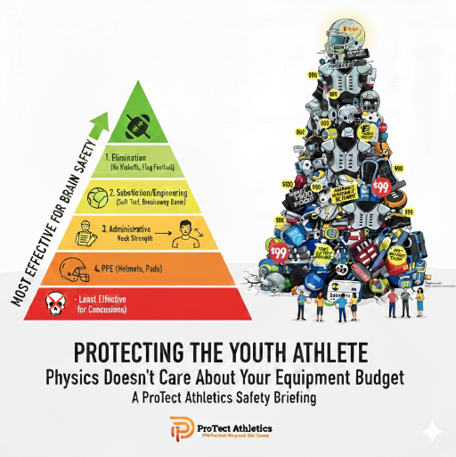
To truly protect athletes, ProTect Athletics utilizes the Hierarchy of Hazard Control, prioritizing the most effective ways to reduce risk.
- Elimination: Removing the hazard (e.g., banning kickoffs or full-contact drills).
- Substitution: Replacing the hazard (e.g., flag football for younger ages).
- Engineering Controls: Changing the environment (e.g., impact-absorbing turf).
- Administrative Controls: Changing the way we play (e.g., “Head-Out” tackling, neck strengthening, and “Hit Counts”).
- PPE (Personal Protective Equipment): Wearable gear—the least effective method because it is a “last resort” that only protects the exterior skull.
VII. Why PPE is the “Last Resort.”
In safety science, PPE is the last line of defense for three reasons:
- The Success Gap: It only works if fitted perfectly every single time.
- False Sense of Security: “Risk Compensation” leads athletes to play more recklessly because they feel “protected.”
- Internal vs. External: A helmet touches the skull; it does not touch the brain. Because the hazard (the brain sloshing) happens internally, an external shell can never be a complete solution. It is a “skull bucket,” not a “brain brake.”
Conclusion
The TV commercials will continue to brag about “zero injury” seasons and “military-grade” shells. Wear the helmet. Ensure it fits perfectly. But never—for one second—believe that gear makes an athlete “safe” from a concussion. True safety is found by moving up the hierarchy: eliminate unnecessary hits, coach better technique, and follow the national “Protect Your Melon” advice—check for symptoms immediately after any jolt, impact or not.
Reference Material & Further Reading
Clinical Research & Biomechanics
- The Lancet: Chronic subdural haematoma secondary to headbanging. (2014). Kertesz, A., et al. (A key study linking rotational movement to brain bleeds).
- University of New South Wales: Head and neck injury risks in heavy metal headbanging. (2008). Patton, D., et al. (The foundational biomechanical study on rotational acceleration).
- Journal of Athletic Training: Consensus Statement on Concussion in Sport. (2023). (The global standard for medical management and return-to-play).
Regulatory & Safety Standards
- Federal Trade Commission (FTC): Consumer Alert: Deceptive Health Claims in Sports Gear. (Warning regarding manufacturers’ unsupported claims on concussion prevention).
- Virginia Tech Helmet Lab: STAR Evaluation System: Technical Specifications and Force Reduction Data. helmet.beam.vt.edu
- NIOSH/OSHA: The Hierarchy of Hazard Control Framework. (Standardized safety engineering protocols applied to high-risk environments).
Public Health & Advocacy
- CDC HEADS UP: Youth Sports Concussion Training and Recognition Resources. cdc.gov/headsup
- Concussion Awareness Now: The “Protect Your Melon” National Awareness Campaign. (A coalition-led initiative focusing on recognition over equipment).

