
 Written by
In the high-stakes world of industrial safety, engineers and site supervisors rely on a rigorous framework to keep workers alive known as the Hierarchy of Controls. This system is the industry standard for risk management, prioritizing hazards by beginning with the physical removal of danger and ending with the most critical, yet most vulnerable, layer: Personal Protective Equipment (PPE).
At ProTect Athletics, we are shifting the paradigm of sports safety to match this professional standard. In the “workplace” of the field, where collisions are an accepted risk, your equipment is the final barrier standing between a clean play and a life-altering injury. To understand why your gear matters, we must first look at where it sits in the hierarchy of survival.
Explore the ProTect Athletics Library:
This article is the latest in our Athletic Safety Leadership Series. To understand the full scope of our safety initiatives, we encourage you to explore our official website for other research-based briefings on topics including:
- Environmental Safety & Heat Regulation
- The Physics of Supplemental Impact Technology
- Root Causes vs. Mechanisms of Athletic Injury
- Concussion Mitigation & Neuromuscular Training
The Hierarchy of Safety: The Industry Standard for Risk
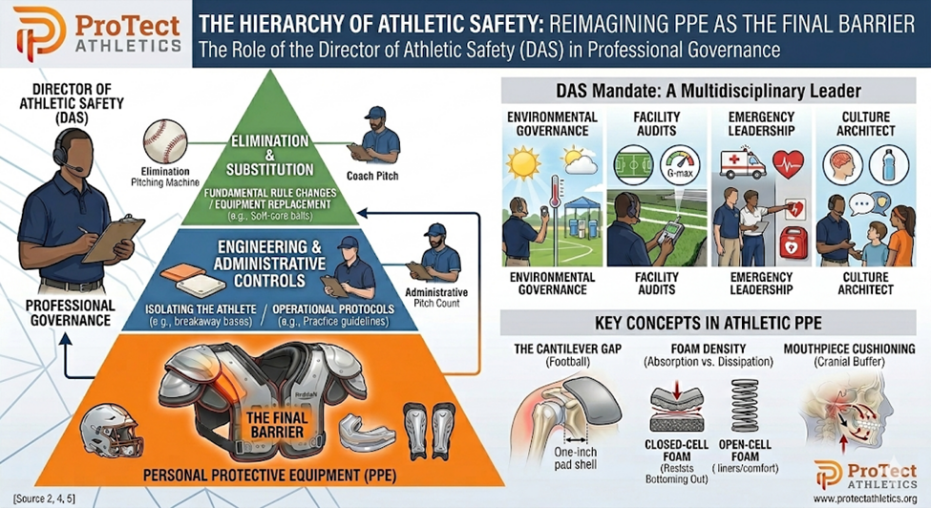
The Hierarchy of Controls is organized from the most effective methods of protection at the top to the least effective at the bottom. In contact and collision athletics, we follow this same industrial protocol to manage the risk of impact:
- Elimination: Physically removing the hazard.
- Substitution: Replacing the hazard with a safer alternative.
- Engineering Controls: Isolating the athlete from the hazard through physical barriers.
- Administrative Controls: Changing the way people play through rules and protocols.
- PPE (Personal Protective Equipment): Protecting the athlete with equipment. This is the final line of defense.
In contact sports, we cannot eliminate collisions without fundamentally changing the game. Because we accept the risk of the collision, we rely heavily on the bottom of the pyramid. PPE is unique because it is the only control that relies entirely on individual compliance, thorough knowledge of manufacturer specifications, and professional fitting.
The Role of Professional Governance: The Director of Athletic Safety (DAS)
Whether you are a parent adjusting a chin strap for the first time or a coach at the collegiate level, the goal is the same: keeping the athlete on the field and out of the clinic. However, the gap between having the gear and being protected is often vast. To close this gap, ProTect Athletics introduces the Director of Athletic Safety (DAS).
Think of the DAS as the Chief Safety Officer for the program. Just as a respirator on a construction site is useless without a professional fit test, athletic PPE requires a “Competent Person” to govern its use.
They don’t just hand out pads; they verify that every piece of equipment meets current NOCSAE, ASTM, and NFHS safety certifications. While most parents and volunteer coaches know the gear should fit, a DAS understands exactly how it fits. They have a thorough knowledge of manufacturer recommendations—like why a one-inch cantilever gap in a shoulder pad is non-negotiable for protecting the heart and collarbone.
The Expansive Mandate: A Multidisciplinary Safety Leader
While managing the final barrier of PPE is a critical responsibility, the role of the DAS is far more expansive than the equipment room. The DAS operates as a multidisciplinary link between coaching staffs, medical professionals, and administration.
Their mandate is to oversee the entire safety architecture of the organization, ensuring that environmental hazards are monitored, facility risks are mitigated, and administrative rules are followed. They serve as the primary architect of a culture of safety, where reporting a potential injury is prioritized and where every staff member is prepared to execute emergency protocols with precision.
Ultimately, the DAS translates the latest clinical research into actionable daily habits, ensuring the organization is not just reactive to injuries, but initiative-taking in preventing them.
The Standard of Play: Mandatory PPE Across the Athletic Landscape
Every sport presents a unique hazard profile requiring specifically engineered barriers. A professional DAS ensures these mandates are met at all levels, acknowledging that biological and anatomical differences between male and female athletes dictate unique equipment needs.
| Sport | Mandatory PPE | Gender & Level Specific Focus |
| Baseball & Softball | NOCSAE Helmet w/ Faceguard, ND200 Chest Protector, Cup, Shin Guards | Contoured ND200 plates for female catchers; infield masks for “hot corners.” |
| Football | Helmet, Shoulder/Hip/Thigh/Knee Pads, Mouthguard | Precision fitting of the cantilever bridge; annual reconditioning. |
| Lacrosse | Helmet (M) / Goggles (W), ND200 Chest Protector, Gloves, Mouthguard | ASTM F3077 goggles for women; full cranial shells for men. |
| Soccer | Shin Guards (meeting NOCSAE standards) | Anatomical placement to protect the Tibia; gender-specific cleat patterns. |
| Field Hockey | Goggles, Shin Guards, Mouthguard | Orbital protection from high-velocity ball and stick strikes. |
| Basketball | Mouthguard | Inter-occlusal cushioning for incidental elbow contact. |
| Wrestling | Ear Guards/Headgear | Auricular hematoma (cauliflower ear) prevention. |
| Ice Hockey | Helmet w/ Cage, Neck Guard, Shoulder/Shin/Elbow Pads | Laceration protection from skates; high-mass impact absorption. |
The “Grow-Into-It” Fallacy: A Youth Level Crisis
In youth athletics, one of the most dangerous administrative failures is the grow-into-it mentality. PPE only works if it is aligned with the athlete’s current anatomy.
If a helmet is too large, the interior padding cannot engage with the skull, failing to mitigate the linear and rotational acceleration that causes concussions. If shoulder pads are oversized, they shift during contact, exposing the AC joint and clavicle to direct impact. If it doesn’t fit today, it doesn’t protect today. A DAS ensures gear is sized for the athlete as they are, not as they will be in two seasons.
A Warning from the Pros: The NFL Shoulder Crisis
The necessity of professional oversight is best illustrated by recent data from the National Football League (NFL). Recent studies indicate that shoulder injuries now account for 6.7% to 10% of all reported professional injuries (Fares et al., 2025).
The acromioclavicular (AC) joint represents 41% of all collegiate and professional shoulder trauma (Apostolakos et al., 2023). Furthermore, shoulder-to-helmet (STH) impacts are responsible for nearly 20% of all concussions. However, properly fitted PPE can reduce peak linear acceleration in the head by as much as 31% (Wusk, 2022).
Anatomy of the Armor: Professional PPE Standards
Under the guidance of a DAS, every piece of equipment is treated as a mechanical barrier. The effectiveness of this armor depends on two functions: force dissipation (spreading the load) and energy absorption (increasing impact duration).
The Cranial Shield (Helmets): The helmet manages both rotational and linear acceleration. A DAS ensures the rim sits exactly one inch above the eyebrows and performs the skin-tug test to ensure padding is engaged. For softball and baseball, integrated face masks must be checked for structural integrity to prevent orbital bypass during high-velocity projectile impacts.
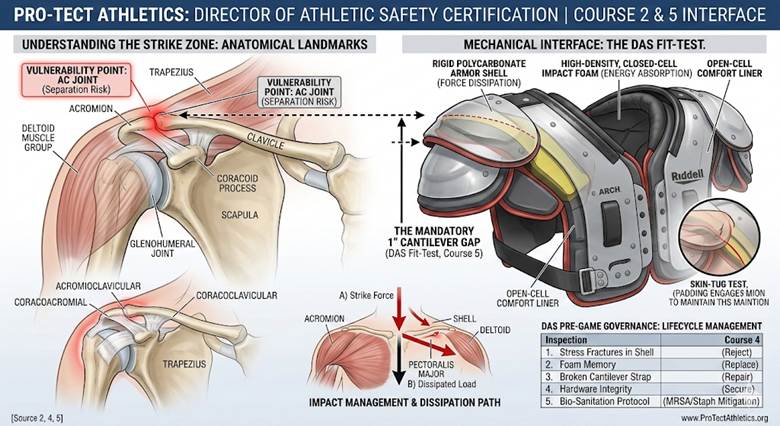
The Thoracic Shield (Shoulder Pads & Chest Protectors): The shoulder pad is an engineering system designed to protect the AC joint and the clavicle. The DAS verifies the cantilever, an internal bridge must maintain a one-inch “crush zone” of air. Additionally, catchers and lacrosse players must use NOCSAE ND200 certified protectors. These are contoured differently for male and female athletes to ensure the protective plate remains flush against the chest wall, preventing the fatal disruption known as Commotio Cordis.
The Internal Engine: Understanding Foam Density: A DAS understands the foam inside the gear is the primary engine of impact mitigation.
- Closed-Cell Foam (High Density): Characterized by sealed air bubbles. It provides superior protection against high-mass collisions and resists bottoming out.
- Open-Cell Foam (Low Density): Interconnected pores allow air to escape instantly. While comfortable, it offers minimal protection and is primarily used for liners.
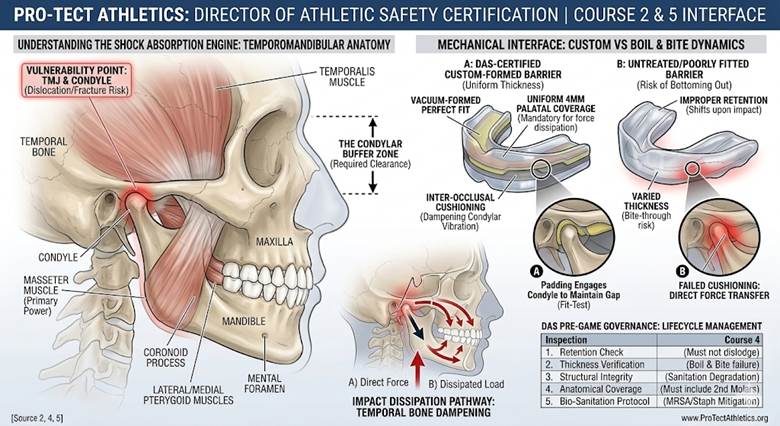
The Mouthpiece: A Critical Cranial Buffer: The mouthpiece provides inter-occlusal cushioning, dampening vibrations transferred through the jaw to the skull.
- Custom-Formed: The professional standard. Vacuum-formed to a mold of the athlete’s teeth, it provides consistent thickness and superior retention.
- Boil and Bite: Common for youth, but protection is often compromised if the athlete bites through the material during fitting.
Limb and Pelvic Protection: Shin guards must cover the lower third of the tibia and start two inches below the kneecap. Extensive testing by Bir et al. (1995) confirms localized shielding significantly reduces compound fracture risk. In softball, infielding masks are fitted specifically to the athlete’s facial structure to dissipate force away from the nose and cheekbones.
Life Cycle Management: Maintenance and Sanitation
A barrier is only effective if its structural integrity is maintained. The DAS oversees:
- Field Audits: Inspections for stress fractures, rusted hardware, or foam fatigue.
- Bio-Maintenance: Sweat is corrosive; it hardens foam and degrades materials. Proper sanitation using manufacturer-approved disinfectants is required to kill pathogens like MRSA and Staph without compromising the gear’s protective properties.
Conclusion: Longevity Over Luck
At ProTect Athletics, our mission is clear: Safety is a skill. PPE is the final barrier, but the Director of Athletic Safety is the gatekeeper of that barrier’s integrity. By moving away from a “gear” mentality and toward a culture of professional protection, we ensure athletes are protecting their ability to stay in the game for a lifetime.
References
- Apostolakos, J. M., et al. (2023). Management of Common Football-Related Injuries About the Shoulder. HSS Journal®.
- Bir, C. A., et al. (1995). An Analysis and Comparison of Soccer Shin Guards. Clinical Journal of Sport Medicine.
- Fares, M. Y., et al. (2025). Shoulder injury patterns and trends in the national football league. The Journal of Sports Medicine and Physical Fitness.
- Wusk, Z. (2022). Football Shoulder Pad Design and Its Effect on Head Kinematics. Annals of Biomedical Engineering.

