 Written by
 By ProTect Athletics
At ProTect Athletics, our mission is to advocate for the safety of everyone involved in the world of athletics by providing the data needed to make informed decisions. We do not seek to influence the dismissal or use of any specific product; rather, we aim to highlight the complexities that arise when professional-level trends “trickle down” to youth and high school programs.
The League’s recent decision to allow Guardian Caps in regular-season games has sparked a national debate. While the League points to a 50% reduction in concussions during early testing, a growing divide exists between this marketing and the scientific reality faced by parents and coaches.
1. The Mechanism of a Concussion: Brain vs. Skull
For a parent, it is vital to understand that a concussion is an internal biological event, not a surface-level bruise.
- The Internal “Slosh”: A concussion is a mild traumatic brain injury (mTBI) caused when a jolt makes the brain move rapidly back and forth. This movement causes the brain to bounce or twist inside the skull, creating chemical changes and stretching brain cells.
- Rotational vs. Linear Force: Research indicates that rotational acceleration—the twisting of the brain—is the primary driver of concussions. While helmets are designed to manage linear (straight-line) impact, no external padding can fully prevent the brain from “sloshing” in its fluid when the head spins.
- The Fluid Gap: Because the brain is surrounded by cerebrospinal fluid and is not “bolted” to the skull, it continues to move even if the helmet stops instantly upon impact. No “cap” can stabilize the brain within the skull.
2. The True Purpose of a Football Helmet
It is a common misconception that helmets are “concussion-prevention” devices; parents should understand their engineering limits.
- Primary Goal: Skull Protection: The primary goal of a helmet is to prevent catastrophic skull fractures and intracranial hemorrhaging. It is a protective shell for the bone, not a magical barrier for the soft tissue of the brain.
- Energy Management Systems: Modern helmets are high-tech shock absorbers. They use sophisticated liners designed to extend the duration of an impact. By slowing down the impact by even a few milliseconds, the peak force hitting the head is significantly reduced.
- Precision Engineering: Every vent, curve, and material density in a modern helmet (like the Riddell SpeedFlex or Schutt F7) is specifically engineered to flex and absorb energy in a predictable way.
- Unproven Outcomes: There is currently no peer-reviewed data proving that adding a “one-size-fits-all” cap maintains the precision engineering of the original helmet’s mechanical response. In some cases, the cap may prevent the helmet’s “flex panels” from working as intended.
3. Transforming Deflection into Traction: The Grip Factor
Coaches should be aware that changing the texture of the helmet changes the physics of the hit.
- From Deflection to Grip: Standard helmets are made of hard polycarbonate designed to be slick so players “slide off” each other during contact. The Guardian Cap transforms this slick surface into a soft, high friction “grippy” one.
- The Torque Effect: When two soft-shell surfaces meet, they are more likely to “grab” or “bind” instead of sliding. This binding action creates a sudden torque on the head.
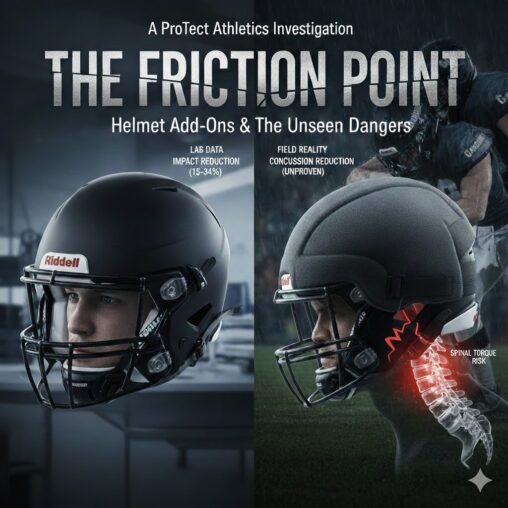
- The Spinal Theory: Critics argue this traction transfers force directly to the neck and spinal cord. While laboratory tests measure impact reduction, the long-term risk of “neck binding” remains a point of significant debate and cannot yet be proven or disproven by large-scale clinical studies.
- Surface Area Expansion: By increasing the helmet’s outer diameter, the cap creates a larger hitting target. A larger helmet means a higher probability of incidental contact that might have been a “clean miss” with a standard shell.
4. Counterproductive Mechanics: Weight vs. Technique
For youth players, weight is the enemy of proper, safe form.
- The Weight Penalty: The professional NXT model adds 12 to 14 ounces of mass to the head. For a young athlete, this is like adding a heavy brick to the top of a pendulum.
- Rotational Inertia: Physics dictates that adding weight to the exterior increase’s rotational inertia. This can actually make the head twist faster during an off-center hit, increasing the exact rotational forces that cause concussions.
- The Fatigue Factor: Increased head weight leads to earlier neck fatigue. As a child’s neck muscles tire, they are more likely to drop their chin. This leads to “head-down” contact, which is the primary cause of catastrophic spinal injuries and is counterproductive to “heads-up” tackling techniques.
5. Laboratory Performance: The Virginia Tech Perspective
Parents should know that gear sold in retail stores often differs from what professional athletes utilize.
- The Model Gap: Virginia Tech laboratory tests show the professional NXT model reduces risk by roughly 34%. However, the mass-market XT model (the one most likely found at local sporting goods stores) only provides a 15% reduction.
- The “Baseline” Rule: An add-on can only enhance what’s already there. A top-tier, five-star rated helmet without a cap is often safer than a low-quality, three-star helmet with a cap.
- Field vs. Lab: While laboratory drop tests show impact reduction, a 2023 study of 2,610 high school players found no measurable association between cap use and lower concussion rates during actual games.
6. Historical Precedent: The Mark Kelso “ProCap”
History shows us that these ideas have been tried—and set aside—before.
- The “Great Gazoo” Era: Buffalo Bills safety Mark Kelso (1990–1993) used a padded cover after suffering multiple concussions. While it helped him personally, it was never widely adopted by the League.
- Persistent Concerns: Adoption was limited by the bulbous look and, more importantly, concerns from coaches that the added weight would cause neck injuries. These same concerns remain largely unproven but are a central part of the current debate among equipment managers.
7. Heat Safety: The Corey Stringer Precedent
In youth sports, heat is often a more immediate danger than impact.
- Thermal Management: Modern helmets use vent holes designed to let heat escape from the crown of the head.
- The Greenhouse Effect: Covering these vents with thick foam traps heat. After the 2001 heatstroke death of Corey Stringer, heat regulation became a primary safety standard for all manufacturers.
- Uncertainty: While the risk of heatstroke is a medical fact, there is no current scientific consensus on exactly how many degrees a Guardian Cap increases core brain temperature during active play. For a youth coach in August, this is a significant variable.
8. The Warranty and Liability Trap
This is a legal and logistical fact that every school board and coach must understand.
- Voiding the Warranty: Most manufacturers (Riddell, Schutt, Xenith) explicitly state that using a third-party add-on voids the helmet’s warranty and original safety certification.
- NOCSAE Standards: The safety board (NOCSAE) treats a helmet with a cap as a “modified” piece of gear.
- Liability Shifting: If an injury happens, the manufacturer can legally claim the equipment was altered from its original, tested state. This shifts the legal and financial responsibility for an injury from the multi-million-dollar manufacturer to the local school district, the coach, or the parent.
Conclusion: Is it Actually “Safer”?
The choice is ultimately yours, but it must be based on facts, not just marketing. While the League has the resources to monitor every player’s temperature and neck strain with professional medical staffs, local youth programs do not.
Is a device that reduces lab-measured impact but increases weight, traps heat, creates a larger hitting target, and voids the safety warranty actually “safer” for your child? At ProTect Athletics, we believe that proper technique and neck strengthening will always trump tools in player safety. We encourage all parents and coaches to look beyond the headlines and evaluate the data for themselves.
References
- NOCSAE. Certification to NOCSAE Standards and Add-on Helmet Products.
- The New York Times. (Feb 3, 2026). “The Questionable Science Behind the Odd-Looking Football Helmets.”
- Virginia Tech Helmet Lab. STAR Evaluation of Helmet Add-on Products.
- Muehling, R. et al. (2023). Concussion Rates In Football Related To Practice Type And Guardian Cap Usage.
